


Finding the perfect seal for your clarinet can feel like chasing an elusive tone. Many American clarinetists overlook how o-rings actually shape sound and performance, yet these components work at the heart of your instrument’s acoustics. A high-quality o-ring preserves the airtight connection that keeps resonance stable and supports a rich Viennese sound. Understanding what sets top-tier o-rings apart helps you optimize every aspect of your clarinet while reducing unnecessary tension and maintaining clarity in every register.
Table of Contents
- Defining Clarinet O-Rings And Misconceptions
- Types Of Clarinet O-Rings And Key Differences
- How O-Rings Affect Sound And Playability
- Installation, Fit, And Maintenance Essentials
- Comparing O-Rings To Traditional Cork Options
Key Takeaways
| Point | Details |
|---|---|
| Importance of O-Rings | O-rings create an airtight seal between clarinet joints, essential for optimal sound production and performance. |
| Material Variations | Choose between natural cork and synthetic rubber o-rings based on durability and maintenance preferences. |
| Maintenance Awareness | Regularly inspect o-rings for wear and replace them to prevent tonal inconsistencies and intonation issues. |
| Fit Precision | Ensure o-rings match the exact specifications of your clarinet model to maintain sound quality and playability. |
Defining Clarinet O-Rings and Misconceptions
Clarinetists often misunderstand what o-rings actually do in their instruments. These small rubber or cork components sit between the clarinet’s joints, creating an airtight seal that prevents air from escaping during play. Many players assume they’re merely decorative or secondarily important, but the reality is different. O-rings work directly within your clarinet’s acoustic system by maintaining the structural integrity of the bore and ensuring consistent air pressure throughout the instrument. Without proper o-rings, your clarinet loses the very foundation that allows sound waves to resonate correctly through the cylindrical bore and back toward the mouthpiece.
One of the biggest misconceptions involves believing that all o-rings perform identically. Players sometimes think they can grab any rubber ring from their repair kit and expect the same results. This couldn’t be further from the truth. Different clarinet types require different o-ring specifications because the joint dimensions and bore configurations vary. An o-ring designed for a Bb clarinet won’t fit properly on a bass clarinet, and even slight size differences can compromise your instrument’s sealing capability. The reed vibration and acoustic resonance that create your tone depend on maintaining precise pressure dynamics throughout the instrument’s bore. When an o-ring fails or doesn’t seat correctly, you’re not just losing a small rubber component; you’re disrupting the entire acoustic balance your clarinet was designed to achieve. This is why selecting o-rings matched specifically to your instrument type matters so much for your personal sound development.
Another common mistake involves ignoring o-ring condition and replacement schedules. Players tend to notice sticky pads or sticky keys long before they consider o-ring deterioration. Yet o-rings degrade from repeated exposure to moisture, temperature changes, and constant compression and release during playing. A worn o-ring becomes less effective at sealing, leading to subtle changes in your tone that feel like a playing problem rather than a mechanical one. You might blame your embouchure or your mouthpiece when the real culprit is sitting invisibly in your clarinet joints. The complex interaction between the mouthpiece-reed system and the cylindrical bore means that even minor seal degradation affects your overall response and intonation stability. When you understand this relationship, you begin viewing o-ring maintenance as an essential part of optimizing your instrument’s performance, not as a minor detail.
Pro tip: Check your o-rings every three months by gently pulling apart your clarinet joints and visually inspecting for cracks, hardening, or visible compression marks; if you notice any signs of deterioration, replacing them immediately will often resolve subtle tonal inconsistencies you’ve been trying to fix through embouchure adjustments alone.
Types of Clarinet O-Rings and Key Differences
Clarinetists need to understand that not all o-rings work the same way, and the material composition makes a significant difference in how your instrument responds. The two primary categories are natural cork rings and synthetic elastic o-rings, each with distinct advantages and performance characteristics. Natural cork has been the traditional choice for decades because it compresses predictably and creates an excellent seal when seated properly in the clarinet’s tenon. However, synthetic materials like rubber and composite blends offer greater durability and consistency, resisting moisture absorption and temperature fluctuations better than cork does. The choice between these materials affects your instrument’s longevity, maintenance requirements, and even subtle aspects of how your joints feel during assembly and play.
Beyond material type, size and thickness variations matter tremendously because they correspond to different clarinet models and joint dimensions. Your Bb clarinet requires o-rings with specific diameters and widths that differ from bass clarinet o-rings or E-flat clarinet components. Installing the wrong size creates an imperfect seal that leaves microscopic air gaps, compromising your tone quality and response consistency. Many players don’t realize that proper fit and maintenance of tenon seals directly impacts how stable your intonation remains across extended passages and dynamic changes. When selecting replacement o-rings, match them precisely to your instrument type rather than assuming generic components will work. This specificity is why My Clarinet Stuff offers o-rings tailored to different clarinet families, whether you play Bb clarinets, bass clarinets, or E-flat clarinets.
The maintenance approach varies depending on which material you’re using. Cork o-rings benefit from regular cork grease application to keep them pliable and prevent cracking, while synthetic rubber o-rings typically require only visual inspection and replacement when they show signs of hardening or visible degradation. Some advanced players prefer natural corks and synthetic rings as distinct sealing components because they understand how each responds differently under playing conditions. Synthetic options generally last longer between replacements, while cork offers that tactile feedback many traditional players appreciate. Understanding these differences allows you to make informed decisions about which type best matches your playing style, climate conditions, and personal preferences for how your clarinet feels in your hands.
Pro tip: Keep a set of replacement o-rings in your clarinet case and replace them at the first sign of hardening or visible cracks; waiting for a catastrophic seal failure means dealing with unexpected intonation shifts and potential frustration during performances.
Here’s a summary of clarinet o-ring size considerations across instrument types:
| Clarinet Type | Typical O-Ring Diameter | Bore Configuration | Importance of Exact Fit |
|---|---|---|---|
| Bb Clarinet | Medium (varies by brand) | Standard cylindrical | Critical for sealing |
| Bass Clarinet | Larger | Wide cylindrical | Essential for resonance |
| E-flat Clarinet | Smaller | Narrow cylindrical | Precise for intonation |
Here’s a quick comparison of clarinet o-ring materials to help you choose the best fit for your needs:
| Material Type | Durability | Acoustic Impact | Maintenance Level |
|---|---|---|---|
| Natural Cork | 6-12 months | Warm, vibrant sound | Regular grease needed |
| Synthetic Rubber | 18-24 months | Consistent, clear | Visual checks only |
| Composite Blend | 18-24 months | Balanced response | Minimal maintenance |
How O-Rings Affect Sound and Playability
Your o-rings have a direct impact on your tone that many players never fully appreciate. When o-rings seal your clarinet’s joints properly, air moves through the instrument exactly as the manufacturer intended, allowing the acoustic column to vibrate freely and resonate at optimal frequencies. Even microscopic leaks created by worn or undersized o-rings force you to compensate by increasing embouchure pressure or breath support, which introduces tension that degrades tone quality. The result feels like a playability problem, but the real culprit is sitting invisibly in your joints. Proper sealing and equipment condition directly influence your ability to produce a good tone with minimal physical tension, meaning that maintaining your o-rings is as important as keeping your reed in good condition.
When o-rings fail, your instrument exhibits symptoms that might mislead you about what needs fixing. You might experience a thin or unfocused sound that seems to originate from your embouchure when the problem is actually a seal failure between joints. Intonation instability becomes more pronounced, especially in the upper register where air pressure and resonance frequency are already challenging. Response feels sluggish or delayed because the clarinet isn’t vibrating efficiently due to air escaping through the compromised seal. Sound production through resonating air columns and reed vibrations depends on maintaining airtight connections throughout the instrument’s bore. When even one o-ring deteriorates, you’re essentially shortening your effective bore length and disrupting the harmonic relationships that create your personal Viennese sound. Many advanced players spend hours adjusting their embouchure or trying different mouthpieces when replacing their o-rings would solve the problem immediately.
The playability consequences extend beyond tone production into how the instrument physically feels in your hands. Fresh, properly fitted o-rings allow your joints to assemble smoothly with appropriate resistance, giving you confidence that everything is secure. Worn o-rings create loose connections that feel mushy or unstable, or conversely, they can become sticky and difficult to disassemble, damaging the tenon over time. Your fingers naturally develop muscle memory around how your clarinet should feel during assembly and play. When o-rings degrade, that familiar feel changes subtly, affecting your overall comfort and consistency at the instrument. The acoustic efficiency you lose through seal degradation translates directly into greater physical effort required during practice and performance, leading to fatigue that undermines your technical control.
Pro tip: Record yourself playing a passage with your current o-rings, then replace them with fresh ones and record the same passage again; comparing the two recordings reveals tonal improvements you might otherwise attribute to your own playing development.
Installation, Fit, and Maintenance Essentials
Installing o-rings correctly makes the difference between a clarinet that plays smoothly and one that feels difficult to assemble. When you insert your barrel or upper joint, the o-ring should seat evenly around the tenon without bunching, twisting, or creating visible gaps. Start by visually inspecting the o-ring before installation to confirm it hasn’t warped or cracked. Position your clarinet joint so the tenon faces upward, then gently slide the barrel or joint straight down with steady, even pressure. Avoid forcing or twisting the joint sideways, which can damage the o-ring and the tenon itself. The joint should fit snugly without requiring excessive force, and you should feel a subtle resistance that tells you the seal is engaging properly. Proper fit and installation techniques are essential for preventing leaks and maintaining the structural integrity of your clarinet’s joints. If assembly feels too tight or too loose, the o-ring is likely the culprit rather than the tenon itself.
Maintenance depends on whether you’re using cork or synthetic o-rings. Cork o-rings benefit from regular cork grease application, which keeps them pliable and prevents the drying and cracking that shortens their lifespan. Apply grease sparingly to cork by rubbing a thin layer around the circumference before assembly, especially during dry seasons or in heated performance spaces. Synthetic rubber o-rings require less maintenance but demand more vigilant monitoring for signs of degradation. Proper maintenance practices and cork grease application help ensure that your clarinet fits together smoothly with appropriate sealing. Inspect both cork and synthetic o-rings monthly by gently pulling apart your joints and looking for visible cracks, hardening, discoloration, or compression marks that refuse to spring back. Keep your clarinet case dry because excessive moisture promotes mold growth on cork and accelerates rubber degradation through hydrolysis.
Knowing when to replace o-rings prevents problems before they impact your performance. Most cork o-rings last 6 to 12 months with regular grease application, while synthetic alternatives can last 18 to 24 months depending on playing frequency and climate conditions. Don’t wait for a complete seal failure because gradual deterioration creates intonation instability that’s frustrating to diagnose. If you notice your joints assembling with less resistance than usual, or if you need to apply more embouchure pressure to maintain your normal tone, replacement time has likely arrived. Store replacement o-rings in a cool, dry place away from direct sunlight and extreme temperature swings, which degrade rubber and cork more quickly than normal aging. Having a spare set in your case ensures you can address sudden seal failure during rehearsals or performances without derailing your preparation schedule.
Pro tip: When installing o-rings, keep a small damp cloth nearby to gently wipe away excess cork grease or dust before assembly, which prevents debris from getting trapped under the o-ring and creating micro leaks that undermine your seal.
Comparing O-Rings to Traditional Cork Options
Traditional cork has dominated clarinet construction for generations, and it remains the choice for many professional and advanced players who value its acoustic properties and tactile characteristics. Cork compresses naturally under pressure, creating an airtight seal while offering subtle feedback during assembly that experienced players find reassuring. The material feels organic in your hands and many clarinetists argue it contributes to the warmth and complexity of their Viennese sound. However, cork demands consistent maintenance through regular grease application, and it degrades predictably over 6 to 12 months regardless of playing frequency. Natural cork also absorbs moisture, which can lead to mold growth in humid climates and accelerated deterioration in dry conditions. Clarinet construction techniques and sealing material comparisons highlight how traditional cork balances acoustic quality with maintenance requirements that many players find challenging.
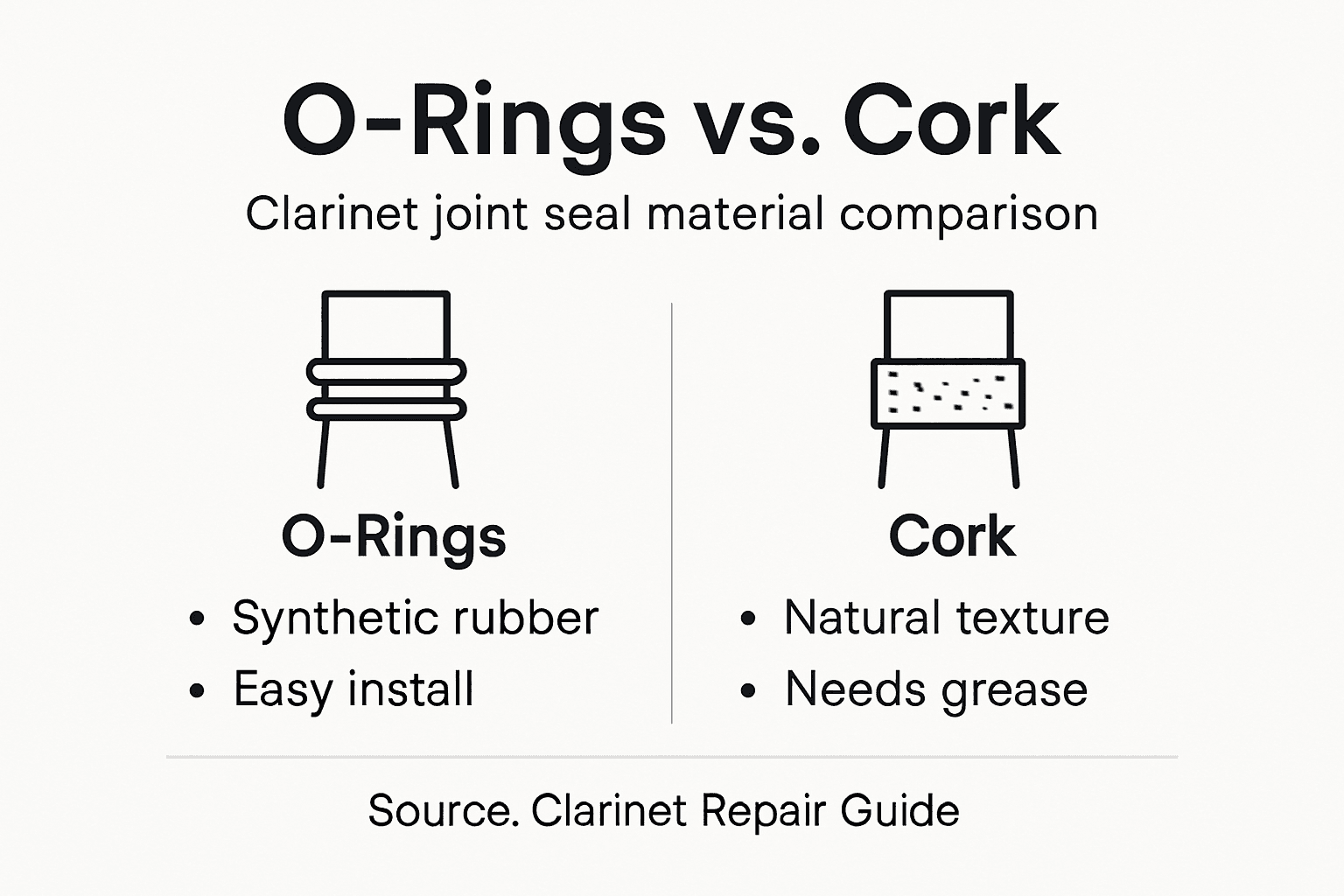
Modern synthetic o-rings offer distinct advantages that appeal to busy professionals and players in unstable climate conditions. Rubber and composite o-rings resist moisture absorption far better than cork, lasting 18 to 24 months instead of 6 to 12 months before requiring replacement. They maintain consistent compression properties throughout their lifespan, meaning your joints feel the same on day one and day 400, which some players appreciate for consistency and others find less musical. Assembly feels different compared to cork because synthetic materials don’t provide the same tactile feedback, though this becomes natural once you adjust your muscle memory. Advantages and disadvantages of synthetic sealing options include easier maintenance but require accepting a different assembly experience. Synthetic o-rings also eliminate the need for cork grease, reducing your daily maintenance routine significantly.
The choice between cork and synthetic depends on your playing context and personal priorities. If you’re a serious player pursuing that authentic Viennese sound and you’re willing to maintain cork properly through regular greasing and climate control in your case, cork remains the premium choice. If you travel frequently, play in varying humidity levels, or prefer minimal maintenance overhead, synthetic o-rings solve real logistical problems without sacrificing performance. Some advanced players actually use synthetic o-rings on their barrel and lower joint where seal leaks are less audible, while keeping cork on their upper joint where the acoustic impact is greater. This hybrid approach combines the benefits of both options strategically.
Your clarinet likely came with cork tenons originally, and switching to synthetic o-rings requires replacing the cork with a tenon equipped for o-ring sealing. This represents a permanent modification, so test synthetic options on an older clarinet before committing your primary instrument. Many repair technicians can install o-ring compatible tenons without significant cost, making the transition straightforward if you decide to pursue it.
Pro tip: If you’re undecided between cork and synthetic, purchase a spare barrel or joint equipped with o-rings and test it on your primary clarinet for two weeks; comparing how each feels and sounds in your normal practice routine provides the most reliable information for making your decision.
Optimize Your Clarinet’s Performance with Precision O-Rings
The article reveals how crucial clarinet o-rings are for maintaining an airtight seal and achieving the ideal tone and playability you strive for. If you have noticed subtle tonal inconsistencies or intonation instability despite practicing your embouchure, worn or improperly sized o-rings could be the hidden cause. Don’t let deteriorated seals disrupt your hard-earned sound quality or cause frustrating assembly issues. Achieving that rich Viennese sound requires attention to every detail, especially the parts that connect your clarinet’s joints and affect air pressure and resonance.

Discover a curated selection of professional-grade o-rings designed specifically for Bb clarinets, bass clarinets, and E-flat clarinets at My Clarinet Stuff. Our boutique offerings also include high-quality barrels and custom mouthpieces that perfectly complement your maintained seals for superior sound. Act now to replace your worn o-rings before they undermine your performance and experience the difference in clarity and ease right away. Explore our products and personalized consultations to elevate your playing experience by visiting O-rings for Clarinet and learn more about proper maintenance at My Clarinet Stuff. Take control of your clarinet’s voice today.
Frequently Asked Questions
What are the main functions of clarinet o-rings?
O-rings create an airtight seal between the clarinet’s joints, preventing air leaks and ensuring consistent air pressure for optimal sound production and resonance.
How often should I replace my clarinet o-rings?
It’s recommended to check and potentially replace cork o-rings every 6 to 12 months and synthetic rubber o-rings every 18 to 24 months, depending on their condition and the climate.
What material types are available for clarinet o-rings, and how do they differ?
The two main types are natural cork rings, known for their warm sound but requiring regular maintenance, and synthetic rubber o-rings, which are more durable and resist moisture but offer less tactile feedback.
How do o-rings affect the playability of a clarinet?
Properly fitted o-rings contribute to a smooth, stable playing experience by ensuring airtight seals. Worn or improperly sized o-rings can lead to issues like unstable intonation and increased physical tension while playing.