
Over 80 percent of American clarinetists report that subtle changes in mouthpiece design can redefine their expressive range and musical tone. For advanced musicians in the United States, sound flexibility is not just a technical goal but the foundation of creative performance. With so many custom accessories and mouthpiece options available, this guide reveals how precise configurations and refined technique enable American clarinetists to unlock powerful, versatile sound on stage and in studio.
Table of Contents
- Defining Clarinet Sound Flexibility
- Components Shaping Flexible Clarinet Sound
- Mouthpieces, Barrels, and Accessory Impact
- Playing Techniques for Enhanced Flexibility
- Common Mistakes Limiting Sound Flexibility
Key Takeaways
| Point | Details |
|---|---|
| Clarinet Sound Flexibility | Clarinet sound flexibility allows musicians to manipulate tone and expressiveness through technical skill and understanding of the instrument. |
| Importance of Components | Key components such as the reed, bore, and mouthpiece critically shape sound flexibility and musically expressive potential. |
| Playing Techniques | Mastery of playing techniques, including breath support and articulation, enhances a clarinetist’s ability to convey emotion and nuance. |
| Common Pitfalls | Technical errors like improper embouchure and breath management limit sound flexibility, making regular practice and conscious technique exploration essential. |
Defining Clarinet Sound Flexibility
Clarinet sound flexibility represents the instrument’s ability to dynamically alter tone, timbre, and expressive range through strategic technical manipulation. This sophisticated acoustic capability emerges from the intricate relationship between the musician’s technique and the instrument’s physical design. Acoustic instrument evolution demonstrates how clarinetists have progressively expanded their sound’s potential through innovative playing approaches.
At its core, sound flexibility involves precise control over multiple acoustic parameters, including embouchure tension, air pressure, reed interaction, and fingering techniques. Professional clarinetists can modulate their sound across various registers, generating subtle timbral variations that transform a simple musical passage into an emotionally compelling performance. Spectral tone control techniques enable musicians to explore nuanced sonic landscapes beyond traditional performance expectations.
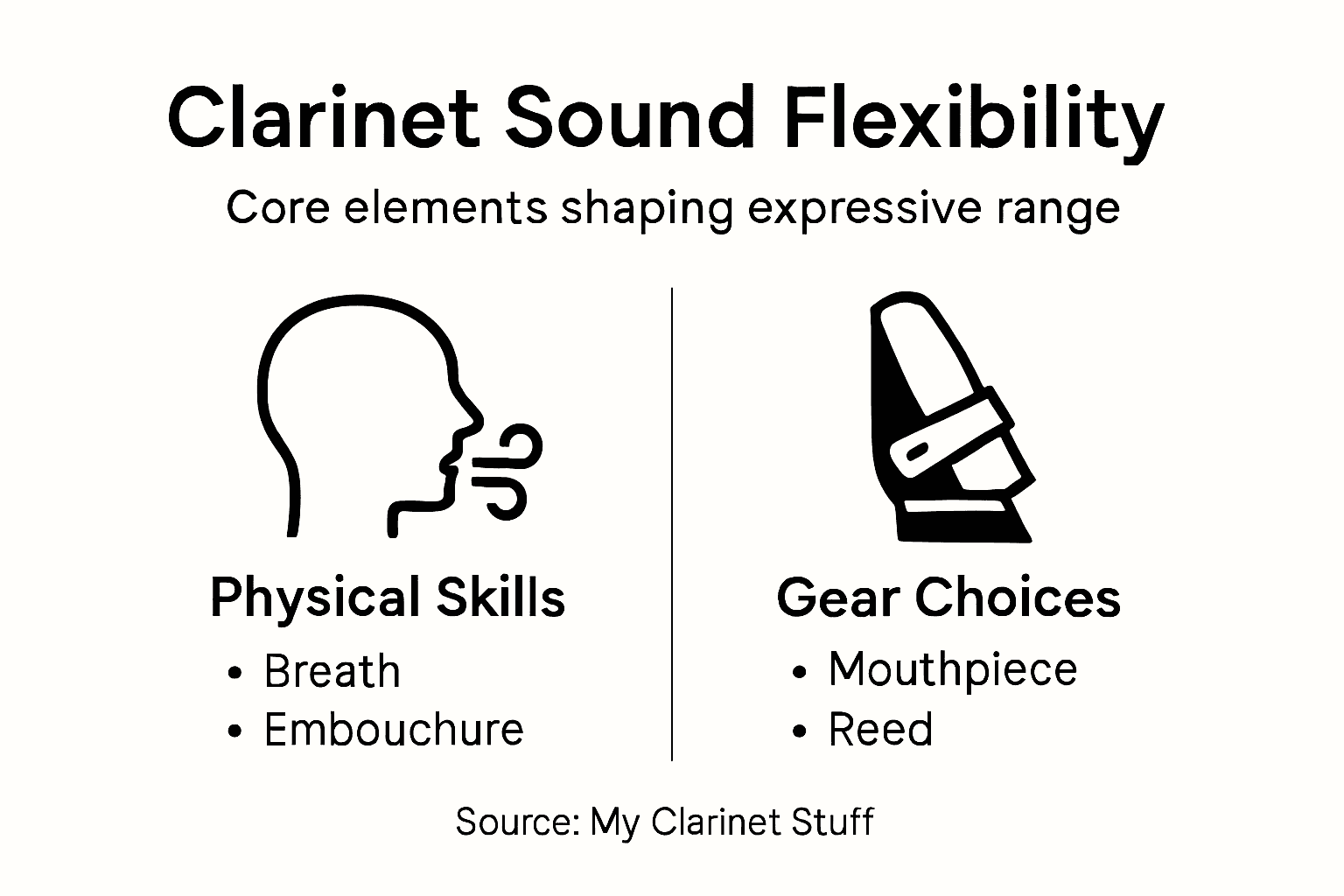
The pursuit of sound flexibility requires mastering several critical elements: breath support, embouchure control, reed selection, and instrument configuration. Advanced players understand that true sound flexibility emerges from a holistic approach integrating technical skill, musical sensitivity, and intimate instrument knowledge. By developing refined control mechanisms, clarinetists can produce sounds ranging from warm, rounded tones to sharp, piercing expressions that communicate complex emotional narratives.
Pro tip: Practice long-tone exercises focusing on consistent timbre across different dynamic levels to systematically improve your clarinet’s sound flexibility.
Components Shaping Flexible Clarinet Sound
The components influencing clarinet sound flexibility are complex and interconnected, involving intricate interactions between physical instrument elements and the musician’s technical mastery. Acoustic characteristics of the clarinet reveal how specific design elements critically impact sound production and tonal variation. The reed, bore, mouthpiece, and player’s technique work synergistically to create a dynamic sonic palette.
Primary physical components play distinct roles in sound manipulation. The reed functions as a critical sound generator, vibrating against the mouthpiece and transforming breath into acoustic energy. Bore design determines resonance characteristics, with variations in diameter, length, and material composition directly influencing timbre and tonal complexity. Mouthpiece geometry further refines sound quality by mediating reed vibration and controlling air flow dynamics.
Musician physiology represents an equally significant factor in sound flexibility. Player vocal tract configurations demonstrate how embouchure control, breath support, and muscular interactions profoundly shape sonic output. Advanced players develop nuanced control mechanisms, subtly adjusting vocal tract positioning, air pressure, and muscular tension to generate an expansive range of expressive textures.
Beyond physical components, psychological and technical mastery determines ultimate sound flexibility. Musicians must develop sophisticated sensory awareness, allowing intuitive manipulation of acoustic parameters through refined muscle memory and deep instrument understanding.

Pro tip: Systematically experiment with different reed strengths and mouthpiece configurations to discover your optimal sound flexibility range.
Here’s how key clarinet components contribute to sound flexibility:
| Component | Role in Sound Flexibility | Impact on Expression |
|---|---|---|
| Reed | Generates vibration and tone | Alters timbre, enables subtle nuance |
| Bore | Shapes resonance and harmonics | Affects tonal complexity and warmth |
| Mouthpiece | Controls air flow and vibration | Adjusts brightness, projection |
| Player Physiology | Modifies air and embouchure | Expands dynamic and emotional range |
Mouthpieces, Barrels, and Accessory Impact
Mouthpiece and barrel configurations represent critical elements that dramatically influence a clarinet’s sound flexibility and performance characteristics. Acoustic impedance variations demonstrate how these precision components can transform an instrument’s fundamental sonic properties, enabling musicians to fine-tune their expressive range with extraordinary precision.
The mouthpiece serves as the primary interface between musician and instrument, acting as a crucial sound-shaping mechanism. Different mouthpiece geometries – including tip width, chamber design, and rail curvature – directly impact reed vibration, air flow dynamics, and resulting tonal characteristics. Professional clarinetists understand that subtle modifications in mouthpiece configuration can produce nuanced changes in brightness, warmth, projection, and overall timbral quality.
Clarinet acoustic principles reveal that barrel design plays an equally significant role in sound manipulation. Barrel length, material composition, and internal bore dimensions interact dynamically to influence pitch stability, register transitions, and harmonic complexity. Skilled musicians strategically select and customize barrels to address specific acoustic challenges, compensating for instrument variations and personal playing techniques.
Beyond physical modifications, accessory selection requires a holistic understanding of how individual components interact within the broader acoustic system. Material choices, precision manufacturing, and thoughtful engineering can unlock previously unrealized sonic potential, transforming an ordinary clarinet into an extraordinary musical instrument capable of nuanced expression.
Pro tip: Experiment systematically with different barrel lengths and mouthpiece materials to discover your unique sound signature and optimize tonal flexibility.
Playing Techniques for Enhanced Flexibility
Mastering sound flexibility requires sophisticated control of multiple technical parameters, with tongue positioning and articulation playing pivotal roles in clarinet performance. Single tonguing techniques demonstrate how precise tongue movements can dramatically expand a musician’s expressive range, particularly when navigating challenging register transitions and complex musical passages.
The nuanced manipulation of sound production involves intricate interactions between physical technique and musical interpretation. Advanced clarinetists develop extraordinary control through carefully practiced methods that enable them to modulate tone, dynamics, and emotional intensity. By strategically adjusting embouchure tension, air pressure, and tongue placement, musicians can create subtle timbral variations that transform a simple musical phrase into a deeply communicative experience.
Expressive performance techniques reveal how microtiming variations and spectral feature modifications contribute to sound flexibility. Professional musicians learn to alter attack characteristics, manage dynamic gradations within individual notes, and use minute variations in amplitude and frequency to convey complex emotional landscapes. These sophisticated techniques transcend traditional performance boundaries, allowing clarinetists to communicate profound musical narratives through sound.
Ultimately, developing sound flexibility is a lifelong journey of technical refinement and artistic exploration. It requires disciplined practice, deep listening, and a willingness to experiment with the instrument’s sonic possibilities. Muscular control, breath management, and psychological presence converge to create truly transformative musical expressions.
Pro tip: Practice long-tone exercises while consciously varying your embouchure and air support to develop more nuanced sound control.
Common Mistakes Limiting Sound Flexibility
Sound limitation in clarinet performance stems from numerous technical and physiological errors that can dramatically restrict an instrument’s expressive potential. Spectral control challenges reveal how subtle acoustic miscalculations can fundamentally undermine a musician’s ability to produce nuanced, flexible tones.
One primary mistake involves improper embouchure tension and air management. Clarinetists often apply inconsistent pressure or fail to maintain a balanced, relaxed mouth position, which directly impacts reed vibration and sound production. Excessive jaw tension or uneven lip compression can create unwanted harmonic interference, reducing the instrument’s natural resonance and limiting tonal variability.
Airflow dynamics in clarinet performance demonstrate that ineffective breath support represents another critical limitation. Musicians who do not understand the intricate relationship between air pressure, tongue position, and reed interaction struggle to achieve smooth register transitions and dynamic control. Inconsistent breath support leads to unstable pitch, reduced tonal clarity, and diminished expressive range.
Additionally, many players inadvertently restrict their sound flexibility by neglecting comprehensive technical practice. Overreliance on muscle memory without conscious exploration of sound production mechanisms prevents the development of sophisticated acoustic control. True mastery requires continuous experimentation, critical listening, and a willingness to deconstruct and rebuild fundamental playing techniques.
Pro tip: Record yourself playing and critically analyze your sound, focusing on identifying and eliminating tension points in your embouchure and breathing technique.
Below are common clarinet sound flexibility mistakes versus expert solutions:
| Limiting Mistake | Negative Effect | Expert Remedy |
|---|---|---|
| Excess jaw tension | Muddled or weak sound quality | Relax facial muscles |
| Inconsistent breath | Unstable pitch and dynamics | Practice breath management |
| Neglecting technical skills | Limited tonal range and control | Regularly explore sound mechanisms |
Unlock Your Clarinet’s Full Expressive Potential Today
Many clarinetists struggle with achieving true sound flexibility due to challenges like inconsistent breath support, embouchure tension, and limited equipment customization. This article highlights how components such as mouthpieces, barrels, and player physiology crucially influence your tonal range and dynamic control. If you are seeking to expand your clarinet’s emotional reach and tonal complexity, discovering the right accessories tailored to your playing style is essential.

Explore our selection of professional-grade mouthpieces and barrels at My Clarinet Stuff, crafted with exceptional Viennese sound tradition and designed to help you refine your tonal palette. Take advantage of personalized consultations to find or customize the perfect component for your needs. Don’t let technical limitations hold back your musical expression. Visit My Clarinet Stuff now to start optimizing your sound flexibility and elevate your performances to new heights.
Frequently Asked Questions
What is clarinet sound flexibility?
Clarinet sound flexibility refers to the instrument’s ability to dynamically alter tone, timbre, and expressive range through various technical manipulations, enabling musicians to create nuanced and emotionally compelling performances.
How can I improve my clarinet’s sound flexibility?
To enhance sound flexibility, focus on critical elements such as breath support, embouchure control, reed selection, and instrument configuration. Regular practice, including long-tone exercises, can help develop better control over timbre and dynamics.
What role do mouthpiece and barrel configurations play in sound flexibility?
Mouthpiece and barrel configurations are crucial as they significantly influence a clarinet’s sound properties. Different designs can affect reed vibration, air flow dynamics, and overall tonal quality, allowing musicians to fine-tune their sound expression.
What common mistakes can limit sound flexibility in clarinet playing?
Common mistakes include improper embouchure tension, ineffective breath support, and neglecting comprehensive technical practice. These errors can restrict tonal variability and expressive range, impairing overall performance.
One Response