


Embouchure is the way a player uses the lips, facial muscles, tongue, and teeth to form the mouthpiece or reed interface on a wind instrument. It’s the physical engine behind tone, pitch, range, and response, and it’s also where most overuse injuries start. Brass players buzz their lips against a rim to create the vibration. Woodwind players shape a seal around a reed or an air stream to control it. Get the embouchure wrong, and nothing downstream, not your reeds, not your instrument, not your practice hours, fixes it on its own.
- Embouchure = lips + facial muscles + tongue + teeth working together at the mouthpiece
- It governs tone quality, intonation, range, and how quickly notes respond
- Brass relies on lip buzzing; woodwinds rely on a seal around a reed or air stream
Key Takeaways
Embouchure controls tone, intonation, range, and injury risk through coordinated use of the lips, facial muscles, tongue, and teeth, and it develops through progressive, athletic training rather than shortcuts.
| Point | Details |
|---|---|
| Embouchure is muscular, not magical | Tone and pitch stability come from the orbicularis oris, buccinator, and modiolus working together, not raw lip pressure. |
| Instrument family changes the demands | Brass buzzes the lips directly, reeds rely on a controlled seal, and flute depends on air stream direction alone. |
| Progress in small increments | Buzzing, long tones, and slow interval work build endurance safely when sessions grow gradually, not overnight. |
| Persistent pain needs evaluation | Numbness, tremors, or lasting air leaks call for a medical or dental check, not just more rest. |
| Myclarinetstuff supports the fit side | Its Test Box and mouthpiece matchmaker let clarinetists rule out equipment mismatch before assuming a technique problem. |
Table of Contents
- How Does Embouchure Actually Produce Sound?
- What Makes Brass, Reed, and Flute Embouchures So Different?
- How Should You Set Up Your Embouchure by Instrument?
- How Do You Build Embouchure Strength Safely?
- When Is Embouchure Pain a Medical Problem?
- What Can Clarinetists Do to Protect and Improve Embouchure?
- How Does Embouchure Change from Beginner to Advanced?
- How Does Embouchure Affect Articulation and Dynamics?
- How Has Embouchure Teaching Changed Over Time?
- How Should Embouchure Adapt Across Musical Styles?
- Sources
How Does Embouchure Actually Produce Sound?
The muscles doing the real work sit in a ring around your mouth. The orbicularis oris circles the lips and has separate inner and outer sections, each with a distinct job in shaping pressure against the mouthpiece. The buccinator in the cheek keeps air from ballooning your cheeks and directs it toward the aperture. The modiolus, a muscular knot at the corner of the mouth, anchors several muscles that pull the lips into position. Your jaw and tongue adjust the size and shape of the oral cavity behind all of it.
- Air moves from your lungs through the oral cavity and reaches the lips or reed.
- The lips (brass) or reed (woodwind) vibrate at a frequency set by tension, aperture size, and air pressure.
- That vibration excites the air column inside the instrument, which the bore and keys shape into a specific pitch.
- Tiny shifts in lip tension or tongue position change the vibration rate, which is why a millimeter of movement can bend a note flat or sharp.
Even trained players underestimate how sensitive this system is. A proposed clinical definition of embouchure frames the whole mechanism as controlling the pressure, direction, and volume of airflow through coordinated movement of the lips, tongue, teeth, jaw, and cheeks, not any single muscle acting alone.
What Makes Brass, Reed, and Flute Embouchures So Different?
No two instrument families ask the same thing of your face. Brass players generate the vibration themselves; woodwind players manage a vibration that’s already happening in the reed or across an edge. That distinction changes everything about how you train.
- Brass: the lips buzz against the rim of the mouthpiece, and the player controls pitch largely through aperture size and air pressure, with the tongue and jaw fine-tuning intonation.
- Single-reed (clarinet, saxophone): the lower lip rolls slightly over the teeth to cushion the reed, the top teeth anchor lightly on the mouthpiece, and the oral cavity shapes tone color as much as the reed does.
- Double-reed (oboe, bassoon): both lips curl over the teeth to grip the reed with even, symmetric pressure, since any asymmetry throws off pitch and reed response almost immediately.
- Flute: there’s no mouthpiece contact at all; the aperture between the lips directs a narrow air stream across an edge, and the angle and speed of that stream, not lip pressure, determine tone and pitch.
Brass players fight fatigue in the orbicularis oris from sustained buzzing. Clarinetists and saxophonists fight jaw tension from over-biting the reed. Oboists and bassoonists fight the sheer physical effort of moving a small volume of air through tiny reed openings. Flutists fight the opposite problem: airflow efficiency, since a huge amount of air escapes past the edge without ever making sound.
Pro Tip: If you switch between reed and brass instruments, don’t assume “relaxed” means the same thing on both. A relaxed clarinet embouchure still needs firm corner support; a relaxed brass embouchure needs looser, more elastic lips than most beginners realize.
How Should You Set Up Your Embouchure by Instrument?
Teachers rarely agree on one “correct” embouchure, and that’s by design. Facial structure, dental alignment, and instrument setup all vary, so pedagogy has evolved toward flexible frameworks rather than a single template.
- Trumpet and horn players often start with the classic Farkas-style setup, roughly two-thirds upper lip and one-third lower lip inside the rim, though plenty of professionals deviate from that ratio successfully.
- Trombone and low brass players sometimes use the Stevens-Costello approach, which emphasizes a puckered “smile” formation and a specific tongue-arch pattern many find useful for range development.
- Clarinetists anchor the top teeth lightly on the mouthpiece, roll the lower lip over the bottom teeth, and apply steady corner pressure without biting down.
- Saxophonists use a similar single-reed seal but generally with less overall pressure, since the larger reed and mouthpiece opening respond to a looser grip.
- Oboists need firm, symmetric lip pressure around a much smaller reed aperture, which is why oboe embouchure fatigues faster per minute of playing than most instruments.
- Flutists focus on aperture shape and air direction rather than pressure against anything.
Named methods matter less than most beginners assume. What matters more is fit: a mouthpiece with the wrong depth or facing length forces compensatory tension no amount of technique work will fully solve. A player struggling with response or fatigue should rule out equipment mismatch before assuming the problem is purely embouchure discipline, which is exactly why choosing the right clarinet mouthpiece is treated as a technical decision, not a cosmetic one.
How Do You Build Embouchure Strength Safely?
Embouchure develops like any other athletic skill: through short, consistent, progressive loading, not marathon sessions that chase quick results.
- Start with buzzing. Brass players buzz on the mouthpiece alone for five to ten minutes; reed players do focused reed-only buzzing to isolate the seal and vibration without the instrument’s resistance.
- Move to long tones. Ten minutes of sustained notes at a comfortable dynamic builds control and lets you feel where tension creeps in.
- Add slow interval work. Play simple intervals slowly, focusing on smooth transitions rather than speed, to train the small muscular adjustments that shift pitch.
- Layer in articulation sets. Short tongued patterns at a slow tempo teach the embouchure to hold steady while the tongue moves independently.
- Increase duration gradually. Add a few minutes per week rather than doubling session length overnight.
Pedagogical guidance built around progressive buzzing and long-tone routines treats breath support, not lip force, as the foundation, a principle that holds across brass and woodwind training alike, according to dictionary-referenced pedagogical notes on progressive embouchure development.
Pro Tip: Stop the moment you feel your corners trembling or your tone going airy and thin. That’s your embouchure telling you it’s out of gas, not a signal to push through for “one more” phrase.
Watch for red flags: numbness, sharp pain, or a sudden inability to produce your usual range. Rest a day or two and scale back intensity before resuming.
When Is Embouchure Pain a Medical Problem?
Most embouchure fatigue resolves with rest. Some doesn’t, and knowing the difference matters.
- Overuse soreness: muscle fatigue, mild swelling, tone that improves after a day off.
- Task-specific dystonia: involuntary lip tremors, tucking, or loss of fine motor control that appears specifically during playing and often doesn’t respond to rest alone.
- Dental or oral causes: persistent air leaks, uneven pressure, or discomfort tied to tooth alignment, missing teeth, or recent dental work.
A clinical technical note on peri-oral musculature describes an ultrasound scanning protocol built specifically for wind players, identifying sonographic patterns in the orbicularis oris that correlate with embouchure dysfunction, including cases where the muscle’s deeper inner layer is injured separately from its outer layer, sometimes producing lip flipping or persistent air leakage that simple rest doesn’t resolve. Case series on brass players confirm that embouchure problems including dystonia can be genuinely difficult to treat and often call for technical retraining rather than rest alone.
Dental status matters more than most players expect. A review of oral health challenges among wind musicians found that orthodontic changes, tooth loss, or restorations can materially interfere with embouchure mechanics, sometimes requiring musician-specific dental management rather than a standard dental approach. If pain or dysfunction persists beyond a week of rest, see a physician familiar with performing artists, or a dentist, before assuming it’s purely technique.
What Can Clarinetists Do to Protect and Improve Embouchure?
Clarinet embouchure has its own failure points: over-biting the reed, an unstable chin, and jaw tension from compensating for a mouthpiece that doesn’t fit the player’s setup. A few cues fix a surprising share of these problems:
- Keep the chin flat and pointed, not bunched, to distribute lower-lip pressure evenly.
- Anchor top teeth lightly, never gripping, on the mouthpiece.
- Practice a two-minute daily “reed-only” buzz to isolate seal quality from full-instrument resistance.
- Reassess mouthpiece fit before assuming a plateau is purely a technique problem.
Mouthpiece depth, facing length, and how a piece breaks in over the first weeks of play all change how much muscular effort your embouchure has to supply. A mouthpiece that’s mismatched to your setup forces exactly the kind of compensatory tension that leads to fatigue and, over time, the overuse patterns described above. That’s the logic behind mouthpiece profiling and behind trying more than one option before committing, something covered in detail in advanced embouchure troubleshooting for clarinetists and in reed selection guidance, since reed and mouthpiece choices interact directly with how your embouchure has to work.
| Point | Detail |
|---|---|
| Isolate the reed seal | Practice reed-only buzzing daily to check seal quality separately from full-instrument playing. |
| Watch mouthpiece fit | A mismatched facing length or depth forces compensatory tension that mimics a technique problem. |
| Try before committing | Testing multiple profiled mouthpieces, as with Myclarinetstuff’s Test Box, isolates gear issues from technique issues. |
How Does Embouchure Change from Beginner to Advanced?
Beginners are usually solving one problem at a time: getting a sound at all, holding a seal, or finding a stable pitch center. Their embouchure work is almost entirely about establishing consistency, and teachers rightly keep instructions simple, often just “firm corners, relaxed center” or “steady air, don’t bite.”
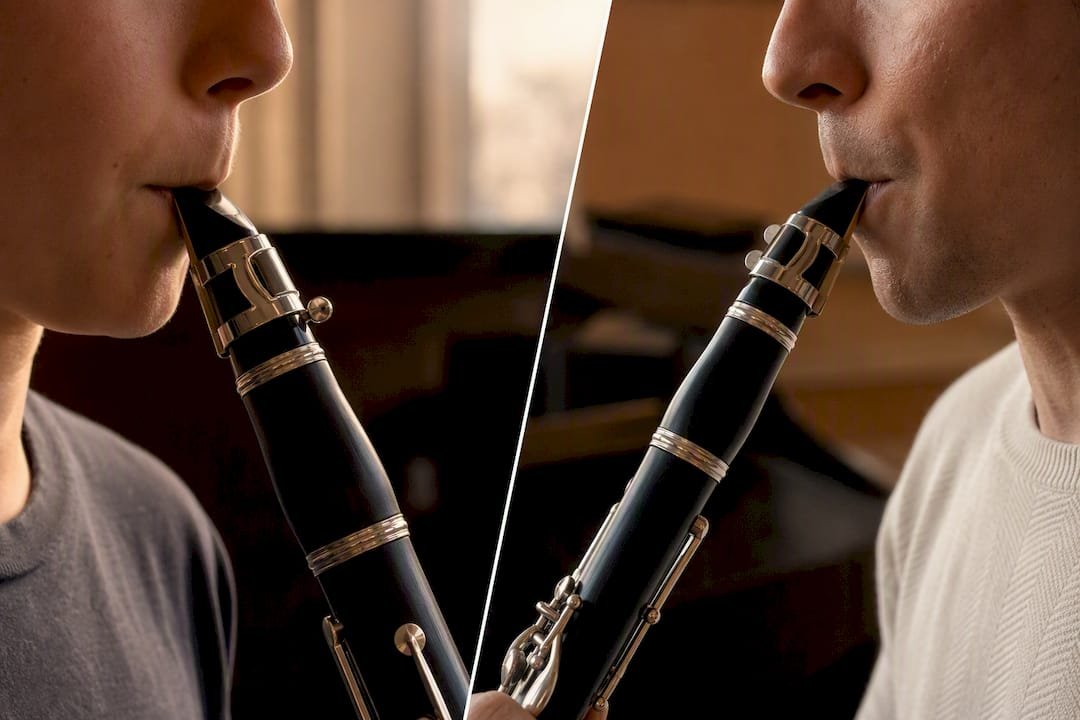
Advanced players are solving several problems simultaneously. They’re adjusting embouchure in real time to match dynamic level, register, and articulation style within a single phrase, often without consciously thinking about any of it. A beginner clarinetist might need thirty seconds to reset embouchure between a low chalumeau passage and a high clarion passage. An advanced player makes that adjustment in the space between two sixteenth notes.
The biggest practical difference is tolerance for variation. Beginners need a narrow, repeatable embouchure shape because their muscular control hasn’t developed enough to safely improvise around it. Advanced players build a wider working range, developed through years of long tones, interval work, and repertoire that demands flexibility, which lets them bend embouchure shape on the fly without losing tone quality or pitch center. That flexibility is exactly what takes years to build safely, and why progressive drills matter more than shortcuts at any skill level.
How Does Embouchure Affect Articulation and Dynamics?
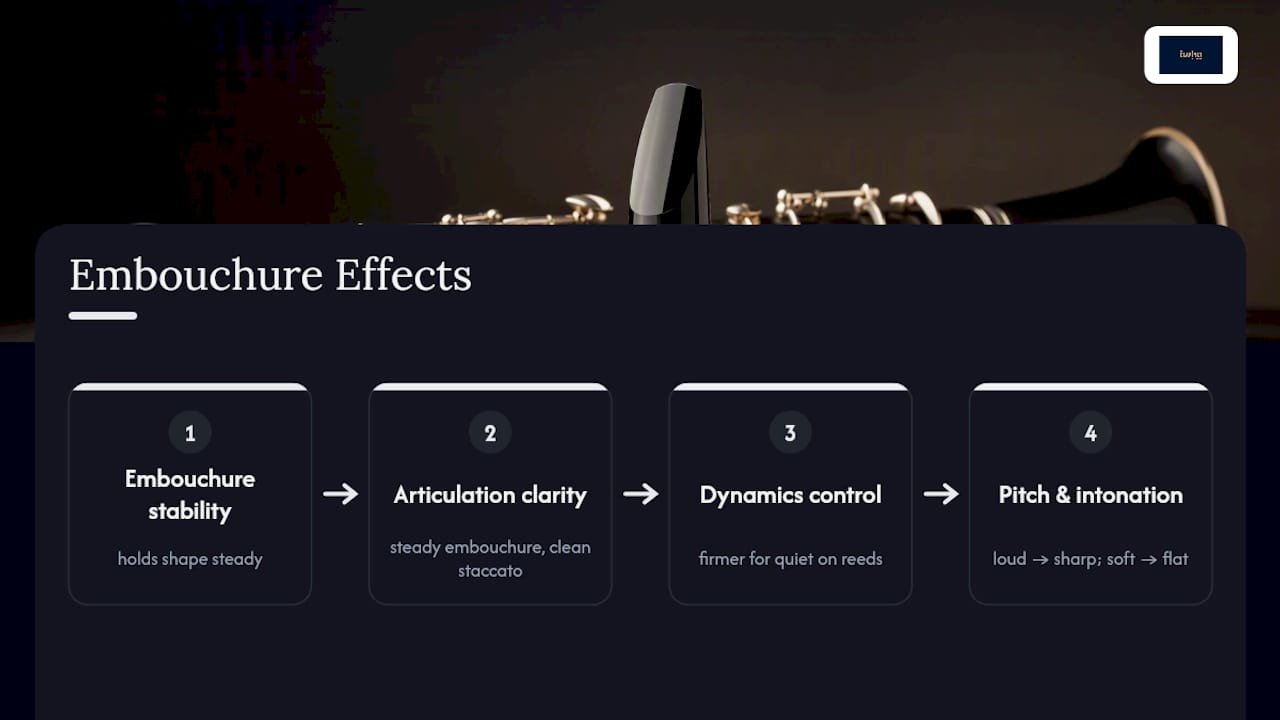
Articulation and dynamics both live or die at the embouchure, not just at the tongue or the air supply most players assume is responsible. A staccato note that sounds clean rather than blurry depends on the embouchure holding its shape steady while the tongue starts and stops the air stream. If the embouchure shifts even slightly during a fast articulated passage, every note comes out with a different pitch center or timbre, which is why uneven articulation often traces back to embouchure instability rather than tonguing technique itself.
Dynamics work the same way in reverse. Playing quietly on a reed instrument generally requires a slightly firmer, more controlled embouchure, since less air pressure makes the reed harder to stabilize. Playing loudly on brass instruments demands more lip tension and a smaller aperture to handle the increased air pressure without the pitch going sharp or the tone splitting. Flutists control dynamics almost entirely through air stream angle and speed, since there’s no reed or lip buzz to adjust, which is part of why flute dynamics can feel disconnected from the embouchure cues that work on other instruments.
This is also where a lot of intonation trouble hides. Players who go sharp when they play loud, or flat when they play soft, are often making an embouchure compensation they don’t notice, not making a breath-support mistake.
How Has Embouchure Teaching Changed Over Time?
Embouchure pedagogy used to be far more rigid than it is now. Early twentieth-century brass method books tended to prescribe a single “correct” mouth position, often based on whatever the author’s own teacher had used, with little acknowledgment that dental structure, lip thickness, and jaw shape vary enough between players to make one universal template unrealistic.
That started shifting mid-century as brass pedagogy split into competing schools of thought, most visibly the Farkas approach built around a specific lip-to-rim ratio, and later the Stevens-Costello method, which took a very different view built around a puckered formation and deliberate tongue arch. Neither camp fully displaced the other, and that’s telling: it suggests different embouchure setups genuinely suit different players rather than one being objectively correct.
Woodwind pedagogy followed a similar arc, moving away from strict prescriptions toward frameworks that account for individual reed, mouthpiece, and anatomical variation. The clinical and dental literature on embouchure is still comparatively thin. A literature review proposing an integrative definition of embouchure notes that research on dysfunctional embouchure remains scarce and sometimes contradictory, which is part of why modern teaching leans on individualized assessment over one-size-fits-all rules.
How Should Embouchure Adapt Across Musical Styles?
Classical playing generally rewards a stable, centered embouchure built for consistent tone across long, sustained phrases and a wide dynamic range played with control. Jazz and commercial styles often ask for more flexibility: bends, growls, and fast register shifts benefit from a slightly looser, more reactive embouchure that can adjust quickly rather than holding one fixed shape.
Folk and traditional styles vary enormously by instrument and region, but many favor a brighter, more open tone that comes from a slightly different aperture or reed angle than the darker, more centered sound classical training emphasizes. Players who move between genres, a classical clarinetist adding klezmer or jazz work, for instance, often find their embouchure needs to loosen at the corners and allow more pitch bending than their classical training encouraged.
None of this means switching styles requires an entirely new embouchure from scratch. It means building enough flexibility into your baseline technique that you can lean the shape one way or another without losing the fundamentals of seal, support, and control covered earlier. Players who chase a specific stylistic sound purely through equipment changes, a different mouthpiece, a different reed strength, without adjusting embouchure flexibility usually find the gear can’t fully compensate.
A note on the long game
Embouchure develops the way athletic conditioning does: incrementally, with occasional plateaus that feel discouraging but aren’t permanent. Chasing a new mouthpiece as the first fix for a stalled embouchure rarely works as well as pairing solid teacher feedback with the right gear. Persistent mechanical trouble deserves an early dental or oral check, not months of guessing.
Try Profiled Mouthpieces Before You Blame Your Embouchure
A lot of embouchure frustration isn’t a technique failure at all. It’s a mismatch between your setup and a mouthpiece that’s forcing your lips, jaw, and tongue to compensate every time you play. Myclarinetstuff’s Gleichweit mouthpieces are CNC-crafted in Austria for consistency you don’t get from piece-to-piece hard rubber variation, which matters when you’re trying to isolate whether a problem is your embouchure or your gear.

The Clarinet Mouthpiece Matchmaker pairs you with mouthpieces suited to your playing style, and the at-home Test Box lets you trial up to five mouthpieces before committing to one. Testing multiple profiled options side by side, instead of guessing from specs alone, is often the fastest way to find out whether your embouchure strain is a technique issue or an equipment one. If you’ve been fighting fatigue, air leaks, or tone inconsistency for weeks with no clear cause, start by requesting a Test Box and rule your equipment out first.
Sources
- Novel ultrasound examination and guided intervention of peri-oral musculature and fascia in wind players with embouchure problems: technical note – PMC
- Wind instruments and oral health: challenges faced by professional wind musicians – MDPI
- Embouchure – Wikipedia