
Achieving a beautiful, resonant clarinet tone is one of the most rewarding yet challenging aspects of playing. Whether you’re a beginner struggling with consistency or an advanced player seeking greater warmth and projection, tone quality depends on mastering four interconnected pillars: air support, embouchure, equipment selection, and focused practice routines. This article breaks down expert tips and premium mouthpiece recommendations to help you systematically enhance your clarinet sound and unlock the rich, expressive tone you’ve been working toward.
Table of Contents
- Key takeaways
- Mastering your clarinet tone: four essential pillars
- Air support and embouchure: the foundation of a rich tone
- Optimizing equipment: reeds and mouthpieces for superior tone quality
- Daily practice routines to enhance your clarinet tone quality
- Explore expert mouthpiece options at My Clarinet Stuff
- Frequently asked questions
Key Takeaways
| Point | Details |
|---|---|
| Air support foundation | Diaphragmatic breathing and steady airflow are essential for sustaining color and volume across notes. |
| Embouchure technique | Proper embouchure involves rolling the lower lip over the bottom teeth to cushion the reed, with the top teeth resting about one third down from the tip and firm corners to prevent air leaks. |
| Premium mouthpieces benefit | Premium mouthpieces often yield immediate improvements in richness and projection compared to stock models. |
| Long tone practice focus | Regular long tone practice with dynamic control and self assessment through recording helps internalize technique and reveal weaknesses. |
Mastering your clarinet tone: four essential pillars
Clarinet tone quality relies on four pillars: air support, embouchure, equipment choices like reeds and mouthpieces, and practice routines centered on long tones. Understanding how these elements interact gives you a clear roadmap for improvement.
Air support begins with diaphragmatic breathing. Instead of shallow chest breathing, engage your diaphragm to create steady, controlled airflow. This foundation allows you to sustain notes with consistent volume and color. Without proper breath support, even the best equipment and technique will produce an unstable, thin sound.
Embouchure refers to how you position your lips, teeth, and jaw around the mouthpiece. Proper embouchure involves rolling your lower lip over your bottom teeth to cushion the reed, placing your top teeth firmly on the mouthpiece about one third down from the tip, and maintaining firm corners to prevent air leaks. A relaxed jaw and correct aperture size prevent the pinched or overly spread tones that plague many players.
Equipment selection matters more than many clarinetists realize. Reed strength, precise placement, and mouthpiece design all directly influence how easily your instrument responds and how warm your tone sounds. Upgrading from a stock mouthpiece to a premium model often yields immediate improvements in richness and projection.
Focused practice routines tie everything together. Regular work on long tones, dynamic control, and self assessment through recording helps you internalize proper technique and identify weak spots. Combining these four pillars creates a systematic path toward the tone quality you want.
Pro Tip: Start each practice session with five minutes of long tones at a comfortable dynamic. This warms up your embouchure and establishes good air support habits before tackling technical passages. Check out our clarinet practice essentials for a complete warmup framework.
Understanding the science behind tone production helps clarify where to focus your efforts. According to ICA tone technique studies, the interaction between steady airflow and reed vibration creates the complex overtone series that defines clarinet timbre. When any pillar is weak, the entire system suffers.
Air support and embouchure: the foundation of a rich tone
Diaphragmatic breathing and steady air support form the bedrock of clarinet tone. To develop this skill, practice long tones by sustaining a single note for counts of 8, then gradually extending to 16 counts as your control improves. Focus on maintaining consistent volume and tone color from the first moment of sound through the final release.
The paper test provides immediate feedback on airflow steadiness. Hold a small piece of paper in front of your mouth and blow gently, trying to keep it suspended at a constant angle. Any wobbling indicates uneven air pressure. Apply this same steady stream concept when playing long tones on your clarinet.
Proper embouchure setup requires attention to several simultaneous elements. Roll your lower lip over your bottom teeth, creating a cushion for the reed. This prevents biting and allows the reed to vibrate freely. Your top teeth rest firmly on the mouthpiece approximately one third of the way down from the tip, providing a stable anchor point.
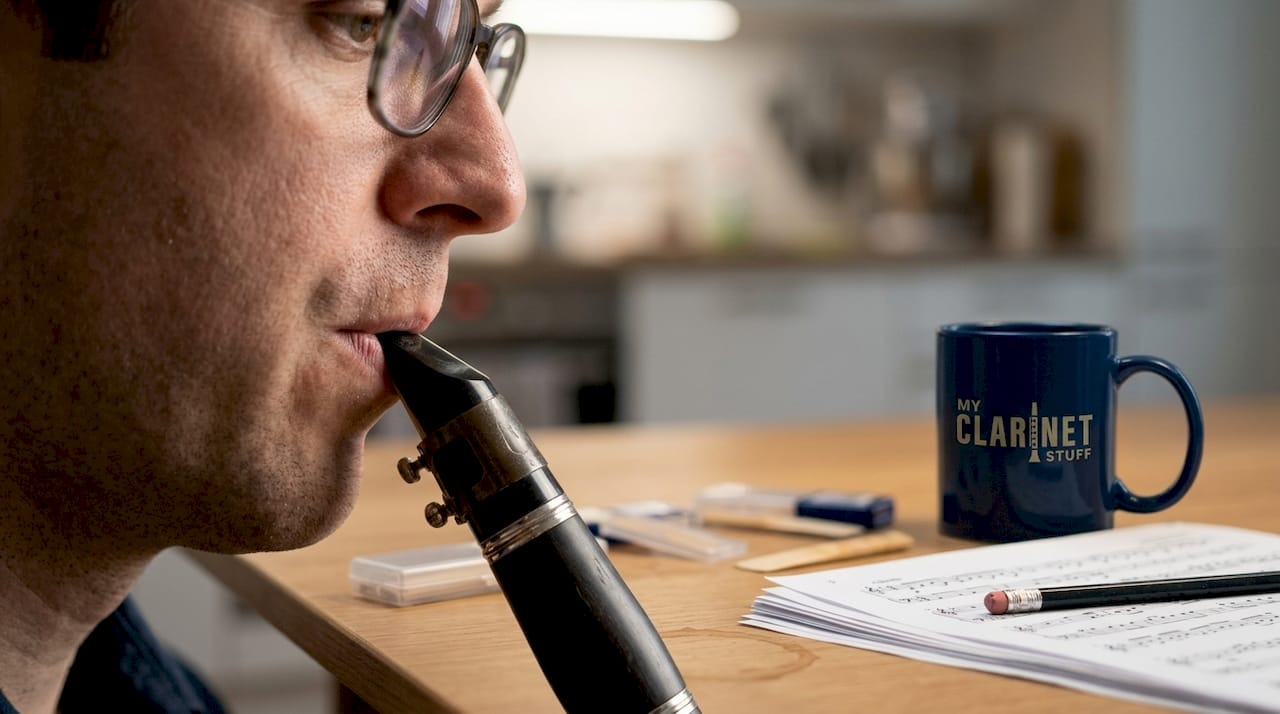
Corner firmness prevents air leaks that create fuzzy, unfocused tone. Imagine drawing the corners of your mouth slightly back and in, as if forming a subtle smile. This muscular engagement seals the sides of your embouchure without creating excessive tension. Your jaw should remain relaxed, dropping naturally rather than jutting forward or pulling back.
Aperture size, the opening between your top and bottom lips around the mouthpiece, significantly affects tone quality. Too large an aperture produces a spread, unfocused sound. Too small creates a pinched, thin tone. Finding the sweet spot takes experimentation and careful listening. Our clarinet embouchure tips guide walks you through systematic adjustments.
Pro Tip: Practice mouthpiece and barrel exercises without the full instrument. This isolates your embouchure and air support, making it easier to identify and correct issues. You should produce a concert F or F sharp with good tone quality. Explore more techniques in our clarinet practice tips collection.
Common embouchure mistakes include biting too hard with the lower jaw, insufficient corner support, and excessive mouthpiece angle. Regular mirror checks help you visually confirm proper setup. Recording yourself and comparing your sound to professional recordings reveals areas needing adjustment.
Optimizing equipment: reeds and mouthpieces for superior tone quality
Selecting appropriate reed strength dramatically impacts both ease of playing and tonal richness. Beginners typically start with 2 to 2.5 strength reeds, which respond easily but may lack depth. Intermediate players often progress to 2.5 to 3 strength, balancing resistance with tone quality. Advanced clarinetists generally use 3 to 3.5 strength reeds for maximum warmth and projection.
Reed placement precision matters more than most players realize. Position the reed so its tip aligns approximately one third of the way down the mouthpiece tip. Center it carefully so equal amounts of mouthpiece rail show on both sides. Secure the ligature snugly without over tightening, which can choke the reed’s vibration. Small adjustments of just 0.5mm up or down noticeably affect intonation and response.
Premium mouthpieces like the Vandoren B45, B40 Lyre, and BD5 offer significant advantages over stock pieces. These professional models feature precision facing curves, optimal tip openings between 1.05 and 1.20 mm, and high quality ebonite material that enhances warmth and resonance. The improved response and tonal richness often surprise players upgrading from beginner equipment.
| Mouthpiece model | Tip opening | Facing length | Best for | Tonal character |
|---|---|---|---|---|
| Vandoren B45 | 1.1975 mm | Medium | Classical, all levels | Warm, focused, versatile |
| Vandoren B40 Lyre | 1.195 mm | Medium long | Advanced classical | Rich, dark, centered |
| Vandoren BD5 | 1.225 mm | Medium | Jazz, contemporary | Bright, projecting, flexible |
| Stock beginner | 1.05-1.15 mm | Short | Students | Basic, less resonant |
Mouthpiece material affects tone quality substantially. Ebonite, also called hard rubber, produces warmer sound than plastic. The density and aging characteristics of quality ebonite contribute to the complex overtones professional players seek. Tip opening size determines how much reed vibrates, directly influencing volume potential and tonal color.
Pro Tip: When testing new mouthpieces, use the same reed strength and brand you’re accustomed to. This isolates the mouthpiece variable, making it easier to evaluate its true characteristics. Our clarinet mouthpiece matchmaker tool helps identify models suited to your playing style and goals.
Facing curves, the gradual slope from where the mouthpiece contacts the reed to the tip opening, vary between models. Longer facings generally provide more flexibility and tonal color options but require stronger embouchure control. Shorter facings offer easier response but may limit expressive range. Understanding these tradeoffs helps you make informed equipment decisions. Learn more about testing clarinet mouthpieces systematically.
Ligature design also influences tone. While often overlooked, the ligature’s pressure distribution affects how freely the reed vibrates. Quality ligatures allow adjustment of pressure points, letting you fine tune response and color. Our equipment selection process covers these details comprehensively.
Daily practice routines to enhance your clarinet tone quality
Establishing consistent practice habits accelerates tone development. Focused 15 to 25 minute sessions centered on specific tone exercises produce better results than unfocused longer practice. Structure your routine to address air support, embouchure stability, and dynamic control systematically.
Begin every session with long tone exercises:
- Select a comfortable middle register note like throat tone G or A
- Sustain the note for 8 counts at mezzo forte, focusing on steady tone and volume
- Gradually extend to 12, then 16 count durations as your control improves
- Move chromatically through your range, noting which notes feel easiest and which need extra attention
- Record yourself regularly to track progress objectively
Dynamic control exercises build expressive flexibility. Start a long tone at pianissimo, gradually crescendo to fortissimo, then diminuendo back to pianissimo without changing pitch or tone quality. This challenging exercise reveals air support weaknesses and embouchure instabilities. Master it slowly before attempting faster dynamic changes.
Self assessment through recording cannot be overstated. Your perception while playing differs dramatically from what listeners hear. Record short practice segments weekly, comparing them to professional recordings. Listen specifically for tone consistency, intonation accuracy, and unwanted sounds like key clicks or air noise.
Extended practice sessions of 20 to 40 minutes yield measurable tone quality gains when structured properly. After your long tone warmup, incorporate scales and arpeggios played with the same attention to tone as your long tone work. This transfers good habits into technical contexts.
Pro Tip: Practice mouthpiece and barrel alone to isolate tone production from fingering coordination. You should produce a clear, centered pitch without the full instrument. This exercise quickly reveals embouchure and air support issues. Find complete routines in our best clarinet practice routines guide.
Consistency matters more than session length. Daily 15 minute focused practice produces better results than sporadic hour long sessions. Most players notice significant tone improvements within 4 to 6 weeks of structured daily work. Track your progress in a practice journal, noting specific observations about tone quality, ease of response, and problem areas.
Integrate these exercises into real musical contexts gradually. As your fundamental tone improves, apply the same air support and embouchure principles to etudes and repertoire. The goal is making excellent tone your default, not something you can only achieve in isolated exercises. Our performance tips guide helps you maintain tone quality under performance pressure.
Explore expert mouthpiece options at My Clarinet Stuff
Ready to take your tone quality to the next level? Upgrading to a premium mouthpiece often provides the breakthrough players need after mastering fundamental technique.

My Clarinet Stuff offers carefully curated mouthpieces proven to enhance tone quality across all playing styles. Our clarinet mouthpiece matchmaker tool asks about your current setup, playing goals, and tonal preferences, then recommends specific models matched to your needs. Whether you’re seeking warmer classical tone or brighter jazz projection, we help you find the right upgrade.
Explore our mouthpiece selection tips to understand what characteristics matter most for your playing situation. We break down tip openings, facing lengths, and material choices in practical terms. Our equipment selection process guide walks you through systematic testing and evaluation, ensuring your investment delivers the tonal improvements you’re after.
Frequently asked questions
What reed strength is best for improving clarinet tone?
Beginners should start with 2 to 2.5 strength reeds for easier response and basic tone development. Intermediate players typically progress to 2.5 to 3 strength as their embouchure strengthens, gaining tonal richness while maintaining control. Advanced clarinetists generally use 3 to 3.5 strength reeds for maximum warmth and projection. Choose strength based on your current skill level, not aspirations, as too hard a reed creates tension and poor tone.
How can I develop steady air support for better tone?
Practice diaphragmatic breathing by placing one hand on your abdomen and feeling it expand as you inhale deeply. Use long tones counting 8 to 16 beats to build sustained airflow control, focusing on consistent volume throughout each note. The paper test provides immediate feedback: hold paper in front of your mouth and blow steadily, keeping it suspended at a constant angle without wobbling. Apply this same steady pressure when playing to eliminate tone wavering.
What makes premium mouthpieces better for tone quality?
Premium mouthpieces crafted from quality ebonite produce richer overtones and warmer tone compared to plastic beginner models. Precision facing curves and optimal tip openings between 1.05 and 1.20 mm improve response consistency and projection. The material density and manufacturing tolerances of professional mouthpieces allow more complex tonal colors and easier dynamic control. Models like the Vandoren B45 and B40 Lyre demonstrate these advantages immediately when compared to stock equipment.
How long does it take to notice improvement in clarinet tone with focused practice?
Most clarinetists observe noticeable tone improvements within 4 to 6 weeks of daily focused practice lasting 15 to 25 minutes. Consistency matters more than session length, so brief daily work outperforms sporadic longer practice. Recording yourself weekly provides objective evidence of progress that’s hard to perceive during practice. Combining proper technique with appropriate equipment accelerates results, especially when upgrading from beginner to intermediate level mouthpieces and reeds.