
Your embouchure is the single most powerful variable in your clarinet playing. It shapes your tone, controls your intonation, and determines how long you can play before fatigue sets in. Yet most players spend years on scales and repertoire while giving their embouchure only passing attention. Whether you are a student just starting out or an experienced player chasing a richer, more flexible sound, understanding the main embouchure styles and how to choose between them can genuinely transform your playing.
Table of Contents
- What is clarinet embouchure and why does it matter?
- Key criteria for choosing an embouchure style
- Single-lip embouchure: The modern standard
- Double-lip embouchure: For warmth and flexibility
- French and German embouchures: Regional approaches
- Comparing clarinet embouchure types: Features and differences
- Advanced and hybrid embouchure techniques
- How to test and refine your clarinet embouchure
- Optimize your embouchure setup with the right gear
- Frequently asked questions
Key Takeaways
| Point | Details |
|---|---|
| Embouchure shapes tone | Your clarinet embouchure directly affects sound quality, control, and endurance. |
| Styles suit needs | Single-lip fits most, but double-lip and regional variations offer tonal options for advanced players. |
| Experiment and adapt | Testing different embouchures and adjusting for your setup is key to finding your best fit. |
| Avoid excess pressure | Too much embouchure pressure reduces stamina and dulls tone. |
What is clarinet embouchure and why does it matter?
Embouchure (pronounced AHM-buh-shur) is simply the way you shape your mouth, lips, jaw, and facial muscles around the mouthpiece and reed. For clarinetists, the basic setup involves resting your upper teeth directly on the mouthpiece, rolling your lower lip over your lower teeth, keeping your chin flat, and firming the corners of your mouth. That combination creates the seal and pressure needed to set the reed vibrating.
Get it right and you get a full, centered tone with easy control across all registers. Get it wrong and you will fight the instrument every session. The core mechanics matter because embouchure affects tone color, pitch stability, dynamic range, and physical endurance all at once.
Here is what a well-formed embouchure should do:
- Create an airtight seal without squeezing the reed shut
- Allow the reed to vibrate freely for a resonant tone
- Maintain consistent pressure across long phrases
- Adapt quickly between registers without tension
Pressure is one of the trickiest variables. Excessive embouchure tightness can cut your endurance by up to 40 minutes, and studies show that 10 to 30 percent of players routinely use more pressure than necessary. For advanced embouchure tips on managing pressure and building stamina, it helps to start with a clear framework.
“A stable, flexible embouchure is not a fixed position. It is a dynamic skill that responds to the music, the reed, and the room.”
After recognizing embouchure’s importance, let’s set criteria for selecting the ideal style.
Key criteria for choosing an embouchure style
Not every embouchure works for every player. Before experimenting, consider these factors:
- Facial structure and teeth alignment: An overbite or underbite changes how your lip sits on the reed.
- Mouthpiece shape and reed strength: A wider tip opening may require a firmer embouchure; a softer reed rewards a lighter touch.
- Desired tone color: Bright and projecting versus dark and covered are legitimate goals that point to different styles.
- Genre and tradition: Orchestral classical playing, jazz, and folk music each have embouchure norms.
- Endurance needs: Long rehearsals demand an efficient setup that minimizes fatigue.
- Adaptability: Solo recitals, chamber music, and marching band all place different demands on your face.
The ICA stresses stable embouchure with strong air support as the foundation, recommending the mouthpiece sit 1/4 to 1/2 inch (12 to 15mm) into the mouth at a 30 to 45 degree angle. Pairing that baseline with the right tone quality tips helps you narrow down which style fits your goals.
Pro Tip: Record yourself playing a long tone with your current embouchure, then listen back. Thin or airy tone usually signals too little pressure or too much mouthpiece. A pinched, nasal sound signals too much tension.
With the selection criteria in mind, let’s explore the most common clarinet embouchure types.
Single-lip embouchure: The modern standard
The single-lip embouchure is what most teachers show on day one, and for good reason. It is efficient, stable, and consistent across genres. Here is how to form it:
- Rest your upper teeth lightly but firmly on the top of the mouthpiece.
- Roll your lower lip inward so it cushions the reed against your lower teeth.
- Firm the corners of your mouth without pulling them back into a smile.
- Keep your chin flat and pointed downward.
- Direct a steady, supported air stream through the instrument.
Single-lip embouchure is the modern standard for clarinetists worldwide, used in virtually every conservatory and school band program. Its biggest advantages are predictability and ease of learning. The upper teeth provide a stable anchor, which makes it easier to control dynamics and articulation.
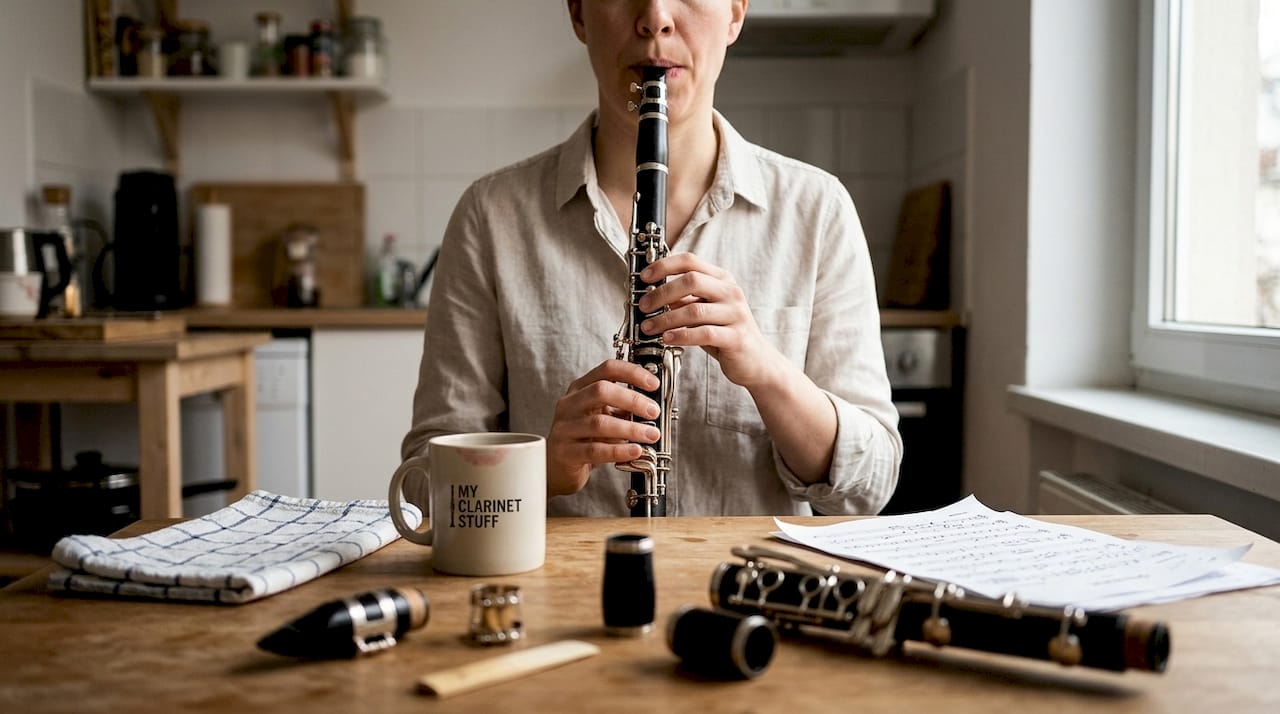
The main drawback is that some players develop upper tooth sensitivity or fatigue over long sessions. A thin mouthpiece patch solves that quickly. For more on getting the most from this setup, check out these clarinet performance tips.
Pro Tip: If your tone sounds thin in the upper register with a single-lip setup, try dropping your jaw slightly and increasing air speed rather than adding lip pressure.
Now that we’ve covered the most common approach, let’s look at an alternative embraced by some advanced and experimental players.
Double-lip embouchure: For warmth and flexibility
In the double-lip embouchure, both lips curl over the teeth, so neither set of teeth touches the mouthpiece directly. The result is a noticeably warmer, rounder tone with greater reed sensitivity.
Here is what makes it distinctive:
- Warmer tone: Without the hard anchor of upper teeth, the mouthpiece vibrates more freely.
- Increased reed sensitivity: Small changes in lip pressure produce immediate tonal shifts.
- Greater flexibility: Bending pitches and shaping phrases feels more intuitive.
- Endurance challenge: Holding both lips in position is physically demanding and tiring for extended sessions.
Double-lip suits warmer tone goals and embouchure experimentation, but it is less stable than single-lip and harder to sustain in long rehearsals. It works well for solo recitals, early music, and players who want to explore tone customization beyond what single-lip offers.
Beyond single- and double-lip, several national and system-based embouchure variants have evolved.
French and German embouchures: Regional approaches
Two major regional traditions have shaped clarinet embouchure in very different directions.
French (Boehm system) embouchure uses a moderate jaw angle, firm corners directed slightly forward, and upper teeth on the mouthpiece. The French-style embouchure produces a clear, projecting tone that carries well in large halls. It is the global standard for most orchestras and conservatories outside of German-speaking countries.
German (Oehler system) embouchure takes a different path. The German-style embouchure uses a more rounded chin, a different jaw angle, and less mouthpiece in the mouth. The result is a darker, more covered sound with a strong low-register focus. This style is preferred in German and Austrian orchestras and pairs naturally with the Oehler clarinet system.
| Feature | French embouchure | German embouchure |
|---|---|---|
| Jaw angle | Moderate | More rounded |
| Tone color | Bright, projecting | Dark, covered |
| Mouthpiece depth | Standard | Slightly less |
| Common setting | Global orchestras | German/Austrian orchestras |
| Reed strength | Medium to hard | Medium |
Players who work across both traditions sometimes adjust their setup depending on the repertoire. Explore practice essentials to build the flexibility needed for that kind of switching.
To help compare these embouchures more directly, here’s a side-by-side summary.
Comparing clarinet embouchure types: Features and differences
| Embouchure | Tone | Stability | Endurance | Best for |
|---|---|---|---|---|
| Single-lip | Bright to neutral | High | High | Beginners, classical, jazz |
| Double-lip | Warm, round | Medium | Low | Solo, early music |
| French | Clear, projecting | High | High | Orchestral, chamber |
| German | Dark, covered | High | High | German/Austrian repertoire |
One important insight from experienced teachers: embouchure must adapt to the mouthpiece, reed, and register you are playing. Avoid tension and avoid smiling. Hybrid approaches that blend features from multiple styles can give you the most versatility across different playing situations. For a full sound improvement checklist, it helps to evaluate your embouchure alongside your air support and equipment choices.
For those seeking more nuance, some advanced variations and hybrid solutions are also available.
Advanced and hybrid embouchure techniques
Once you have a solid foundation in one of the standard styles, you can explore more specialized approaches.
- Gigliotti upper lip tuck: The upper lip is tucked slightly under the top teeth, creating a more stable mouthpiece contact and a more open throat. This hybrid feel suits players who want single-lip stability with a warmer tone.
- Viennese embouchure: A unique combination of lip and jaw angle developed for the Viennese clarinet tradition. It requires significant expert adjustment and is not recommended for beginners.
- Personal hybrids: Many professional players blend elements from two or more styles to match their facial anatomy, mouthpiece, and musical goals.
Advanced variations like the Gigliotti tuck and Viennese adjustments require expert technique and ideally some guidance from a teacher who knows the style. Pair any new embouchure experiment with solid warm-up routines to protect your muscles while you adapt.
Pro Tip: When trying a new embouchure style, give it at least two weeks of consistent practice before judging the results. Your muscles need time to build new memory.
Finally, apply what you’ve learned with actionable tips for testing and refining embouchures.
How to test and refine your clarinet embouchure
Experimenting with embouchure is a skill in itself. Here is a practical process:
- Set a baseline: Play a long tone on a comfortable note and record the sound and your physical sensations.
- Use a mirror or phone camera: Check your chin shape, lip position, and jaw angle in real time. Flat chin and firm corners are your visual targets.
- Test one variable at a time: Change only your jaw angle, or only your lip pressure, not both at once.
- Spend at least 10 to 15 minutes per session on each variation before drawing conclusions.
- Document your results: Write down what produced the clearest tone, the best endurance, and the most comfort.
Long tones build endurance and give you the clearest feedback on tone quality. The ICA recommends keeping the mouthpiece at a 30 to 45 degree angle and no more than 1/2 inch into the mouth as your starting benchmark.
“The best embouchure is the one that produces your best sound with the least physical effort. Efficiency is the goal, not rigidity.”
Pairing your embouchure work with the right accessory selection makes a real difference. A mouthpiece that matches your embouchure style will reward your practice far faster than fighting mismatched equipment.
These practical steps prepare you to confidently choose, adapt, or hybridize embouchure styles as you advance.
Optimize your embouchure setup with the right gear
Understanding embouchure is only half the equation. The mouthpiece you play on shapes how every technique feels and sounds. At MyClarinetStuff.com, we carry precision CNC-crafted Gleichweit mouthpieces designed in Austria for consistent response across all embouchure styles. Whether you favor the bright projection of a French-style setup or the warmth of a double-lip approach, the right mouthpiece makes your embouchure work easier, not harder.

Use the clarinet mouthpiece matchmaker to find the model that fits your playing style and embouchure goals. Then visit the clarinet accessory guide to round out your setup with barrels, patches, and reeds that complement your technique. Our at-home test box program lets you try before you commit, so you can make a confident, informed choice.
Frequently asked questions
Which clarinet embouchure is best for beginners?
Single-lip embouchure is the modern standard and the best starting point for beginners because it offers the most stability and the shortest learning curve.
How do I know if my embouchure pressure is correct?
If your lips or jaw tire within 20 to 30 minutes, your pressure is likely too high. Overuse of pressure is common in 10 to 30 percent of players and directly reduces endurance.
Can I switch between embouchure styles for different genres?
Yes. Advanced players regularly adapt or blend techniques for different contexts. Hybrids blend styles for versatility across classical, jazz, and folk repertoire.
How far should the mouthpiece go in my mouth?
About 1/4 to 1/2 inch (12 to 15mm) is the standard benchmark, with the mouthpiece held at a 30 to 45 degree angle to the body.
Does embouchure need to change with different mouthpieces or reeds?
Yes. Embouchure must adapt to the mouthpiece, reed strength, and register you are playing to maintain optimal tone and response.