


The simplest effective system for clarinet hobby progress tracking is a five-minute weekly journal paired with short, repeatable session templates and one habit number: days practiced per week. Time-only tracking fails adults because minutes logged don’t tell you what changed, and clean-tempo counts alone miss tone and musicality. Expect real, felt gains in four to twelve weeks, not overnight, and expect the clearest proof to show up only when you look back across several weeks at once.
TL;DR:
- Consistent weekly journaling focused on problem spots, tempo ceilings, concrete wins, and next tasks provides clearer progress measures than time or raw tempo alone.
- Short, structured practice sessions split across tones, technique, and repertoire yield more reliable improvements than longer, less focused practice.
- Tracking should prioritize specific actionable data over effort metrics to ensure the practice leads to measurable skill advancement.
- Using simple tools like habit calendars and labeled timers supports progress without turning practice into a burdensome chore.
- Regular recordings and equipment consistency are essential for accurately assessing and hearing improvement over multiple months.
Table of Contents
- What to track: the anti-homework rule and four fields that change tomorrow’s practice
- The 5-minute weekly practice journal: template and two example entries
- Practice-session templates and timing: repeatable 5/10/20/30-minute plans
- Tools and apps that help you track without turning practice into homework
- What to do when progress stalls: three quick diagnostics and fixes
- Putting it together: weekly workflow that keeps tracking effortless and revealing
- Why most hobbyists quit tracking, and what actually keeps it alive
- How Myclarinetstuff helps you hear your own progress clearly
- Sources
What to track: the anti-homework rule and four fields that change tomorrow’s practice
Most practice logs fail the same way: they record what happened without shaping what happens next. The anti-homework rule fixes that. If a note doesn’t change tomorrow’s plan, skip it — a practice log should make tomorrow easier, not pile up unread paperwork.
Four fields cover nearly everything worth logging:
- Problem spot, with location. Not “the Weber piece was hard,” but “measure 34, the low-register slur into the altissimo break.”
- Tempo ceiling. The fastest speed you played the passage cleanly, twice in a row, without a slip.
- One concrete win. A phrase that finally slotted, a register break that stopped cracking.
- First task for next session. The single thing you’ll do in the first sixty seconds of your next sit-down.
Total minutes and raw tempo numbers alone are low-signal for adult hobbyists — they tell you effort happened, not that anything moved forward. Actionable tracking beats volume tracking: logging tempo ceilings, problem locations, and concrete wins shapes next season’s practice far more than a minutes total ever could.
Pro Tip: If a log entry doesn’t tell your future self exactly where to start, it’s not a practice log. It’s a diary entry, and it won’t move your playing forward.
The 5-minute weekly practice journal: template and two example entries
Daily logging burns out fast for adults juggling work and family. A once-a-week check does the same job with a fraction of the friction. Answer four questions every Sunday, in under five minutes:
- How many days did you practice this week?
- What’s one new thing you can do now that you couldn’t do seven days ago?
- What’s still sticking?
- What’s your next small repertoire goal?
Two real-world entries show the range you’ll see:
- Productive week: “4 days. Cleared the sixteenth-note run in bar 12 of the Mozart at tempo. Still fighting intonation on throat tones. Next: work the second movement’s opening phrase.”
- Stall week: “3 days. Nothing feels new. Same crack on the high C as last week. Next: try the same passage a half-step slower and record it.”
A weekly journal of just these four questions builds a 52-entry annual record. Read entries from January against entries from June, and improvement that felt invisible day to day suddenly reads as obvious.
Practice-session templates and timing: repeatable 5/10/20/30-minute plans
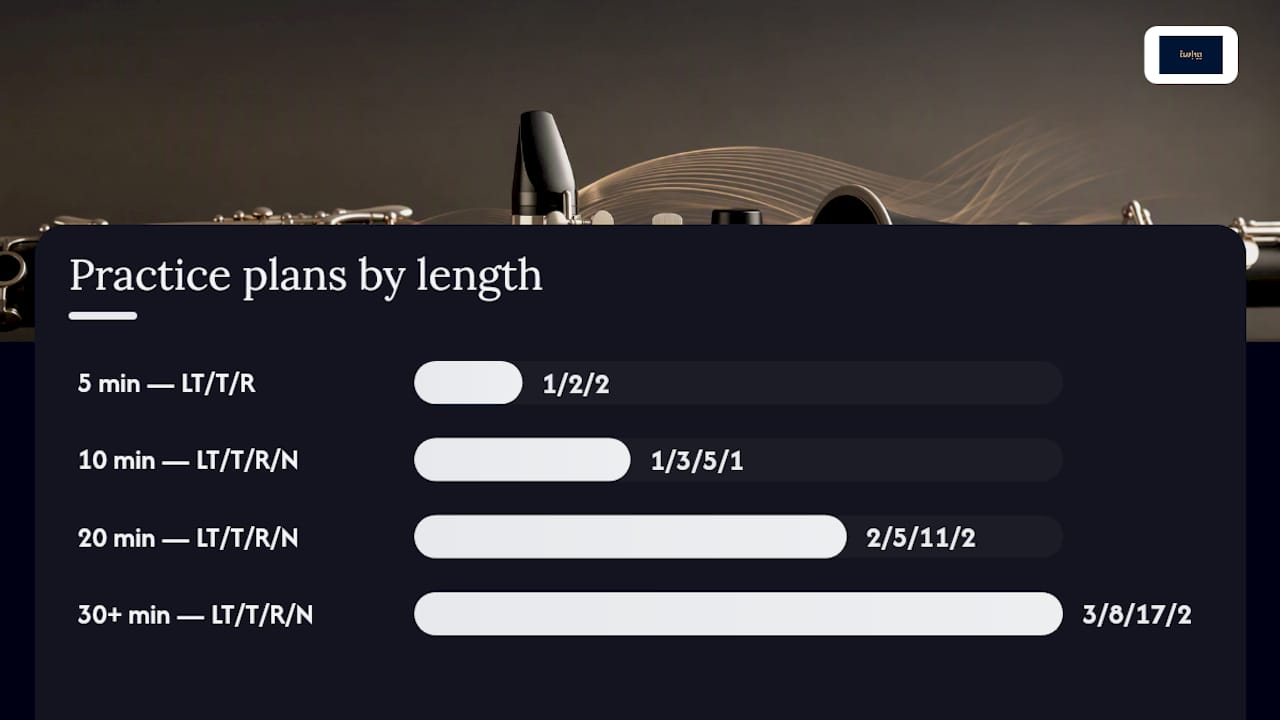
Your weekly journal only works if your practice sessions feed it clean data, which means repeatable structure beats improvisation. Non-professional clarinetists see the most consistent gains from short, frequent sessions split roughly 5% long tones, 30% technique and scales, and 65% repertoire.
Scale the split to whatever time you actually have:
- 5 minutes: 1 minute long tones, 2 minutes on one technical trouble spot, 2 minutes reviewing yesterday’s win.
- 10 minutes: 1 minute long tones, 3 minutes scales or technique, 5 minutes repertoire, 1 minute writing the one-line note.
- 20 minutes: 2 minutes long tones, 5 minutes technique, 11 minutes repertoire, 2 minutes review and note.
- 30+ minutes: 3 minutes long tones, 8 minutes technique, 17 minutes repertoire (split across two pieces), 2 minutes review.
Tempo progression follows one rule: start at whatever speed you can play cleanly twice in a row, then bump it 5 to 10 BPM only after you’ve strung together several clean repetitions at the current speed. Jumping tempo before the reps are clean just teaches your fingers to fumble faster.
Pro Tip: Record a 30 second phone clip of your hardest passage every six to eight weeks. Your ears adjust to your own sound in real time, but a recording from two months ago won’t lie to you. Recording periodically is one of the most honest checks available to a self-taught ear.
Tools and apps that help you track without turning practice into homework
Digital tools should support the four-field log and the weekly journal, not replace them with dashboards you’ll never open again. Four categories cover what a hobbyist actually needs:
- Habit or streak calendar. A simple app or a wall calendar with an X for each practice day. Days-per-week consistency predicts progress better than total weekly minutes.
- Labeled session timer. Any timer app that lets you name blocks (long tones, technique, repertoire) so you stick to your template.
- Audio recorder. Your phone’s voice memo app is enough for the six to eight week comparison checks.
- Lightweight practice-log app. Look for one with a “next task” field specifically. If it doesn’t have that field, a paper notebook works just as well.
A hybrid workflow tends to stick best: a phone app for the daily streak mark, and a small paper notebook by your music stand for the one-line anti-homework note. Skip anything that asks you to track more than four or five data points. The analytics trap is real. If you spend more time reading charts than playing your clarinet, the tool has taken over the hobby. For structured routines that pair well with this kind of tracking, a smart practice workflow can help keep sessions consistent without extra overhead.
What to do when progress stalls: three quick diagnostics and fixes
Plateaus show up first in the weekly journal, not in how you feel during a session. If your answer to “what’s one new thing you can do now” repeats itself for two or three weeks running, you’ve stalled.
Run this one-line check before changing anything: has your “one new thing” answer changed in the last two weekly entries? If not, try one of these:
- Pick an easier piece to finish. Confidence from completing something builds momentum that a stuck passage can drain.
- Change one practice variable. Swap session time, alter your warmup routine, or shorten the session length. Don’t change three things at once, or you won’t know what fixed it.
- Bring the stall to your teacher as a focused question. Instead of “I’m stuck,” bring the exact measure, the tempo ceiling, and what you’ve already tried.
Pro Tip: A stall in your journal is data, not failure. Three flat weeks in a row is the signal to adjust the plan, not to practice harder at the same broken approach.
Putting it together: weekly workflow that keeps tracking effortless and revealing
The whole system runs on a loop small enough to survive a busy month: a daily micro-session using your chosen time template, a one-line note at the end of each session, a five-minute weekly journal review every weekend, and a recording comparison once a month.
Each logged “next task” becomes tomorrow’s opener, and each tempo ceiling becomes tomorrow’s starting point, so the loop feeds itself.
- Daily: pick a template, play, write one line.
- Weekly: answer the four journal questions.
- Monthly: record three familiar passages and compare against last month’s clip.
Three numbers are worth checking once a month:
| Metric | What to compare |
|---|---|
| Repertoire count | Pieces you can play start to finish, this month vs. last |
| Fluency on three pieces | Clean-tempo playthroughs without stopping |
| Scale tempo ceiling | Fastest clean BPM on your current scale set |
Why most hobbyists quit tracking, and what actually keeps it alive
I’ve watched the same pattern play out with adult players who pick up tracking with good intentions and drop it within a month: they start with a detailed spreadsheet, log minutes and tempos obsessively for three weeks, then quietly stop because the log became a second job. The system in this article works because it demands less, not more. Four months of a weekly journal and templated sessions reveals gains a daily log never would, because the weekly format forces you to compare this week against several weeks ago instead of yesterday.
The habit metric matters more than any tempo number. A player who hits four practice days a week for four months, using nothing but a fifteen-minute template and a Sunday journal, will outpace someone chasing perfect BPM charts three days a week. Pair that consistency with occasional attention to your equipment. A practice routine built around tone quality and a mouthpiece that responds predictably remove one more variable from your weekly comparison, so the only thing changing week to week is your playing.
— Milos
How Myclarinetstuff helps you hear your own progress clearly
A tracking system only works if you can trust what you’re hearing session to session, and an inconsistent mouthpiece muddies that comparison before you even open your journal. Myclarinetstuff exists to remove that variable: our CNC-crafted synthetic mouthpieces, made in Austria, deliver the same response and tonal clarity every single session, so a tempo ceiling you hit today means the same thing next month.
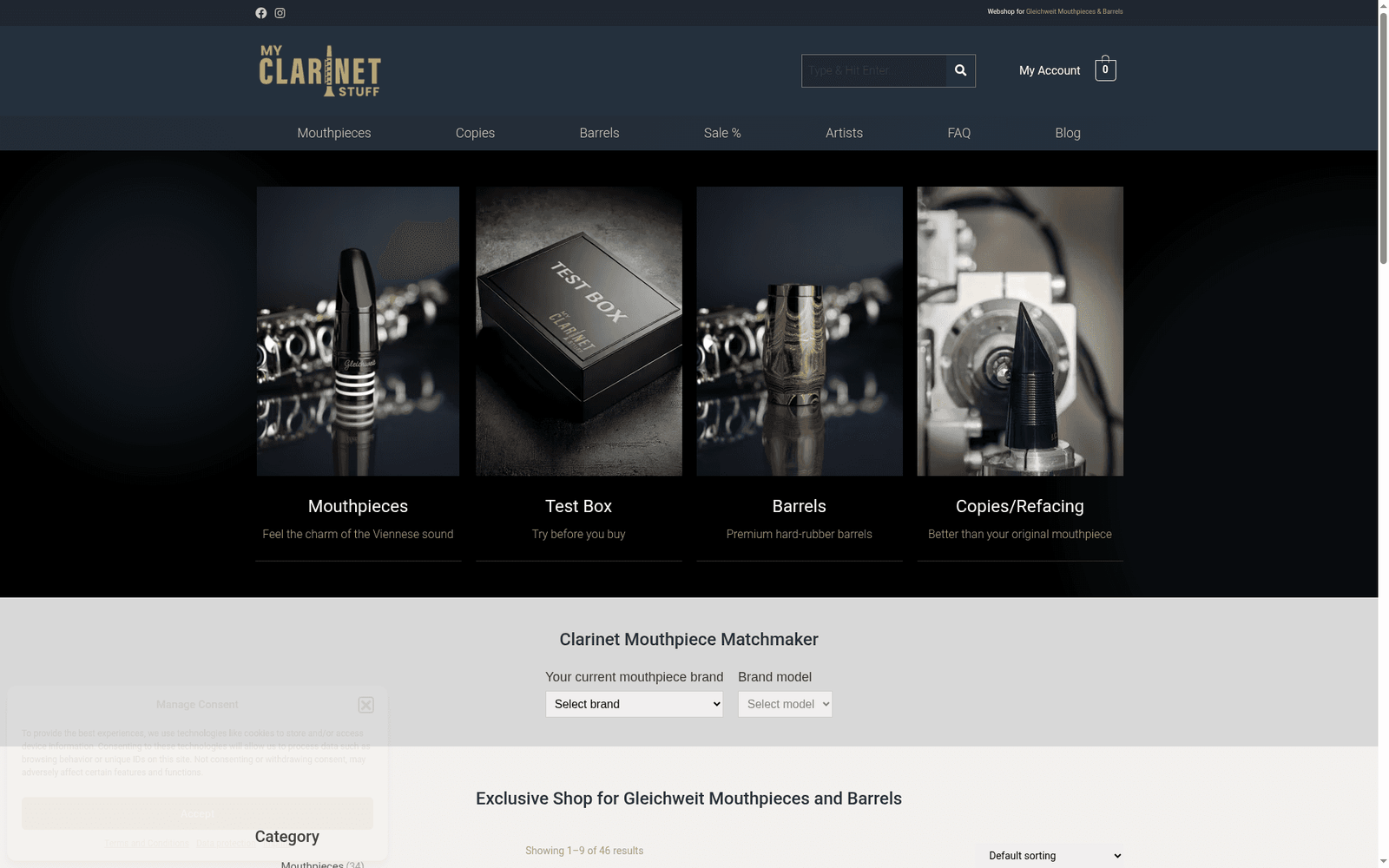
If you’re not sure which mouthpiece facing or tip opening fits your embouchure and sound goals, the Clarinet Mouthpiece Matchmaker walks you through the choice in a few questions. None of this replaces the weekly journal or your session templates. Your tracking system stands on its own. But when your equipment stops introducing random variation into your recordings, your monthly comparison clips become a much more honest measure of what you actually improved. Start with the Matchmaker, and treat consistent gear as one more way to make your progress easier to hear.
Sources
- How to Use a Practice Log Without Turning It Into Homework | Practis Blog
- How to Track Your Music Practice Progress as an Adult Learner | Tunelark
- Practice guidelines for the non-professional playing clarinetist