


The clarinet’s difficulty is front-loaded: getting a stable, squeak-free tone is genuinely the hardest part, and most of that struggle clears up within the first few months of consistent practice. The single biggest early hurdle is embouchure, the muscle control around the mouthpiece and reed, and most players work through the worst of the squeaking in the first several weeks.
TL;DR:
- Early squeaks mainly result from reed vibrations caused by leaks or inconsistent air support, which improve significantly within the first few months of practice.
- Using a softer reed of strength 2 or 2.5 and ensuring proper mouthpiece fit can greatly reduce initial squeaks by improving embouchure stability.
- Regular, short daily practice focusing on long tones accelerates embouchure muscle memory development and minimizes frustration during the first year.
- Mechanical issues like leaky pads or misaligned keys often cause squeaks more than technique, and maintenance can drastically shorten the learning curve.
- Trying multiple mouthpieces through a test box helps identify the most compatible equipment, preventing frustration from equipment and technique mismatch.
Table of Contents
- Why the Clarinet Feels Hard at First
- Clarinet vs Saxophone, Flute, Piano, and Guitar for Beginners
- Timeline and Daily Practice That Shortens the Curve
- Equipment and Setup That Reduce Early Squeaks
- What Milos Has Learned Fitting Beginners With Mouthpieces
- Physical Factors: Hand Size, Breath Control, and More
- How Instrument Quality and Condition Change the Learning Curve
- Posture and Hand Position for Comfortable Play
- Overcoming Finger Stretching and Coordination Challenges
- Why the Clarinet Feels Harder Than It Actually Is
- Selecting Beginner Reeds and Mouthpieces That Actually Help
- What Actually Helped One Beginner Get Past the Wall
- Try the Test Box Before You Guess at a Mouthpiece
- Sources
Why the Clarinet Feels Hard at First
That embarrassing squawk almost every beginner produces in week one isn’t a sign of a bad ear or clumsy fingers. It happens when the reed vibrates unevenly against the mouthpiece, usually because of a leak somewhere in the seal between your lips and the mouthpiece, or because air support drops mid note. The reed needs a steady, focused column of air to vibrate predictably, and a beginner’s embouchure hasn’t yet learned to hold that shape without tensing up.
Embouchure itself comes down to a few mechanical habits: firm corners of the mouth pulling in like a drawstring, the bottom lip cushioning the reed without biting down, and the top teeth resting lightly on the mouthpiece for a stable anchor point. Too much front pressure from the jaw flattens the reed’s vibration and produces that pinched, sharp squeal. Too little support, and the tone collapses into a breathy honk. The angle at which you hold the instrument also matters more than most beginners realize. Too vertical and the reed can’t respond properly; too horizontal and you lose control of pitch.
Then there’s the register break, the jump from the low chalumeau range into the clarion register above it. It requires a coordinated change in air speed, embouchure firmness, and fingering all at once, which is why it feels like hitting a wall rather than a gradual climb. Reed and embouchure issues together cause most early problems, and a teacher can usually spot the exact cause in a single lesson.
A quick self-check when a squeak shows up:
- Is the reed too hard, chipped, or mounted with the tip past the mouthpiece edge?
- Are you slouching, which restricts breath support?
- Is your air steady and continuous, or are you running out mid phrase?
- Are your fingers sealing the tone holes completely, with no gaps at the edges?
Pro Tip: Record yourself on your phone during practice. Squeaks that seem random in the moment almost always cluster around the same note or the same phrase once you listen back, which tells you exactly where to focus.
Clarinet vs Saxophone, Flute, Piano, and Guitar for Beginners
Every instrument front loads its difficulty somewhere. The question for a beginner isn’t “which is easiest” in the abstract, it’s where you’re willing to struggle first.
- Flute skips the reed entirely, but shaping an embouchure to produce any sound at all across the mouthpiece hole is its own multi-week ordeal, often longer than the clarinet’s squeak phase.
- Saxophone uses a similar reed and mouthpiece setup to the clarinet, but its embouchure is more forgiving of small errors and its early fingering logic is simpler because it has no equivalent to the clarinet’s register break.
- Piano is famously easy to enter. Press a key, get a clean note, no embouchure and no reed. But the long-term technical demands grow steeper as repertoire gets harder, essentially the opposite difficulty curve from the clarinet.
- Guitar rewards early practice with strummed chords fast, but clean fingerpicking and barre chords bring their own wall a few months in.
The clarinet’s real advantage shows up after the wall. Progress often accelerates once the embouchure and reed setup click, and school bands, community orchestras, and chamber groups all lean heavily on clarinet parts, which gives beginners more ensemble opportunities than many comparable instruments.
Timeline and Daily Practice That Shortens the Curve
Progress on clarinet follows a fairly predictable arc, and knowing the milestones ahead of time keeps frustration from masquerading as failure.
- Lesson 1: A clean, sustained note on the mouthpiece and barrel alone, then on the full instrument with guidance.
- Weeks 2 to 8: Squeaks taper off as embouchure muscles build endurance and the reed feels less unpredictable.
- Month 3: Many beginners reach mostly squeak-free playing and start reading simple melodies without constant reed drama.
- Months 2 to 4: The chalumeau-to-clarion break starts to feel like a normal transition instead of a cliff.
- Months 6 to 12: Ready for beginner ensemble parts, with enough control to blend tone and pitch with other players.
A short, focused daily routine beats occasional marathon sessions. Fifteen to twenty minutes on long tones alone does more for embouchure development than almost any other exercise, because sustaining a single pitch forces you to notice air leaks and tension immediately. Follow that with a few embouchure-focused drills, a short technical exercise on scales or the break, then whatever repertoire you’re working through.
Pro Tip: Short daily practice beats occasional long sessions. Embouchure is muscle memory, and muscle memory needs frequency more than duration.
Get a teacher involved as soon as squeaks feel stuck rather than improving week over week. Reed or mouthpiece changes make sense once your embouchure is consistent enough that you can tell the equipment, not your technique, is the limiting factor.
Equipment and Setup That Reduce Early Squeaks
Gear choices matter more for clarinet than for most beginner instruments, because the reed and mouthpiece sit directly between your effort and your sound.
Mouthpiece shape, specifically tip opening and facing length, changes how much resistance you feel and how forgiving small embouchure errors are. A well matched mouthpiece paired with a softer starter reed makes tone control noticeably easier during those first months, while a mismatched combination can make an otherwise correct embouchure sound bad.
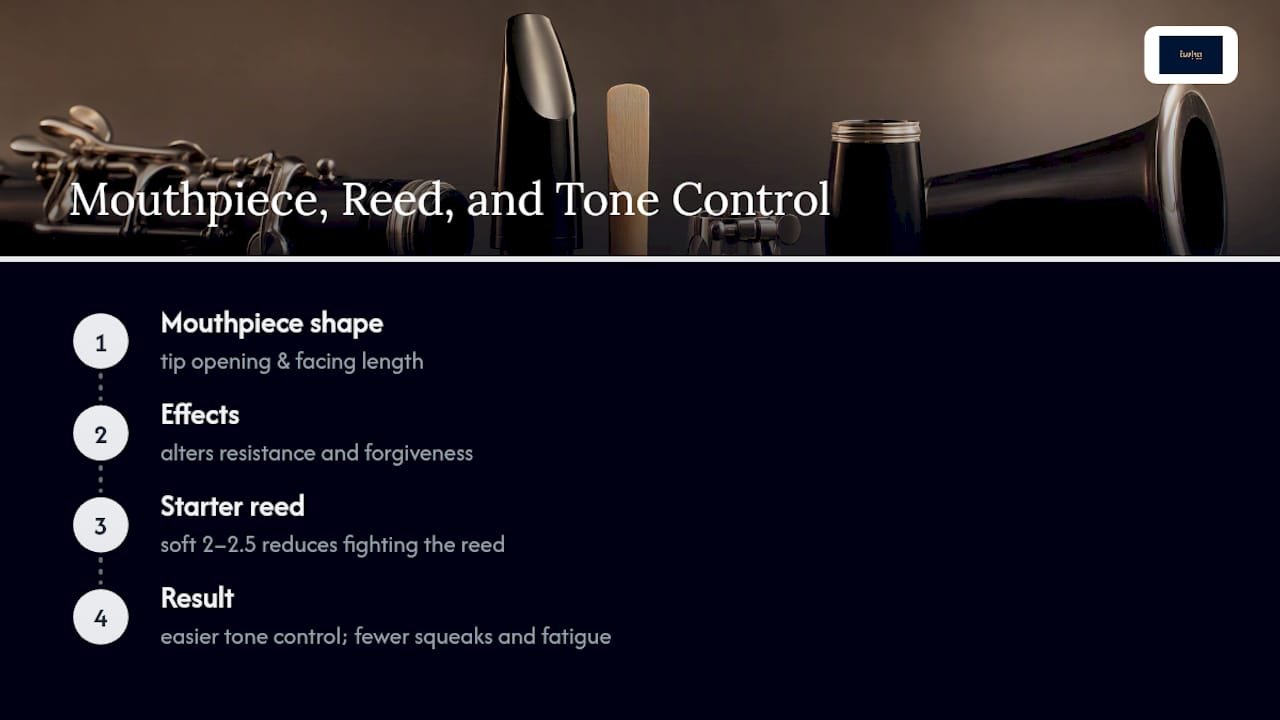
On reed strength, start soft. A strength of 2 to 2.5 gives you enough resistance to build embouchure strength without fighting the reed on every note. Jumping to a stiffer reed too early is one of the most common beginner mistakes, and it usually shows up as fatigue and squeaking that seems to have no obvious cause. Our beginner reed guide walks through strength progression in more detail.
Instrument condition matters just as much as technique. Sticky pads, misaligned tenons, or a register key that isn’t seated correctly can make an otherwise well-played note squeak or crack for reasons that have nothing to do with your embouchure. Addressing these mechanical issues removes a barrier that no amount of practice will fix on its own.
For smaller hands, an adjustable thumb rest and a neck strap that takes weight off the right thumb make a real ergonomic difference. Check reed strength, mouthpiece fit, and basic mechanical condition before buying anything else.
What Milos Has Learned Fitting Beginners With Mouthpieces
The biggest variable we see isn’t talent, it’s equipment consistency. Two beginners with identical practice habits can have completely different squeak phases depending on whether their mouthpiece and reed are actually matched to their embouchure. A precision manufactured mouthpiece removes one entire category of guesswork from that equation.
Cheap or worn mouthpieces introduce inconsistency exactly when a beginner needs a stable baseline to build technique against. Equipment variability is a hidden cost that many new players never think to question, they just assume the struggle is normal.
That’s the logic behind the Test Box program: rather than guessing, you try up to five mouthpieces at home against your own embouchure and reeds before committing.
Physical Factors: Hand Size, Breath Control, and More
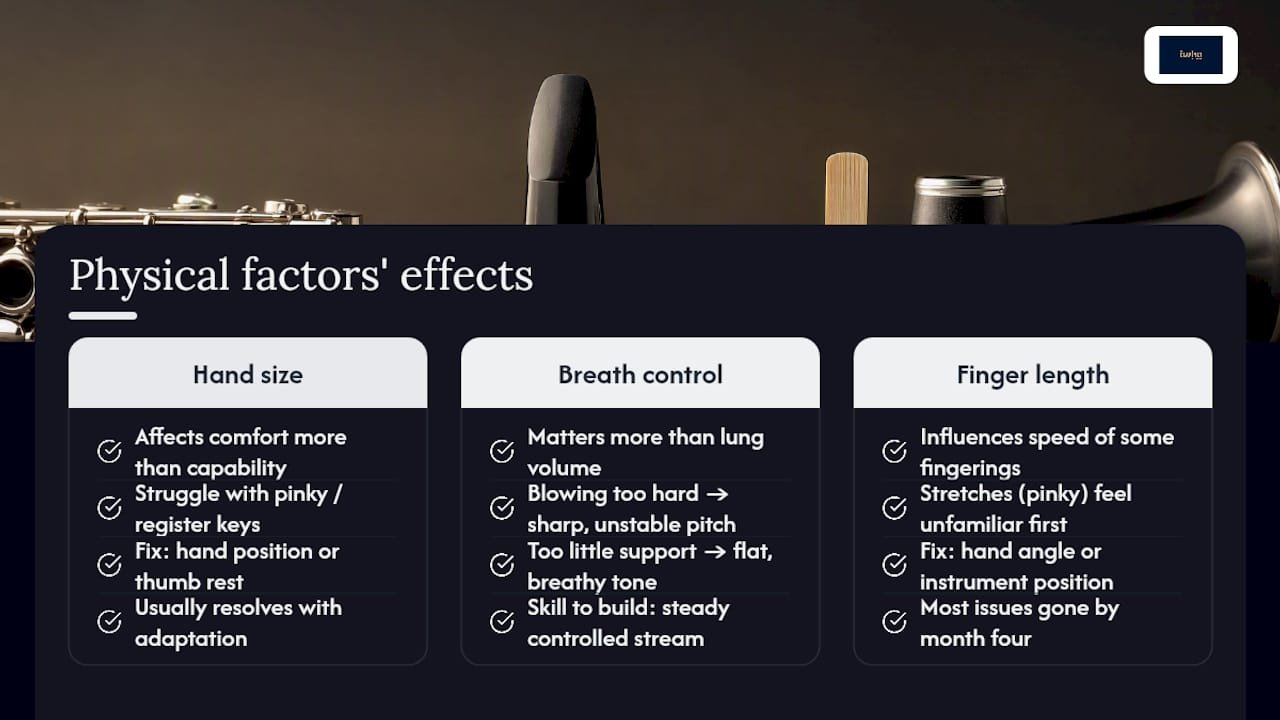
Hand size affects comfort more than it affects capability. Smaller hands sometimes struggle to reach the pinky keys or the register key cleanly, but this is almost always solvable with hand position adjustments and, occasionally, a different thumb rest, not a sign that clarinet is the wrong instrument. Stretching between the right hand’s E/F and F-sharp keys trips up a lot of beginners regardless of hand size, simply because it’s an unfamiliar motion.
Breath control matters more than raw lung capacity. The clarinet doesn’t require huge volumes of air the way brass instruments do, it requires a steady, controlled stream at consistent pressure. Beginners who blow too hard, thinking more air equals a better sound, often produce sharper, more unstable pitches and tire out their embouchure faster. Beginners who don’t support the air stream enough get a flat, breathy tone that squeaks under pressure. The skill to build is control, not force.
Finger length and flexibility have some influence on how quickly certain fingerings feel natural, particularly stretches involving the pinky keys, but they rarely create a permanent ceiling. Most physical limitations that feel significant in month one become non issues by month four, once the relevant muscles and joints adapt to the specific movements the instrument demands. If a stretch genuinely feels impossible rather than just unfamiliar, that’s worth mentioning to a teacher, since a small adjustment in hand angle or instrument position often solves it.
How Instrument Quality and Condition Change the Learning Curve
A poorly maintained clarinet can make a correct embouchure sound wrong, which is one of the most demoralizing experiences a beginner can have. Leaky pads mean your fingers can be doing everything right while the instrument still fails to produce a clean note, and there’s no way to diagnose that without knowing to check the mechanism itself.
Tenon corks that are too loose or too tight throw off the alignment between joints, which affects tone and can even change pitch center slightly. A register key that’s misadjusted turns the already tricky break into a much bigger obstacle than it needs to be, since a chunk of the “why does this note crack” experience is actually a maintenance issue rather than a technique issue.
Rental instruments and older student horns are notorious for developing these small mechanical problems, especially if they’ve passed through several previous students without a proper service. Before assuming a persistent squeak is your fault, it’s worth having a technician check pad seating, tenon fit, and key alignment. A quick service appointment can eliminate weeks of frustrated troubleshooting that had nothing to do with your playing.
Posture and Hand Position for Comfortable Play
Sit or stand with your spine reasonably straight and your shoulders relaxed, not pulled back in a rigid military posture. Tension in the shoulders travels down into the arms and hands, which stiffens the exact muscles you need to stay loose for fast, accurate fingering.
Hold the clarinet at roughly a 30 to 40 degree angle from your body, close enough to your chest that your head doesn’t have to tilt down to meet the mouthpiece. Craning your neck downward for extended periods creates fatigue that has nothing to do with your musical skill and everything to do with poor ergonomics.
Your left hand sits above your right on the instrument, with curved fingers resting lightly over the tone holes rather than pressing flat. Flat fingers seal tone holes less completely and make quick transitions between notes noticeably slower. The right thumb supports the weight of the instrument from underneath the thumb rest, while a neck strap can take pressure off that thumb during longer sessions, which matters more than beginners expect once they’re practicing daily.
Overcoming Finger Stretching and Coordination Challenges
The stretch between the right hand’s ring finger and pinky, needed for several common fingerings, catches almost every beginner off guard. It feels awkward at first because the hand simply hasn’t built the specific flexibility and independence that motion requires.
Isolated finger exercises away from the instrument help. Simple stretches, and slow, deliberate practice of just the problem fingering pattern at a tempo well below performance speed, build the coordination faster than trying to power through it at full speed. Repetition at a manageable pace teaches the hand the movement; rushing it just reinforces the tension that makes the stretch feel harder than it is.
Patience matters here more than most other technical areas, because finger flexibility genuinely does improve with consistent, moderate practice. A stretch that feels impossible in week two is often comfortable by week eight, purely because the tendons and small hand muscles have adapted. If a specific fingering still feels physically wrong after weeks of practice, a teacher can usually spot a hand position issue that’s making the stretch harder than it needs to be.
Why the Clarinet Feels Harder Than It Actually Is
Perceived difficulty and actual difficulty often diverge on clarinet, and that gap causes more dropouts than the instrument’s real technical demands. A beginner who squeaks constantly in week three assumes they’re uniquely bad at this, when in reality nearly every clarinetist who has ever played goes through the same phase.
Comparing yourself to how a flute or guitar beginner sounds after the same three weeks is a trap. Different instruments front-load their difficulty in different places, and clarinet happens to put its hardest wall right at the very beginning, which makes early progress feel slower than it actually is relative to the whole learning arc.
Motivation tends to hold up best when practice goals are framed around process rather than sound quality alone: five minutes of long tones, one clean run of a scale, one attempt at crossing the break. Judging yourself purely on whether today’s practice “sounded good” sets up a discouraging measure during exactly the phase when sounding good isn’t realistic yet.
Selecting Beginner Reeds and Mouthpieces That Actually Help
Reed strength is the single most common equipment mistake among new clarinetists. Starting at 2 or 2.5 gives enough resistance to develop embouchure strength without forcing you to fight the reed on every note, and our reed selection guide breaks down how to judge when you’re ready to move up a strength.
Mouthpiece choice matters just as much, and it’s the piece most beginners think about least. A mouthpiece with a moderate tip opening and facing length gives more forgiving response than the tighter, more advanced setups some student instruments ship with by default. Our mouthpiece guide for beginners covers what to look for and what tends to cause trouble.
Reed and mouthpiece need to work together, not just individually. A reed that’s perfect on one mouthpiece can feel completely wrong on another, which is why so many beginners blame themselves for problems that are actually a mismatch. Checking reed compatibility against your specific mouthpiece before assuming your technique is at fault saves weeks of unnecessary frustration.
What Actually Helped One Beginner Get Past the Wall
A student I worked with squeaked through most month one, then committed to fifteen minutes of long tones daily and switched to a softer reed matched through a test box. By month three she was playing simple ensemble parts. Setbacks are normal. The right support just speeds you past them.
— Milos
Try the Test Box Before You Guess at a Mouthpiece
Most of the early struggle on clarinet traces back to one thing: a mouthpiece and reed combination that doesn’t match your embouchure yet, and no way to know that without trying alternatives. A Test Box service offers a way to try multiple synthetic mouthpieces at home against your own reeds and embouchure, then keep the one that produces the best tone.

Some synthetic mouthpieces are manufactured with high precision to provide consistent specifications, reducing variability compared to traditional hard rubber mouthpieces. That consistency matters most in exactly the phase this article covers: the first three months, when you need to know that a squeak is about your technique and not about a warped tip rail. If you’re past the worst of the squeak phase and ready to stop guessing at equipment, start with the Mouthpiece Matchmaker or go straight to the Test Box variety pack and find the setup that fits your embouchure now.
Sources
- Is Clarinet Hard to Learn? An Honest Beginner’s Guide | TuneLark
- Is Clarinet Hard to Learn for Beginners? | Sydney Music Lessons
- Classical-music