


TL;DR:
- The bass clarinet plays a unique role in modern composition with its deep sound and expressive range. It is used in solo, chamber, jazz, electronic, and theatrical contexts, often emphasizing storytelling and interpretive agency. Its techniques, such as multiphonics and microtones, expand expressive possibilities and demand specialized equipment for optimal performance.
The bass clarinet is defined by its ability to occupy sonic territory no other woodwind can claim: a dark, resonant low register paired with an expressive upper range that composers increasingly treat as a narrative voice. Bass clarinet contemporary music uses now span solo concertos, experimental notation, jazz fusion, and electronic collaboration, making it one of the most versatile instruments in modern composition. Performers and composers who understand its full range of applications gain a real creative advantage, whether they are writing new works, programming concerts, or developing students through challenging repertoire.
1. Bass clarinet contemporary music uses: solo concertos
Modern composers write large-scale bass clarinet concertos that prioritize orchestral balance over solo dominance. This approach, sometimes called quasi-symphonic integration, treats the soloist as a character woven into the orchestral fabric rather than a voice competing against it. Works by composers such as Joseph Phibbs, Tobias Dafgard, and Michael Gordon illustrate how this model produces music of genuine dramatic weight. The bass clarinet does not simply display virtuosity. It tells a story alongside the orchestra.
2. Orchestral “windows” and narrative roles
Contemporary composers create orchestral windows that allow the bass clarinet to emerge as a character rather than a conventional soloist. These are structural moments in the score where the texture clears and the instrument steps forward with a distinct voice. This technique gives the bass clarinet a narrative function, one closer to a protagonist in a drama than a featured player in a concerto. Educators can use recordings of these works to teach students about musical storytelling and ensemble listening.
3. Multiphonics and extended harmonic color
Researchers have cataloged at least 201 multiphonic partials from 40 fingerings to assist composers in selecting harmonic colors for bass clarinet. That catalog gives composers a concrete toolkit for writing textures that would have been considered unplayable a generation ago. Multiphonics, the technique of producing two or more pitches simultaneously from a single instrument, are now a standard expectation in contemporary compositions for bass clarinet. Performers who master even a portion of these fingerings gain access to a genuinely new expressive vocabulary.
Pro Tip: When learning multiphonics, start with fingerings that share the most partials with neighboring fingerings. Visual maps linking related fingerings make the learning curve far less steep.
4. Non-linear and graphic notation
Bil Smith’s contemporary bass clarinet score employs non-linear notation that encourages interpretive agency, merging visual art with performance. This score-object approach abandons traditional left-to-right reading and asks the performer to make active decisions about sequence and duration. The result is a piece that changes with every performance. For educators, this kind of work teaches students that notation is a tool, not a law, and that their interpretive choices carry real musical weight.
5. Quarter-tones and microtonal writing
Quarter-tone passages appear with growing frequency in contemporary bass clarinet parts, requiring performers to command fingerings that fall between standard pitches. These microtonal inflections give composers access to a pitch vocabulary that standard Western notation cannot fully represent. The bass clarinet’s long tube and flexible embouchure make it well suited to microtonal work, though the specific fingerings vary by instrument model. Composers writing quarter-tone passages should consult performer-specific fingering guides rather than assuming universal applicability.
6. Chamber music and mixed ensembles
The role of bass clarinet in ensembles has expanded well beyond the wind band. Chamber groups now regularly feature the instrument alongside strings, piano, and electronics, exploiting its ability to blend with low strings while cutting through mid-range textures. Works written for bass clarinet and string quartet, for example, use the instrument’s dark tone to substitute for a second cello or to provide a bass voice that is more agile than any bowed instrument. This flexibility makes it a composer’s first choice when a low woodwind voice is needed in an intimate setting.
7. Jazz fusion and improvisation
Bass clarinet in jazz music carries a lineage that runs from Eric Dolphy’s free jazz explorations through modern fusion ensembles. Contemporary jazz composers write for the instrument’s ability to move between a warm, woody low register and a piercing, reedy upper range within a single phrase. In fusion contexts, the bass clarinet often takes the role that a baritone saxophone might fill, providing harmonic depth while retaining the agility to solo. Its sound sits differently in a mix than brass or guitar, giving arrangers a genuinely distinct color.
8. Electronic music and live processing
Bass clarinet pairs naturally with live electronics because its complex overtone structure responds well to processing. Composers working in electroacoustic music use the instrument’s sound as raw material for real-time manipulation, feeding it through delay, pitch-shifting, and spectral processing to create textures that blur the line between acoustic and synthetic. The performer’s role in these contexts extends beyond playing notes. They become a co-author of the electronic texture, making decisions about dynamics and articulation that shape the processed output. This is one of the fastest-growing areas of contemporary bass clarinet writing.
9. Theatrical and interdisciplinary performance
Contemporary bass clarinet music distinguishes theatrical expressive approaches from poised symphonic tones, requiring conscious interpretive decisions from performers. In theatrical contexts, the instrument may be combined with movement, spoken text, or visual projection. These interdisciplinary works ask performers to function as actors as much as musicians. The bass clarinet’s physical size and distinctive sound make it a compelling stage presence, and composers writing for theater increasingly treat it as a character prop as much as an instrument.
10. Pedagogical repertoire and student development
Performing complex contemporary works forces mastery of challenging expressive techniques, and works by David Maslanka exemplify the educational value of this approach. Maslanka’s writing demands dynamic control across the full range, large interval leaps, and sustained breath management, all of which build foundational skills that transfer to any repertoire. Educators who assign contemporary works rather than exclusively standard etudes report faster development of expressive range in their students. The difficulty is the point.
Extended techniques compared: what composers and performers need to know
Understanding how different techniques behave across instruments is critical for composers writing new works. Bass clarinet technique execution varies significantly across major brands such as Leblanc, Selmer, and Eppelsheim, which means a fingering chart written for one instrument may not transfer cleanly to another. Composers should always work directly with a performer on their specific instrument before finalizing extended technique passages.
| Technique | What it does | Composer consideration | Performer challenge |
|---|---|---|---|
| Multiphonics | Produces two or more simultaneous pitches | Specify fingering, not just pitch | Varies by instrument model |
| Quarter-tones | Pitches between standard semitones | Use microtonal notation clearly | Requires alternate fingerings |
| Altissimo register | Notes above standard upper range | Mark with extended range notation | Demands embouchure precision |
| Slap tongue | Percussive attack with tongue | Notate with standard symbol | Fatigues embouchure quickly |
| Circular breathing | Continuous tone without pause | Mark duration expectations | Requires dedicated practice |
Contemporary composers also use timbre descriptors and pitch-class detection to navigate multiphonic writing, moving beyond traditional notation constraints. This approach gives performers more useful information than a simple fingering number. It tells them what the sound should feel like, not just what keys to press.
Pro Tip: When writing extended techniques for bass clarinet, always include a performance note specifying the instrument model the part was tested on. This saves performers significant preparation time.
What challenges and opportunities do contemporary bass clarinet performers face?
Modern concertos demand that bass clarinetists blend soloist virtuosity with orchestral poise, balancing theatricality with symphonic tone. That dual demand is the defining challenge of the contemporary repertoire. Performers must make conscious choices about when to project and when to recede, a skill that takes years to develop.
The most common technical demands in contemporary bass clarinet writing include:
- Large interval leaps across two or more octaves within a single phrase, requiring precise air support and embouchure flexibility
- Dynamic control from near-silence to full projection, often within a few measures
- Advanced multiphonic fingerings that differ by instrument brand and require individual testing
- Circular breathing for sustained electronic or drone-based passages
- Theatrical physicality in interdisciplinary works, where movement affects tone production
Pedagogical approaches use contemporary works for bass clarinet to develop advanced expression and technical command among students. The opportunity embedded in these challenges is real. A student who works through a demanding contemporary piece develops skills that no etude book fully replicates.
What genres and ensembles are driving the bass clarinet’s role today?
The bass clarinet’s growing presence in modern music reflects demand from several distinct musical communities. Each genre uses the instrument differently, and understanding those differences helps composers tailor their writing.
- Contemporary classical ensembles use the bass clarinet as both a harmonic anchor and a solo voice, often in works that blend acoustic and electronic elements
- Chamber music groups favor it for its ability to blend with strings and piano while providing a low voice more agile than a cello
- Jazz fusion bands deploy it for harmonic depth and timbral contrast, particularly in arrangements that avoid standard rhythm-section instruments
- Experimental and electroacoustic ensembles treat the instrument as a sound source for live processing, prioritizing overtone complexity over melodic clarity
- Wind bands and new music orchestras commission works that push the instrument’s range and technique, creating a growing body of repertoire for educational programs
The influence of bass clarinet in pop and crossover contexts is smaller but growing, particularly in studio recording where its distinctive low-register color adds depth that synthesizers rarely replicate convincingly.
Key Takeaways
The bass clarinet’s contemporary value lies in its range of techniques and narrative roles, making it one of the most compositionally flexible instruments in modern music.
| Point | Details |
|---|---|
| Multiphonics are now standard | Over 201 partials from 40 fingerings give composers a concrete harmonic toolkit. |
| Notation is evolving fast | Non-linear and graphic scores shift the performer into an active interpretive role. |
| Technique varies by instrument | Fingering charts must be tested on the specific instrument model being used. |
| Pedagogy benefits from modern works | David Maslanka’s repertoire builds dynamic control and expressive range in students. |
| Genre reach is broad | Jazz, electroacoustic, chamber, and theatrical contexts all drive contemporary demand. |
The bass clarinet deserves more compositional attention than it gets
I have spent years watching composers reach for the bass clarinet as a last resort, a way to fill out a low register when nothing else fits. That instinct undersells the instrument badly. The bass clarinet is not a substitute for anything. It has a character that no other woodwind replicates, and the contemporary repertoire is finally starting to reflect that.
What strikes me most about the current generation of writing for the instrument is how seriously composers are taking the performer’s interpretive agency. The shift from instructive to interpretive notation is not just a stylistic trend. It reflects a genuine change in the relationship between composer and performer. Works like Bil Smith’s score-object pieces ask the performer to be a co-author, and that is a fundamentally different artistic proposition than playing a Brahms sonata.
For educators, the practical implication is clear. Assigning contemporary bass clarinet works is not just about expanding repertoire. It builds a different kind of musician, one who reads sound as well as notes. I have seen students transform their relationship with the instrument through a single challenging contemporary piece. That is not an accident. It is what good compositional writing does.
If you are a composer who has not yet written for bass clarinet, the research on multiphonics alone should convince you. The instrument’s harmonic possibilities are genuinely underexplored. Start there.
— Milos
Gear that keeps up with contemporary bass clarinet demands
Contemporary bass clarinet playing puts real demands on your equipment. Extended techniques, wide dynamic ranges, and long rehearsal sessions all expose weaknesses in a mouthpiece that was designed for a narrower range of expression.
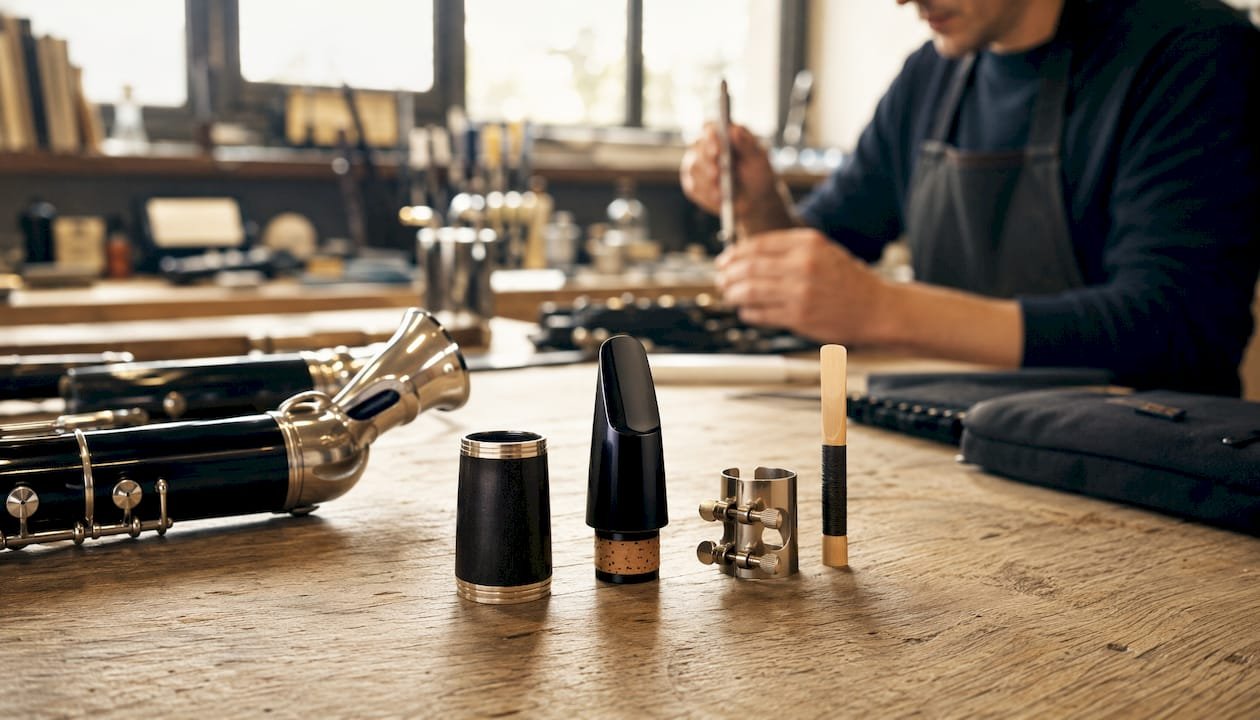

Myclarinetstuff carries the Gleichweit 22-3 bass clarinet mouthpiece, a precision CNC-crafted synthetic mouthpiece made in Austria that delivers consistent projection and tonal clarity across the full range. Unlike traditional hard rubber, the synthetic material holds its geometry through temperature changes and heavy use, which matters when you are performing multiphonics or pushing the altissimo register. Use the mouthpiece matchmaker tool on the Myclarinetstuff site to find the right fit for your playing style and the repertoire you are working on.
FAQ
What is the bass clarinet most used for in contemporary music?
The bass clarinet is most used in contemporary music for solo concertos, chamber music, electroacoustic performance, and extended technique writing including multiphonics and quarter-tones. Modern composers increasingly assign it narrative roles within orchestral textures rather than treating it as a conventional soloist.
How does multiphonic technique work on bass clarinet?
Multiphonics on bass clarinet involve specific fingerings that cause the instrument to produce two or more pitches simultaneously. Researchers have mapped at least 201 multiphonic partials from 40 fingerings, giving composers a detailed toolkit for harmonic color selection.
Do bass clarinet fingerings work the same across all instrument brands?
Bass clarinet technique execution varies significantly across major brands, meaning multiphonic and quarter-tone fingerings must be tested on the specific instrument model being used. A fingering chart written for one manufacturer does not reliably transfer to another.
How is the bass clarinet used in jazz music?
The bass clarinet in jazz music provides harmonic depth and timbral contrast, filling a role similar to a baritone saxophone but with a distinctly woody, agile character. Contemporary jazz composers use it for both harmonic support and solo improvisation across a wide dynamic range.
Can contemporary bass clarinet repertoire help students develop faster?
Pedagogical approaches using contemporary works for bass clarinet, particularly pieces by David Maslanka, develop advanced expression and technical command more effectively than standard etudes alone. The technical demands of modern repertoire build dynamic control, interval accuracy, and expressive range simultaneously.