
Over 1.4 million american students take up a band instrument each year, yet many struggle to find a clarinet that truly fits their needs. Choosing the right clarinet is about more than brand names or price tags. Your skill level, musical style, and future goals all shape what makes an instrument feel right in your hands. This guide walks you through every critical step so you can make a confident, informed choice and discover a clarinet that matches your potential.
Table of Contents
- Step 1: Assess Your Clarinet Goals and Playing Style
- Step 2: Compare Clarinet Types and Key Custom Features
- Step 3: Evaluate Instruments Using In-Store or Trial Options
- Step 4: Test Compatibility with Mouthpieces and Accessories
- Step 5: Verify Quality and Confirm Your Clarinet Choice
Quick Summary
| Key Insight | Explanation |
|---|---|
| 1. Define your clarinet goals first | Assess your skill level and musical aspirations to find the right instrument that supports your growth. |
| 2. Test multiple clarinet types | Explore various clarinet types and their unique features to determine which best suits your playing style. |
| 3. Trial instruments in different settings | Experiment with playing to evaluate comfort, intonation, and sound before making a final decision. |
| 4. Experiment with mouthpieces | Test different mouthpieces to find what complements your style and enhances your sound quality effectively. |
| 5. Seek feedback and verify quality | Consult experienced musicians and utilize trial periods to ensure your chosen clarinet meets your expectations. |
Step 1: Assess Your Clarinet Goals and Playing Style
Choosing the right clarinet starts with understanding your musical objectives and personal playing approach. According to Northern Illinois University, your physical technique and mental focus are critical foundations for achieving your desired sound quality and performance outcomes.
Begin by honestly evaluating your skill level and musical aspirations. Are you a beginner seeking an instrument for learning, an intermediate player looking to upgrade, or an advanced musician requiring a professional performance tool? Different playing styles demand specific clarinet characteristics. Classical musicians might prioritize precision and tonal purity, while jazz players could seek more flexibility and expressive range. Clarinet Association recommends developing versatility through consistent practice of scales, etudes, and varied musical pieces.
Pro tip: Don’t just consider your current skill level but also your potential growth. A quality instrument that allows room for development can save you money and frustration in the long run. Select an instrument that challenges you slightly beyond your current abilities while remaining comfortable and inspiring to play. This balanced approach ensures your clarinet will support your musical journey as you progress and refine your skills.
Step 2: Compare Clarinet Types and Key Custom Features
Understanding the nuanced differences between clarinet types is crucial for selecting your ideal instrument. International Clarinet Association highlights that each clarinet variant offers unique characteristics tailored to specific musical needs, from the standard Bb clarinet to specialized instruments like A, E flat, and bass clarinets.
Your selection process should focus on examining key technical specifications and performance capabilities. Woodwind Fingering Guide emphasizes that different fingering systems like Boehm, Oehler, and Albert significantly impact playability and sound production. Pay close attention to key configurations, material quality, and bore design. Consider factors such as tonal characteristics ideal for your preferred musical genre whether classical, jazz, orchestral, or chamber music.
Pro tip: Don’t just compare technical specifications. Test multiple instruments if possible to understand how their unique features translate into actual playing experience. A clarinet that looks perfect on paper might feel completely different when you hold it. Ultimately, the right instrument should feel like a natural extension of your musical expression, offering both comfort and the ability to grow with your developing skills.
Step 3: Evaluate Instruments Using In-Store or Trial Options
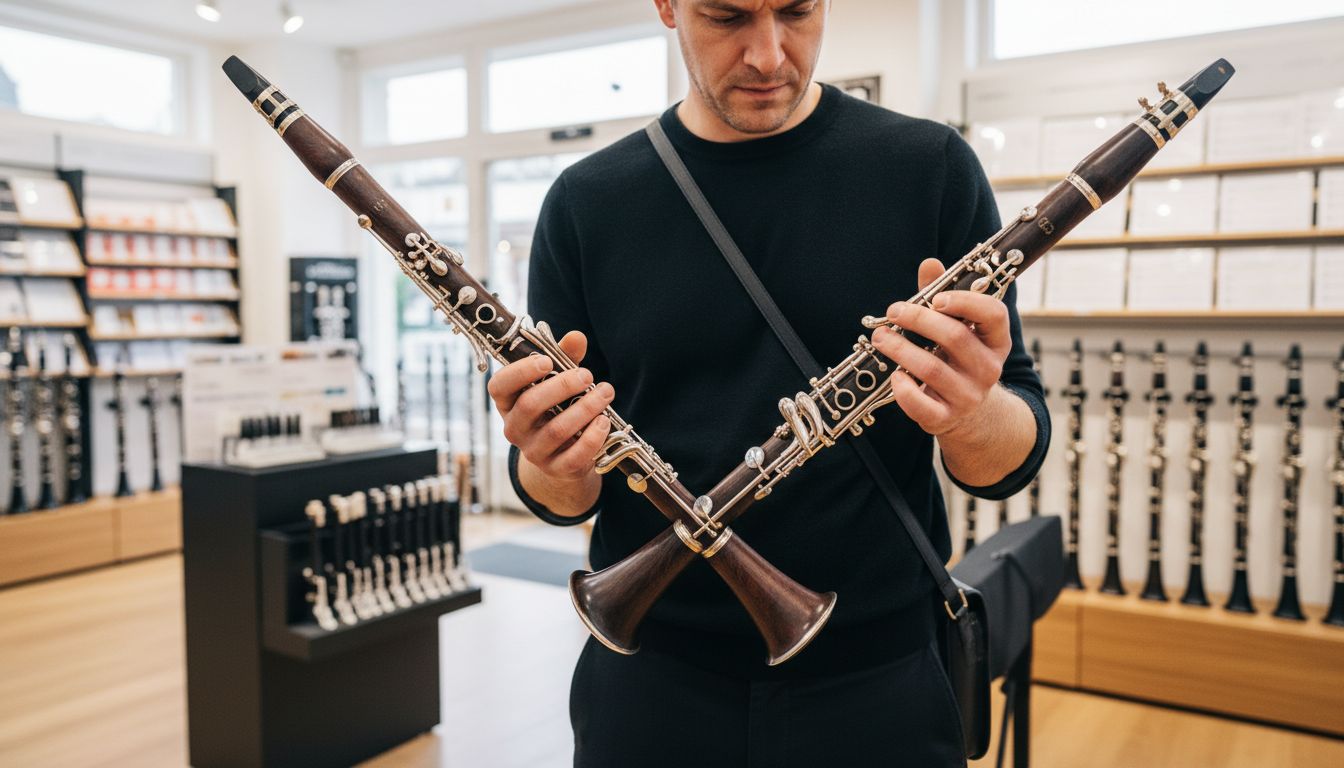
Trialing clarinets is a critical step in finding your perfect instrument. International Clarinet Association recommends comprehensive testing in various settings, consulting with professional musicians to assess sound quality and intonation before making a final decision.
When evaluating instruments, pay attention to multiple performance aspects beyond initial sound. Clarinet Association suggests experimenting with different instruments to find one that provides ease of play and optimal tone production. Focus on how the clarinet feels during extended playing sessions. Check the instrument’s response across different registers, test key mechanisms for smooth action, and evaluate the overall comfort of your embouchure and hand positioning.
Pro tip: Schedule multiple trial sessions if possible. Your perception of an instrument can change with repeated playing. Bring along sheet music that challenges different technical aspects of playing. Record yourself to objectively analyze tone quality, and if feasible, ask an experienced musician or instructor to listen and provide feedback. Remember that the right clarinet should feel like a natural extension of your musical expression an instrument that inspires you to practice and grow as a musician.
Step 4: Test Compatibility with Mouthpieces and Accessories
Selecting the right mouthpiece is crucial for achieving your desired musical expression. International Clarinet Association emphasizes that players should experiment with various mouthpieces to find one that perfectly complements their unique embouchure and playing style.
Start by understanding how different accessories interact with your instrument. Clarinet Association recommends testing multiple combinations to identify the most suitable setup that enhances both comfort and sound quality. Pay close attention to how each mouthpiece affects your articulation, tone production, and overall playing experience. Consider factors like tip opening, material composition, and design characteristics that might impact your sound.
Pro tip: When testing mouthpieces, bring your current instrument and try accessories under consistent playing conditions. Record yourself to objectively compare subtle differences in tone and response. Remember that compatibility is highly personal small changes in mouthpiece design can dramatically transform your musical voice. Take your time, be patient, and trust your ears to guide you toward the perfect combination that feels like an extension of your musical personality.
Step 5: Verify Quality and Confirm Your Clarinet Choice
International Clarinet Association recommends a comprehensive evaluation process to ensure your chosen clarinet meets the highest performance standards. Thoroughly test the instrument across multiple dimensions beyond initial impressions, examining its sound quality, intonation, and overall comfort during extended playing sessions.
Clarinet Association emphasizes the importance of assessing the instrument’s response across different musical registers and its alignment with your technical and artistic goals. Conduct a systematic review by playing scales, challenging passages, and exploring the full range of the instrument. Pay attention to key mechanisms, evaluate the consistency of tone production, and assess how smoothly the clarinet responds to your playing technique.
Pro tip: Seek feedback from experienced musicians or instructors who can provide an objective perspective. Request a trial period if possible, which allows you to test the instrument in various performance settings. Remember that selecting a clarinet is a deeply personal journey your perfect instrument should not just meet technical requirements but also inspire your musical expression and feel like a natural extension of your artistic voice.
Find Your Perfect Clarinet Sound with Expert Accessories
Choosing the right clarinet is a personal journey that requires balancing your musical goals with the ideal instrument features. The article highlights common challenges such as evaluating mouthpiece compatibility, refining tone quality, and ensuring comfort during extended play. If you want to enhance your playing experience and support your growth as a clarinetist, selecting premium accessories crafted to match your unique style is essential.

Explore My Clarinet Stuff for a curated selection of professional-grade mouthpieces, barrels, and custom components designed to elevate your sound with craftsmanship rooted in the Viennese tradition. Whether you need personalized consultations to find the perfect mouthpiece or want to try accessory combos that best complement your instrument, now is the time to invest in gear that inspires and challenges you. Visit us today to discover how the right clarinet accessories can transform your musical expression and bring your perfect instrument one step closer.
Frequently Asked Questions
How do I know which clarinet is best for my skill level?
Choosing a clarinet that matches your skill level involves honestly assessing your current abilities and musical goals. Beginners should look for instruments that are comfortable and easy to play, while intermediate and advanced players may seek higher-quality options that support more technical growth. Evaluate your needs carefully to select an appropriate instrument.
What features should I consider when comparing different clarinet types?
When comparing clarinet types, focus on key specifications, such as fingering systems, key configurations, and material quality. Each type, whether Bb, A, or bass clarinet, offers unique tonal characteristics suited for specific musical styles. Prioritize the features that align with your preferred genre to enhance your playing experience.
How can I effectively trial a clarinet before making a purchase?
To effectively trial a clarinet, test it in various settings and pay attention to sound quality and playability. Schedule multiple sessions to gauge your comfort and assess how the clarinet feels during extended playing. Bring music that challenges your skills to see how the instrument performs under pressure.
Why is selecting the right mouthpiece crucial for my clarinet?
Selecting the right mouthpiece is essential because it dramatically influences your tone production and overall playing experience. Experiment with different mouthpieces to find one that complements your embouchure and playing style. Allocate time to try various combinations to discover which setup enhances your sound quality the most.
What should I check to verify the quality of my chosen clarinet?
To verify the quality of your chosen clarinet, conduct a thorough evaluation of its sound quality, intonation, and comfort during play. Test the instrument across various registers and play challenging passages to assess its responsiveness. Seek feedback from experienced musicians to gain additional insights into its performance.
How can I ensure my clarinet will grow with my skills?
To ensure your clarinet will grow with your skills, select an instrument that presents slightly more of a challenge than your current ability. This approach encourages improvement while remaining comfortable to play. Choose a clarinet that inspires you and aligns with your long-term musical aspirations.