


Many clarinetists assume synthetic mouthpieces deliver inferior tone compared to traditional hard rubber models. Research reveals precision-crafted synthetics match tonal quality by 92% in blind listening tests. This guide explores how mouthpiece materials, design features, and manufacturing precision shape your sound, helping students and educators make informed equipment choices.
Table of Contents
- Understanding The Clarinet Mouthpiece: Definition And Role
- Materials And Manufacturing: Hard Rubber Vs. Synthetic Cnc-Crafted Mouthpieces
- How Mouthpiece Design Influences Tone, Projection, And Playability
- Common Misconceptions About Clarinet Mouthpieces
- Choosing The Right Mouthpiece: Practical Advice For Students And Educators
- Bridging Understanding To Application: Benefits Of Gleichweit Precision-Crafted Mouthpieces
- Explore Precision-Crafted Clarinet Mouthpieces At My Clarinet Stuff
- Frequently Asked Questions
Key Takeaways
| Point | Details |
|---|---|
| Mouthpiece design and material define sound quality and playability | Construction choices directly impact tone color, projection strength, and articulation precision. |
| CNC-crafted synthetic mouthpieces provide superior consistency | Precision manufacturing reduces dimensional variance to less than 0.05mm compared to hand-finished hard rubber. |
| Design elements tailor performance to musical genres | Chamber shape, facing curve, and tip opening optimize performance for classical, jazz, or folk styles. |
| Material misconceptions mislead equipment decisions | Evidence-based selection prevents costly mistakes and accelerates skill development. |
| Educators favor synthetic mouthpieces for teaching reliability | Stable performance aids embouchure development and reduces frustration for developing players. |
Understanding the Clarinet Mouthpiece: Definition and Role
A clarinet mouthpiece serves as the interface between player and instrument, transforming breath into controlled sound vibrations. When you blow air across the reed attached to the mouthpiece, the mouthpiece directs airflow and initiates sound vibrations that resonate through the clarinet body. This small component significantly influences tone color, volume projection, and response speed.
The mouthpiece’s shape and material composition determine how efficiently it converts your air stream into acoustic energy. Different configurations produce brighter or darker tones, easier or harder articulation, and varied dynamic ranges. Understanding this relationship helps you match equipment to your musical goals.
Your embouchure adapts to the mouthpiece’s physical characteristics, making the right choice crucial for comfort and technique development. A well-designed mouthpiece reduces muscle fatigue and supports cleaner articulation. Poor matches create tension and limit tonal flexibility, especially impacting clarinet playability and mouthpiece impact for advancing students.
Key mouthpiece components include:
- Tip opening: Gap between reed and mouthpiece tip affecting air resistance
- Facing curve: Length and shape of the curved surface where reed contacts mouthpiece
- Chamber: Internal cavity that shapes tonal brightness and projection
- Bore: Opening connecting mouthpiece to barrel influencing pitch stability
Each element interacts to create your unique sound signature. Mastering these basics prepares you to evaluate material and manufacturing differences intelligently.
Materials and Manufacturing: Hard Rubber vs. Synthetic CNC-Crafted Mouthpieces
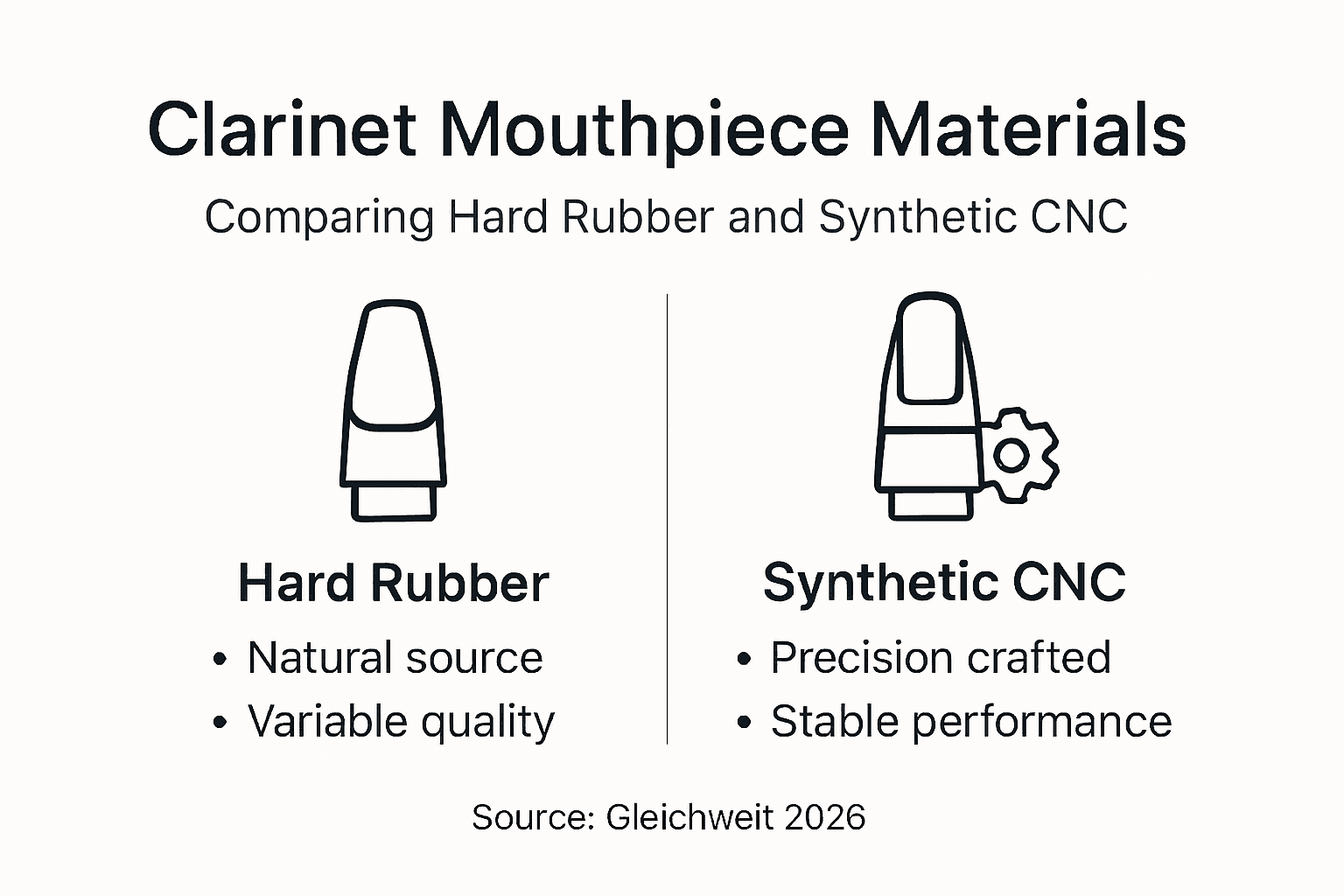
Traditional hard rubber mouthpieces dominated clarinet manufacturing for over a century. This natural material, derived from vulcanized rubber compounds, offers warm tonal qualities but suffers dimensional instability. Temperature and humidity changes cause rubber to expand or contract, altering facing curves and tip openings by measurable amounts. Hand-finishing processes introduce further variance between supposedly identical models.
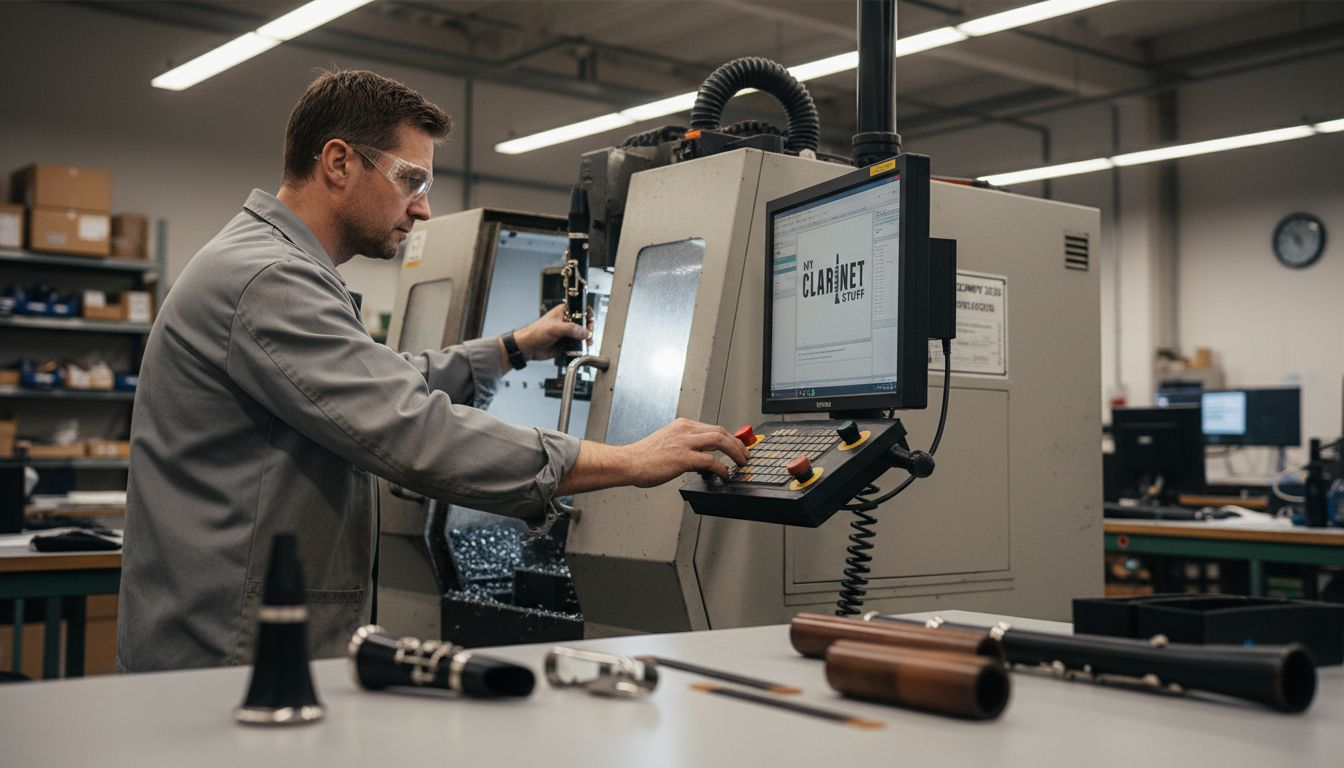
Modern synthetic materials eliminate these consistency problems. High-grade polymers maintain stable dimensions across temperature ranges from freezing to summer heat. Precision CNC crafting reduces dimensional variance to less than 0.05mm, vastly improving tonal clarity and consistency compared to hand-finished alternatives. This manufacturing precision means every mouthpiece from the same model performs identically.
CNC machining uses computer-controlled cutting tools to replicate exact specifications repeatedly. The process removes human error from critical dimensions like facing curve radius and tip rail thickness. You get predictable performance that matches your practice room experience during outdoor performances or different climate conditions.
Pro Tip: Choose CNC-crafted synthetic mouthpieces to eliminate equipment variability from your practice equation, letting you focus purely on technique refinement.
Material comparison:
| Feature | Hard Rubber | Synthetic CNC-Crafted |
|---|---|---|
| Dimensional Stability | Varies with temperature/humidity | Remains constant across conditions |
| Manufacturing Precision | Hand-finished, variable | CNC-machined to 0.05mm tolerance |
| Batch Consistency | Each piece differs slightly | Identical performance within model |
| Environmental Sensitivity | Requires climate adjustment | No adaptation needed |
| Tonal Clarity | Warm, slightly variable | Consistent, controlled projection |
Understanding mouthpiece material differences helps you prioritize reliability over tradition. Students especially benefit from equipment that performs consistently during lessons, rehearsals, and performances. The stability of synthetic materials parallels advances in other precision fields where material properties affecting stability drive quality improvements.
Consistency directly impacts embouchure development because muscle memory forms around predictable equipment response. When your mouthpiece behaves differently each week, you compensate with tension rather than developing efficient technique. Reliable equipment accelerates progress by providing stable feedback during skill acquisition.
Before committing to any mouthpiece, testing mouthpiece tone quality under realistic conditions reveals how materials perform in your specific playing environment.
How Mouthpiece Design Influences Tone, Projection, and Playability
Internal chamber geometry shapes acoustic output more than any other design element. Larger chambers produce darker, mellower tones with reduced edge, ideal for orchestral blend. Smaller chambers create brighter sounds with enhanced projection, favored in jazz and solo performance contexts. The chamber volume directly affects how sound waves resonate before entering the instrument bore.
Facing curve length controls articulation responsiveness and dynamic flexibility. Short facings respond quickly to tongue attacks, enabling rapid passages and crisp staccato. Longer facings offer smoother legato transitions and greater dynamic range but require more air support. Your choice depends on repertoire demands and personal playing style.
Tip opening size determines air resistance and genre suitability. Measured in millimeters or using numerical systems, openings range from close (1.0mm) to very open (1.8mm+). Jazz players often prefer larger openings for powerful projection and tonal flexibility. Classical players favor smaller openings providing focused tone and easier control in soft dynamics.
Pro Tip: Match mouthpiece design features to your primary playing style, but test slightly outside your comfort zone to discover hidden tonal possibilities.
Design feature impacts:
- Chamber volume: Determines tonal brightness and projection strength
- Facing curve length: Controls articulation speed and dynamic range
- Tip opening width: Affects air resistance and genre appropriateness
- Baffle presence: Adds edge and brilliance to tone when present
- Side rail thickness: Influences reed vibration patterns and response
Chamber shape, facing curve, and tip opening influence tonal brightness, articulation ease, and projection suitable for various genres. Advanced players often own multiple mouthpieces optimized for different musical contexts. A classical recital mouthpiece emphasizes blend and refinement, while a big band setup prioritizes cutting power and projection.
Genre-specific design preferences:
| Genre | Typical Tip Opening | Facing Length | Chamber Style |
|---|---|---|---|
| Classical Orchestra | 1.0mm to 1.2mm | Medium to Long | Round, Spacious |
| Jazz/Big Band | 1.4mm to 1.8mm | Short to Medium | Small, Baffled |
| Solo Recital | 1.1mm to 1.4mm | Medium | Balanced |
| Folk/Klezmer | 1.3mm to 1.6mm | Short | Compact |
Understanding these relationships helps you communicate preferences when seeking mouthpiece design and tone tips from experienced players or retailers. Design literacy transforms vague dissatisfaction into specific equipment adjustments.
Common Misconceptions About Clarinet Mouthpieces
Myth 1: Synthetic mouthpieces inherently produce inferior tone quality. Reality check reveals synthetic mouthpieces can equal or surpass hard rubber’s tonal clarity when precision-crafted. The 92% tonal similarity index in blind listening tests proves material matters less than manufacturing precision. Players often cannot distinguish materials in controlled listening conditions.
Myth 2: Harder materials automatically create better tone projection. Material hardness affects durability more than acoustic properties. Tonal characteristics result from internal geometry and facing precision, not surface hardness alone. Softer synthetics can project brilliantly when designed correctly, while hard materials sometimes dampen vibrations inefficiently.
Myth 3: Dimensional variability in hand-finished hard rubber mouthpieces remains negligible. Measurements reveal significant variance between nominally identical hard rubber models. Facing curve radii differ by 0.2mm or more, tip openings vary by 0.1mm, and internal chambers show machining irregularities. These differences create unpredictable performance across the same product line.
Accurate information prevents costly equipment mistakes that waste money and practice time. Students cycling through incompatible mouthpieces develop compensatory habits that limit long-term progress. Educators armed with facts guide students toward evidence-based choices supporting efficient skill development.
Precision engineering matters far more than raw material composition. A perfectly crafted synthetic mouthpiece outperforms an inconsistent hard rubber model every time, regardless of traditional preferences or marketing claims.
Manufacturing precision trumps material nostalgia in 2026. Modern clarinetists benefit from technological advances that earlier generations lacked. Embracing engineering improvements accelerates your musical development compared to limiting choices based on outdated assumptions.
Question equipment claims skeptically and demand measurable performance data. Marketing often emphasizes tradition over innovation, preserving profitable myths rather than serving player interests. Your ears provide the ultimate evidence, but understanding technical realities sharpens listening discrimination.
Choosing the Right Mouthpiece: Practical Advice for Students and Educators
Students benefit enormously from consistent synthetic mouthpieces providing stable tone guidance throughout skill development. Educators prefer synthetic mouthpieces for students to ensure consistency and aid embouchure development without climate-related performance drift. Reliable equipment removes variables that confuse technique refinement during critical learning phases.
Match tip opening sizes to both genre preferences and current skill level. Beginners need moderate openings (1.1mm to 1.3mm) balancing control with sufficient airflow. Intermediate players experiment within their primary genre range, while advanced musicians maintain multiple mouthpieces optimized for specific repertoire demands. Resist the temptation to play overly open or closed setups that fight your natural embouchure.
Consider embouchure development stages when selecting equipment. Young players building facial muscle coordination need forgiving mouthpieces that respond across wide dynamic ranges. Advanced students refining tone colors benefit from more specialized designs revealing subtle technique adjustments. Your mouthpiece should support current abilities while allowing room for growth.
Test mouthpieces in realistic playing conditions before purchasing. Try equipment during actual rehearsals or lessons, not just quick store visits. Evaluate articulation clarity, dynamic range, intonation stability, and endurance comfort across 20-30 minute sessions. Short tests miss fatigue factors and projection characteristics that emerge during extended playing.
Selection criteria:
- Material stability: Choose synthetics for environmental consistency
- Tip opening: Match to genre and skill level appropriately
- Facing length: Balance articulation speed with dynamic control needs
- Chamber design: Optimize tonal brightness for primary repertoire
- Manufacturing precision: Demand CNC-crafted accuracy over hand-finished variance
- Brand reputation: Research user reviews and educator recommendations
Seek experienced guidance from trusted teachers and professional players. They identify subtle compatibility issues between your natural tendencies and equipment characteristics. Their expertise accelerates your search by eliminating incompatible options early. Leverage resources like tips for choosing clarinet mouthpieces and comprehensive mouthpiece selection tips to build selection knowledge.
Understand important factors to choose mouthpieces by balancing technical specifications with personal comfort and musical goals. Equipment serves your artistic vision, not the reverse. Similarly, choosing the right equipment requires matching specifications to actual needs across any technical field.
Bridging Understanding to Application: Benefits of Gleichweit Precision-Crafted Mouthpieces
Gleichweit employs advanced CNC machining in Austria, delivering dimensional accuracy under 0.05mm and tonal clarity praised by players worldwide. This manufacturing precision eliminates the variability plaguing traditional mouthpieces, providing predictable performance across all playing conditions. Every Gleichweit model performs identically to its specifications, supporting consistent technique development.
Synthetic construction ensures stable performance whether you practice in heated studios, outdoor festivals, or air-conditioned concert halls. Temperature and humidity changes that compromise traditional mouthpieces leave Gleichweit models unaffected. You develop muscle memory around reliable equipment response rather than compensating for environmental drift.
Professional and student clarinetists rate Gleichweit highly for tonal clarity spanning classical warmth to jazz brilliance. The product line covers diverse genre requirements through scientifically optimized designs rather than marketing gimmicks. Each model targets specific playing styles with measurable acoustic characteristics.
Gleichweit advantages:
- Austrian CNC precision: Sub-0.05mm tolerance manufacturing
- Climate stability: Synthetic materials resist environmental changes
- Genre versatility: Models optimized for classical, jazz, and folk styles
- Educational value: Consistency aids student embouchure development
- Professional quality: Suitable for advanced players and educators
- Tonal reliability: Predictable projection and response characteristics
The brand supports students, educators, and professional clarinetists through thoughtfully designed equipment matching real performance needs. Explore Gleichweit mouthpiece features to understand how precision engineering translates into musical benefits. Compare options using the Mouthpiece Matchmaker tool for personalized recommendations matching your playing style.
Browse the comprehensive mouthpiece types list to discover models suited to specific techniques and genres. Modern manufacturing technology, similar to other precision manufacturing approaches, enables quality previously impossible through traditional methods. Gleichweit exemplifies how engineering advances serve musical artistry.
Explore Precision-Crafted Clarinet Mouthpieces at My Clarinet Stuff
Ready to experience how precision engineering enhances your clarinet performance? My Clarinet Stuff offers carefully curated mouthpieces supporting players from beginners through professionals.

Our Clarinet Mouthpiece Matchmaker tool analyzes your playing style, genre preferences, and skill level to recommend optimal equipment matches. Browse expert mouthpiece selection tips on My Clarinet Stuff explaining how design features affect your unique needs. Discover why clarinetists nationwide trust Gleichweit’s acclaimed synthetic mouthpieces manufactured to exacting Austrian standards. Learn more About Gleichweit mouthpieces and their precision crafting process. Visit our site today to find equipment that elevates your musical expression and eliminates frustrating inconsistency from your playing experience.
Frequently Asked Questions
What is a clarinet mouthpiece?
A clarinet mouthpiece is the tapered component attaching to the instrument’s barrel where you position the reed and apply your embouchure. It channels your breath across the reed, creating vibrations that generate sound waves traveling through the clarinet body. The mouthpiece’s internal geometry and material composition directly influence tonal color, projection strength, and articulation precision.
Why do material and design matter for tone quality?
Material stability ensures consistent dimensions across temperature and humidity changes, maintaining predictable acoustic properties. Design elements like chamber volume, facing curve, and tip opening shape how sound waves form and project, determining whether you produce bright jazz tones or warm orchestral colors. Precision manufacturing eliminates dimensional variance that creates unpredictable performance between supposedly identical models.
Who benefits most from synthetic mouthpieces?
Students developing embouchure coordination benefit enormously from synthetic mouthpieces providing stable, consistent response during skill acquisition. Educators prefer synthetics for teaching situations requiring reliable equipment that performs identically across varying practice environments. Professional players appreciate synthetics for outdoor performances and touring where climate changes would compromise traditional hard rubber models.
How should I start choosing a mouthpiece?
Begin by identifying your primary musical genre and current skill level to narrow appropriate tip opening and facing length ranges. Test mouthpieces during extended practice sessions evaluating articulation, dynamic range, and endurance comfort rather than quick store trials. Seek guidance from experienced teachers who can match equipment characteristics to your natural playing tendencies and developmental needs.
What advantages does CNC crafting provide?
CNC machining uses computer-controlled precision tools maintaining dimensional tolerances under 0.05mm, vastly superior to hand-finishing processes. This manufacturing accuracy produces identical performance across every mouthpiece within the same model, eliminating the variability lottery of traditional production methods. Consistent dimensions support efficient embouchure development by providing stable feedback as you refine technique.