


TL;DR:
- Optimizing clarinet airflow involves coordinating natural exhalation, high tongue position, and proper posture to produce a focused, resonant tone. Most players struggle with controlling their breath and tongue, but understanding their system improves tone, articulation, and endurance simultaneously. Consistent practice of breathing exercises, long tones, and tongue positioning ingrains these mechanics into daily routines for lasting tone enhancement.
Optimizing clarinet airflow is the practice of coordinating natural breath mechanics with precise tongue placement and posture to produce a focused, resonant tone with effortless control. Most players who struggle with thin, forced, or inconsistent sound are fighting their own breath rather than working with it. The International Clarinet Association and Band Director Media Group both confirm that the real gains come from understanding how your ribs, diaphragm, tongue, and embouchure work together as a system. Get that coordination right, and tone quality, articulation speed, and endurance all improve at once.
How to optimize clarinet airflow through natural breath coordination
The foundation of efficient clarinet playing is an unforced, complete exhale. According to expert Jeremy Ruth of the International Clarinet Association, allowing a natural exhale without pushing beyond residual lung volume is the single most important factor in improving airflow. Pushing air past that natural stopping point creates tension throughout the torso and forces the body into a conflict between inhale and exhale signals.
The biomechanics are straightforward. Ribs move up and out during inhalation and down and in during exhalation, providing the primary structural change that drives airflow. When musicians brace their shoulders or hold their chest rigid, the torso loses that volume change, and the throat and abdomen are forced to compensate. The result is a tight, pushed tone that fatigues quickly.
The term for this in advanced pedagogy is “expressive exhale coordination.” It means letting the tissues rebound naturally rather than muscling the air out. Forced breath or glottal holding interrupts the natural exhale-inhale cycle and creates what Jeremy Ruth calls a “breathing traffic jam,” where the body is simultaneously trying to push out and pull in. Tone becomes unstable, and articulation suffers.
Here are the physical sensations to notice and develop:
- Ribs descending during the exhale without any muscular bracing or squeezing
- Diaphragm returning to its resting dome position as air leaves naturally
- Throat staying open with no glottal tension or swallowing sensation
- Shoulders remaining still throughout both inhale and exhale phases
- A slight pause at the end of the exhale before the next inhale begins reflexively
Pro Tip: Place one hand on your lower ribs while practicing long tones. If your ribs stop moving before the phrase ends, you are bracing. Let them continue their natural descent all the way through the note.
What is the optimum tongue position for focused clarinet airflow?
Tongue position is the most underused tool in a clarinetist’s technique. Band Director Media Group clarifies that airflow optimization depends as much on shaping the oral cavity with tongue position as it does on breath strength. A high tongue placement narrows the oral cavity, creating a cool, fast, pressurized airstream that produces a focused, projecting tone.
The target position is described as saying the syllable “he” silently. The back of the tongue rises toward the roof of the mouth, and the sides of the tongue touch the upper back teeth. This narrows the airstream in the same way a thumb over a garden hose increases water pressure. The air that reaches the reed is faster and more directed, which translates directly into tone clarity and projection.
The advanced teaching view is that the tongue acts as an airflow valve. When the tongue drops low in the mouth, the airstream widens and slows, producing a spread, unfocused tone. When throat tension replaces tongue focus, the sound chokes rather than projects. The goal is a narrow, free stream, not a constricted one.
Follow these steps to develop the correct tongue position:
- Say “he” silently with your mouth closed and notice where the back of your tongue contacts the roof of your mouth. That is your target position.
- Hold that position while taking a breath through the corners of your mouth, keeping the tongue high throughout the inhale.
- Play a long tone on middle G and focus on maintaining the high tongue arch without clamping the throat.
- Try the Swab Exercise: finger note B and blow a cool, pressurized airstream with the tongue high. When the tongue position is correct, overtone altissimo notes will emerge as confirmation.
- Listen for the difference between a warm, centered tone (tongue high) and a spread, airy tone (tongue low) and train your ear to recognize the target sound.
Pro Tip: Record yourself playing the same long tone with a low tongue and then a high tongue. The difference in focus and projection is immediately audible on playback and gives you an objective reference point.
How can posture and breathing exercises support airflow optimization?
Posture is not a separate topic from airflow. It is the physical container that either allows or prevents efficient breath mechanics. Proper posture with feet flat and spine tall gives the rib cage room to move freely, which directly improves airflow speed and control. Collapsed posture compresses the torso and limits the volume change available for breathing.
The key checkpoints for clarinet posture are:
- Feet flat on the floor, hip-width apart, with weight distributed evenly
- Spine tall without being rigid, allowing natural spinal curves to remain
- Shoulders relaxed and low, not raised or pulled back in a military brace
- Torso open and available for rib movement in all directions, including the sides and back
- Head balanced over the spine, not jutting forward toward the instrument
Breathing exercises are the fastest way to retrain posture and breath coordination together. Ball-valve tube breathing uses a resistance tube to teach sustained, controlled airflow while keeping the shoulders relaxed. The incremental resistance forces the player to engage the rib cage rather than the throat or shoulders, building the right muscle memory over time.
| Exercise | Method | Benefit |
|---|---|---|
| Ball-valve tube breathing | Breathe in and out through a resistance tube for 2 minutes | Builds sustained airflow control with relaxed shoulders |
| Rib expansion breathing | Inhale for 4 counts, hold for 2, exhale for 8 counts | Trains full rib movement and slow, controlled exhale |
| Posture check long tones | Play a single note for 8 counts while monitoring rib descent | Connects posture awareness directly to tone production |
| Shoulder release breathing | Shrug shoulders to ears, then drop them completely before inhaling | Removes compensatory tension before playing |
For students and educators building a daily routine, five minutes of posture and breathing work before picking up the instrument produces measurable tone improvements within two weeks. The clarinet warm-up tips at Myclarinetstuff expand on this with specific sequences designed to connect breath mechanics to sound production from the first note.
What practice methods help you apply airflow techniques effectively?
Knowing the mechanics and training them are two different things. A structured warm-up progression is the most reliable way to translate breath coordination and tongue position into consistent playing. The following sequence moves from breath awareness to full musical application.
- Start with posture and breathing exercises (5 minutes) before touching the instrument. Use the rib expansion breathing and shoulder release exercises from the previous section.
- Play continuous Klosé Scales at a moderate tempo, taking breaths only after phrases without circular breathing or pushing past residual lung volume. This trains the exhale to finish naturally before the next inhale begins.
- Run the Swab Exercise on note B for 2 minutes, listening for overtone confirmation of correct tongue position. Adjust the tongue arch until the altissimo overtones appear consistently.
- Play long tones on each note of the scale with full attention on rib descent and tongue height simultaneously. This is where breath coordination and tongue position merge into a single physical habit.
- Apply to a short musical phrase from your current repertoire and notice where the tone changes. Unstable or spread tone at phrase endings usually signals premature exhale interruption. Thin tone at phrase beginnings often signals a dropped tongue.
| Technique | Common mistake | Correct approach |
|---|---|---|
| Exhale coordination | Pushing air past residual volume | Let ribs descend naturally to the end of the phrase |
| Tongue position | Tongue flat or low in mouth | Maintain “he” arch with sides touching upper teeth |
| Posture | Shoulders raised during inhale | Keep shoulders still; let ribs expand laterally |
| Warm-up sequence | Jumping straight to repertoire | Build from breathing exercises to long tones to phrases |
Connecting these mechanics to your broader clarinet practice routines accelerates progress. Airflow work done in isolation tends to disappear under performance pressure. Building it into every warm-up makes it automatic.
Key takeaways
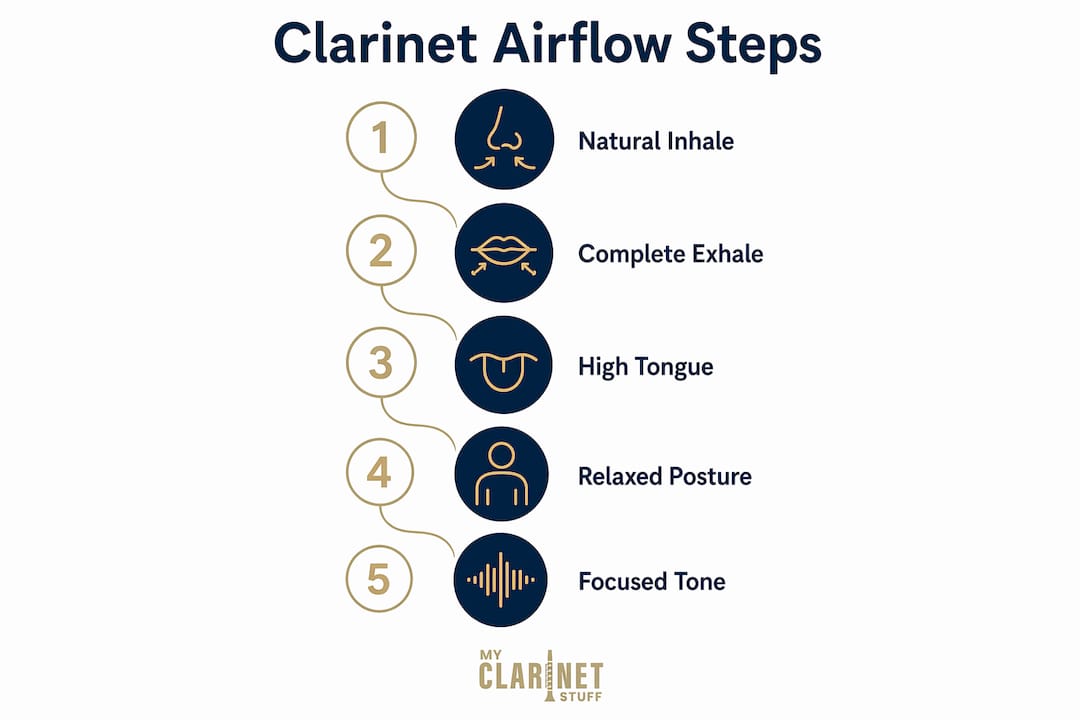
Efficient clarinet airflow depends on three coordinated elements: a complete natural exhale, a high tongue position that narrows the airstream, and posture that keeps the rib cage free to move.
| Point | Details |
|---|---|
| Natural exhale is the foundation | Allow ribs to descend fully without pushing or bracing to prevent unstable tone. |
| High tongue position focuses the airstream | Position the tongue as if saying “he” to create a fast, pressurized, directed airstream. |
| Posture enables breath mechanics | Feet flat, spine tall, and relaxed shoulders give the rib cage room to drive airflow. |
| Swab Exercise confirms correct technique | Overtone notes on fingered B verify that tongue position and airstream focus are correct. |
| Warm-up sequence builds lasting habits | Progress from breathing exercises to long tones to phrases to make airflow automatic. |
What I’ve learned from years of watching players fight their own breath
Most clarinetists I work with believe their problem is not enough air. They push harder, take bigger breaths, and tighten everything in the process. The actual problem is almost always the opposite. They are interrupting a perfectly functional exhale before it finishes, then trying to compensate with force.
The moment a student stops pushing and simply lets the exhale complete itself, the tone opens up in a way that no amount of effort produces. It sounds counterintuitive, but relaxing into the exhale gives you more control, not less. The rib cage and diaphragm know exactly what to do. The job of the player is to stop interfering.
Tongue position is the other piece that most players discover late. I spent years teaching embouchure adjustments that produced marginal improvements, until I started focusing on tongue arch first. A single session on the Swab Exercise often produces more tone clarity than months of embouchure work. The clarinet tone quality tips at Myclarinetstuff reflect this same priority.
My advice to educators is to introduce breath coordination and tongue position together from the first lesson. Separating them creates habits that have to be unlearned later. Students who learn to feel the rib descent and maintain the tongue arch simultaneously develop a physical awareness that transfers to every register and every dynamic level.
— Milos
Find the right mouthpiece to match your airflow technique

Your technique improvements will only go as far as your equipment allows. A mouthpiece with the wrong facing length or tip opening creates resistance that works against natural airflow, no matter how well you coordinate your breath and tongue. At Myclarinetstuff, Gleichweit’s precision CNC-crafted synthetic mouthpieces are designed to support focused, efficient airflow with consistent facing geometry across every unit. Use the Mouthpiece Matchmaker tool to find the specific Gleichweit model that fits your playing style, register demands, and airflow goals. For a broader look at how mouthpiece design affects resistance and tone, the mouthpiece types guide at Myclarinetstuff breaks down every category with practical selection criteria.
FAQ
What does optimizing clarinet airflow actually mean?
Optimizing clarinet airflow means coordinating a natural, complete exhale with high tongue position and relaxed posture to produce a focused, resonant tone. It is a timing and mechanics issue, not simply a matter of blowing harder.
Why does my clarinet tone sound forced or thin?
A forced tone usually results from pushing air past residual lung volume or bracing the rib cage, which interrupts natural exhale-inhale coordination. A thin tone often signals a low tongue position that widens and slows the airstream.
How does tongue position affect clarinet airflow?
A high tongue position, with the back of the tongue near the roof of the mouth and sides touching the upper teeth, narrows the oral cavity and creates a fast, pressurized airstream that improves tone focus and articulation speed.
What is the Swab Exercise for clarinet?
The Swab Exercise involves fingering note B and blowing a cool, pressurized airstream with the tongue held high. When tongue position is correct, overtone altissimo notes emerge as confirmation that the airstream is properly focused.
How often should I practice clarinet breathing exercises?
Five minutes of dedicated breathing and posture work before every practice session is enough to build the muscle memory needed for consistent airflow control. Daily repetition over two to four weeks produces noticeable improvements in tone quality and phrase endurance.
Recommended
- How to Improve Clarinet Tone: A Practical Guide – My Clarinet Stuff
- 7 Expert Clarinet Performance Tips for Better Sound Quality – My Clarinet Stuff
- 7-Step Clarinet Sound Improvement Checklist for Experts – My Clarinet Stuff
- Clarinet Performance Tips Guide for Achieving Your Best Sound – My Clarinet Stuff