


TL;DR:
- A structured testing process ensures accurate evaluation of clarinet mouthpieces benefits sound, response, and fit.
- Key parameters like tip opening, chamber shape, and flatness directly influence tone and playability.
- Personal preferences and playing style ultimately determine the ideal mouthpiece for each player.
Choosing a clarinet mouthpiece without a clear testing process is like tuning a car by sound alone. You might get close, but you’ll never know what you’re missing. Many clarinetists settle for a mouthpiece that feels “good enough” because they lack a reliable framework to compare options fairly. Unpredictable tone, sluggish response, and inconsistent articulation across registers are common frustrations, and they often trace back to mouthpiece fit rather than technique. This guide gives you a structured, expert-backed process for evaluating mouthpieces across every key parameter, so you can make a confident, informed decision that actually improves your playing.
Table of Contents
- Understanding clarinet mouthpiece parameters
- Setting up for an objective mouthpiece test
- Step-by-step playtesting process
- Advanced measurement and troubleshooting
- Reed matching: optimizing your results
- Why the perfect mouthpiece is player-dependent: a clarinetist’s perspective
- Test and select your ideal mouthpiece with expert tools
- Frequently asked questions
Key Takeaways
| Point | Details |
|---|---|
| Know your parameters | Tip opening, facing length, chamber, and table flatness determine how a mouthpiece responds and sounds. |
| Test with consistency | Keep setup, environment, and testing method constant for reliable mouthpiece comparisons. |
| Document your results | Record playtests and take notes immediately after each trial for more objective evaluations. |
| Look for physical issues | Spot leaks, warped tables, or uneven rails early to avoid faulty evaluations. |
| Select the right reed | Pair reed strength and brand to your chosen mouthpiece for optimal comfort and sound. |
Understanding clarinet mouthpiece parameters
Before you play a single note, you need to know what you’re actually evaluating. Testing clarinet mouthpieces involves evaluating key parameters: tip opening, facing length, chamber, baffle, and table flatness. Each one affects how the mouthpiece feels and sounds in a distinct way.
Tip opening is the distance between the reed tip and the mouthpiece tip. Measured in inches or millimeters, it typically ranges from about 0.040" (1.0mm) on the narrow end to 0.075" (1.9mm) on the wider end. Narrower openings suit classical playing because they reward precision and produce a focused, centered tone. Wider openings allow more reed movement, which is ideal for jazz improvisation and expressive folk styles.
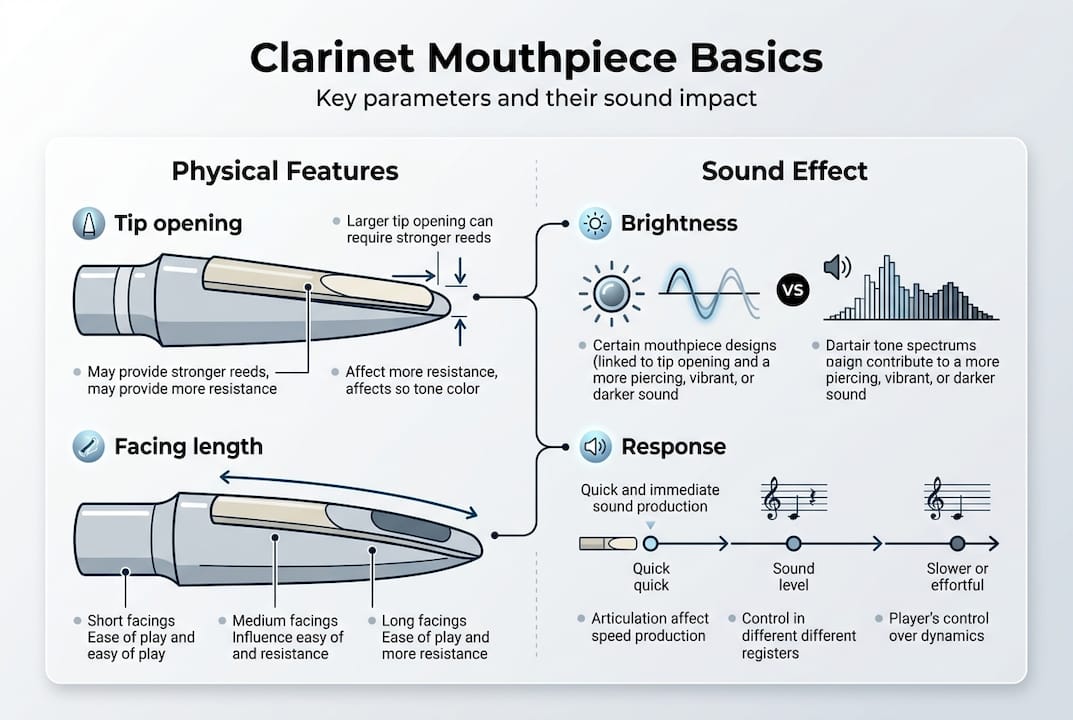
Facing length and curve describe how far down the mouthpiece the reed begins to separate from the table, and how gradually that curve rises. A shorter facing creates fast, snappy response, which many jazz players prefer. A longer facing adds tonal depth and flexibility, which classical players often find more satisfying.
Chamber and baffle shape the color of your sound. A large, rounded chamber produces a darker, warmer tone. A smaller chamber with a higher baffle creates brightness and projection. Neither is universally better. It depends entirely on your genre and personal preference.
Table flatness and rail symmetry are the physical foundation everything else rests on. If the table is warped or the rails are uneven, the reed cannot seal properly. That means air leaks, unstable tone, and unpredictable response. These are problems no amount of technique can fix. Reviewing mouthpiece selection tips and understanding professional mouthpiece features can help you recognize quality before you even pick up your instrument.
| Parameter | Narrow/Small | Medium | Wide/Large |
|---|---|---|---|
| Tip opening | Classical, precise | Versatile | Jazz, folk |
| Chamber size | Bright, projecting | Balanced | Dark, warm |
| Facing length | Fast response | Moderate | Flexible, expressive |
| Baffle height | Bright | Neutral | Dark |
Pro Tip: Before any playtest, lay the mouthpiece table on a glass plate or flat surface and check for rocking. Even a slight warp can ruin an otherwise excellent mouthpiece.
Setting up for an objective mouthpiece test
Now that you know what you’re looking for in a mouthpiece, the next step is to set up a consistent, repeatable environment and toolset for fair testing. A consistent setup means using the same clarinet, reeds, ligature, and barrel for every mouthpiece you try, then testing in a quiet room and recording A/B comparisons.
Here’s what you need before you start:
- Your clarinet: Use the same instrument for every test. Switching bodies introduces too many variables.
- Reeds: Pick three matched reeds of the same brand and strength. Rotate them across tests to neutralize reed variability.
- Ligature: Use one ligature throughout. Different ligatures affect response and tone.
- Barrel: Keep it constant. Barrel length affects tuning and projection.
- Chromatic tuner: Essential for documenting intonation tendencies.
- Digital caliper: Useful for measuring tip opening if specs aren’t printed on the mouthpiece.
- Feeler gauge: For checking table flatness and rail evenness.
- Mirror: Helps you observe embouchure consistency across tests.
- Smartphone: For recording audio of each playtest session.
| Item | Purpose | Recommendation |
|---|---|---|
| Tuner | Track intonation | Clip-on or app-based |
| Digital caliper | Measure tip opening | 0.01mm precision |
| Feeler gauge | Check table/rail flatness | 0.05mm or finer |
| Smartphone | Record A/B audio | Place at consistent distance |
| Mirror | Monitor embouchure | Freestanding preferred |
Environmental consistency matters more than most players realize. Humidity affects reed response. Ambient noise makes it harder to evaluate tone accurately. Lighting matters for visual checks. Set up in the same room at roughly the same time of day for each session. You can also explore mouthpiece maintenance workflow and caring for your mouthpiece to keep your test candidates in peak condition.
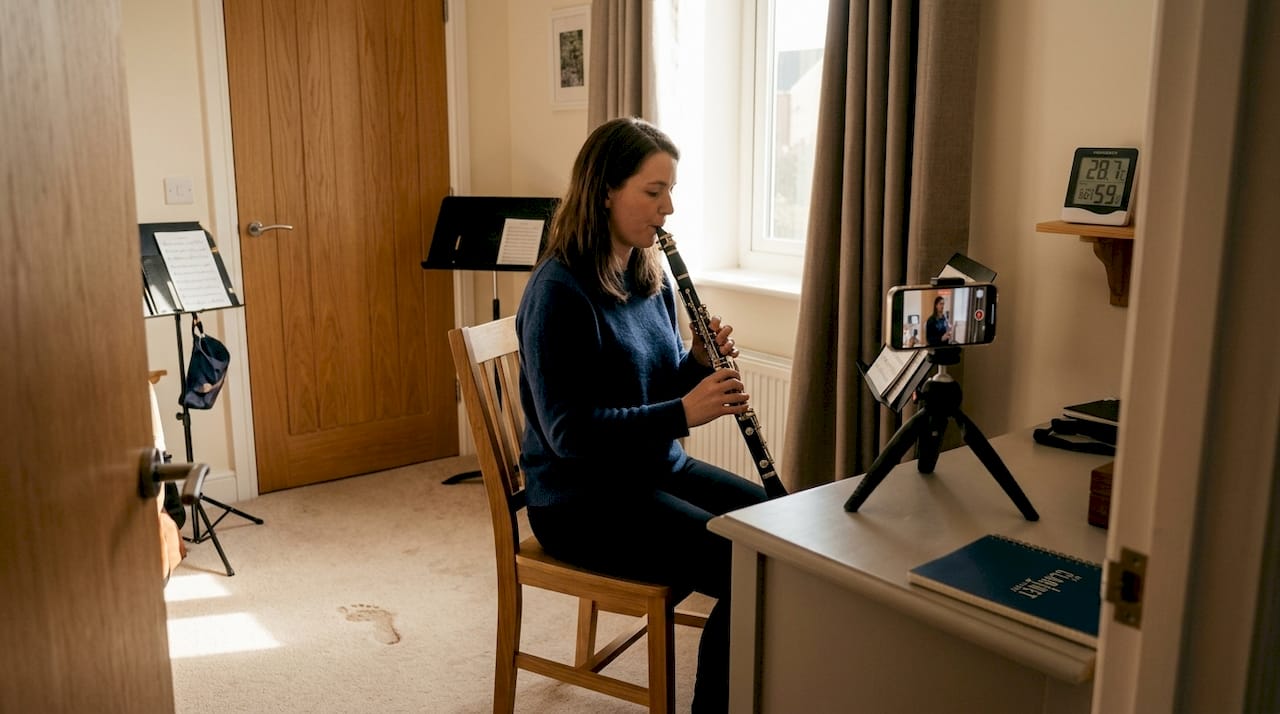
Pro Tip: Record every playtest with your smartphone positioned at the same distance and angle each time. Listening back 24 hours later gives you a much more objective perspective than in-the-moment impressions.
Step-by-step playtesting process
With your setup in place, it’s time to dive into playtesting. Here’s a step-by-step process used by pros.
- Warm up for five minutes on your current mouthpiece before switching. This stabilizes your embouchure and gives you a reliable reference point.
- Play long tones on the new mouthpiece, holding each note for 8 to 16 counts from low E to high C. Listen for evenness, tone color, and any notes that feel resistant or unstable.
- Run scales and arpeggios from pianissimo to fortissimo. This reveals dynamic range and how the mouthpiece responds under pressure changes.
- Test the break and altissimo registers. These are the most revealing. A mouthpiece that speaks cleanly across the break and into the altissimo is a strong candidate.
- Play an etude or orchestral passage that you know well. Familiar music lets you focus on the mouthpiece rather than the notes.
- Check intonation with your tuner across all registers. Document any consistent sharp or flat tendencies.
The test sequence of long tones, scales and arpeggios, and mock auditions with articulation, dynamics, and altissimo is the same framework professionals use before major purchases or auditions. A 15-minute mock audition mirrors real-world evaluation conditions far better than a five-minute noodle session. You can also review the clarinet playtesting method and consult a clarinet reed guide to pair the right reed with each candidate during testing.
Pro Tip: Write brief notes immediately after each mouthpiece test, before you move to the next one. Memory fades fast, and your first impressions are often your most accurate.
Advanced measurement and troubleshooting
As you refine your testing process, it’s important to learn the advanced checks that separate satisfactory from exceptional results.
Some problems show up in the playtest. Others hide until you look closer. Here are the physical defects to watch for:
- Air leaks or airy tone: Usually a warped table or poor reed seal.
- Unstable low register: Often caused by uneven rails that prevent the reed from vibrating symmetrically.
- Chirping or squeaking: Can result from rail asymmetry or a damaged tip rail.
- Unexpected resistance: May indicate a chamber obstruction or overly narrow tip opening for your reed strength.
- Intonation that drifts by register: Sometimes tied to chamber geometry rather than embouchure.
Measurement techniques including feeler gauges, glass rulers, symmetry checks, and flatness checks are the standard tools for troubleshooting physical defects. Place the mouthpiece table on a known-flat glass surface. Slide a feeler gauge of 0.05mm under the table edges. Any gap indicates warping. For rails, look down the bore with good lighting and check that both side rails appear equal in width from tip to where the facing begins.
“Warped table or uneven rails cause leaks and unstable low register. Check flatness first before blaming your reed or embouchure.”
If you find significant defects, a professional mouthpiece refacing specialist can correct table flatness, rail symmetry, and facing curves. Not every mouthpiece is worth refacing, but a quality piece with minor issues often plays like new after professional work. For guidance on choosing a mouthpiece with these checks already in mind, start with manufacturers who use precision CNC processes, since those tend to have far fewer physical inconsistencies out of the box.
Reed matching: optimizing your results
The final piece is matching your tested mouthpiece to the right reed, since this interplay can make or break your sound.
Tip opening is the most important factor in determining reed strength. A larger tip needs softer reeds; testing multiple strengths and brands is essential. Vandoren Traditional and V12 work well for classical, while Java and ZZ suit jazz styles.
| Tip opening | Recommended reed strength | Style fit |
|---|---|---|
| Narrow (under 1.1mm) | 3.5 to 5 | Classical, orchestral |
| Medium (1.1 to 1.5mm) | 3 to 4 | Versatile, chamber, folk |
| Wide (over 1.5mm) | 2 to 3.5 | Jazz, big band, folk |
Here are top reed options by style:
- Classical: Vandoren Traditional, Vandoren V12, D’Addario Reserve
- Jazz: Vandoren Java, Vandoren ZZ, D’Addario Select Jazz
- Folk/versatile: Vandoren 56 Rue Lepic, Rico Royal
Never test a mouthpiece with just one reed. A single reed can be too hard, too soft, or simply a bad cut that misrepresents the mouthpiece entirely. Test each mouthpiece with at least three reeds of different strengths to get a true picture of its range and character. The reed compatibility guide at MyClarinetStuff.com offers detailed pairing recommendations, and the clarinet reeds guide explains the differences between reed types in practical terms.
Why the perfect mouthpiece is player-dependent: a clarinetist’s perspective
Here’s what most guides won’t tell you: there are no universal benchmarks for a great clarinet mouthpiece. None. Every measurement chart and tip opening table is a starting point, not a verdict. The final judgment is always subjective, and that’s not a flaw in the process. That’s the reality of acoustic instruments.
A mouthpiece that wins every blind test in a classical setting can feel completely wrong for a jazz doubler who needs flexibility and edge. A wide-open jazz piece that feels liberating to one player feels uncontrollable to another with a different embouchure. The technical framework in this guide gives you the tools to compare fairly, but your ears and your body are the final judges.
We’ve seen players chase hype around certain models for months, only to discover that a less-talked-about piece fits their playing perfectly. The personalized testing advice that resonates most with experienced players always comes back to the same point: record yourself, listen back honestly, and consult your teacher before committing. Your teacher hears things you can’t hear from inside the instrument. Trust that perspective alongside your own.
Test and select your ideal mouthpiece with expert tools
Ready to make mouthpiece testing easier and more reliable? MyClarinetStuff.com brings together everything covered in this guide into one place designed for serious clarinetists.

Start with the Clarinet Mouthpiece Matchmaker, which walks you through your style, setup, and goals to suggest the best Gleichweit mouthpiece options for your specific needs. Browse the full clarinet mouthpiece types list to understand what’s available across the range. And if you want to build a complete setup, the clarinet accessory selection guide covers barrels, ligatures, and everything else that shapes your sound. Our at-home test box program lets you try before you commit, so the process you just learned becomes practical and pressure-free.
Frequently asked questions
How do I know if a mouthpiece fits my clarinet?
Check that your mouthpiece forms an airtight seal with the barrel and that reed alignment is balanced. Table flatness and symmetry affect reed seal and stability, so if it wobbles or leaks, try another model.
How long should I test each mouthpiece?
Plan for at least 15 minutes per mouthpiece, covering long tones, scales, and musical excerpts. 15-minute mock auditions mirror real evaluation conditions far better than a quick run-through.
Why does my mouthpiece squeak or sound airy?
Squeaks often result from warped tables or uneven rails. Uneven rails or warped tables cause leaks and instability, so verify flatness with a glass plate and consider a professional reface if the problem continues.
Can I use the same reed for every mouthpiece?
No. Adjust reed strength to match the tip opening since wider tips need softer reeds and narrower tips need harder reeds for the best response and tone.
Is there a universal best clarinet mouthpiece?
No. Ideal mouthpiece choice is always player-dependent, shaped by genre, personal preference, embouchure, and instrument setup. Test personally and consult your teacher for the most reliable guidance.