
TL;DR:
- A structured practice routine focused on rib-driven breathing, proper embouchure formation, and tongue positioning significantly improves clarinet tone. Short daily sessions of long tones, overtone drills, and scales build tone quality more effectively than lengthy, unfocused practice. Consistent practice and mindful self-assessment lead to lasting tonal development and technical control.
A practice routine for better clarinet tone is a structured set of targeted exercises designed to develop steady airflow, embouchure control, and tonal consistency. Tone quality on the clarinet depends on three interlocking factors: how you breathe, how you form your embouchure, and where your tongue sits inside your mouth. Skipping any one of these produces a thin, uneven, or forced sound. This guide draws on methods from Larry Guy, the International Clarinet Association, and current pedagogical research to give you a clear, level-appropriate path to a richer, more controlled sound.
What foundational techniques build a better clarinet tone?
Tone development in clarinet pedagogy begins with breath support, and the most common misconception is that support means pushing from the stomach. Effective air support is a coordinated, rib-driven process where the intercostal muscles regulate airflow. That distinction matters because rib-driven breath produces a resonant, less effortful sound, while stomach-pushing creates pressure that tightens the throat and kills tone.
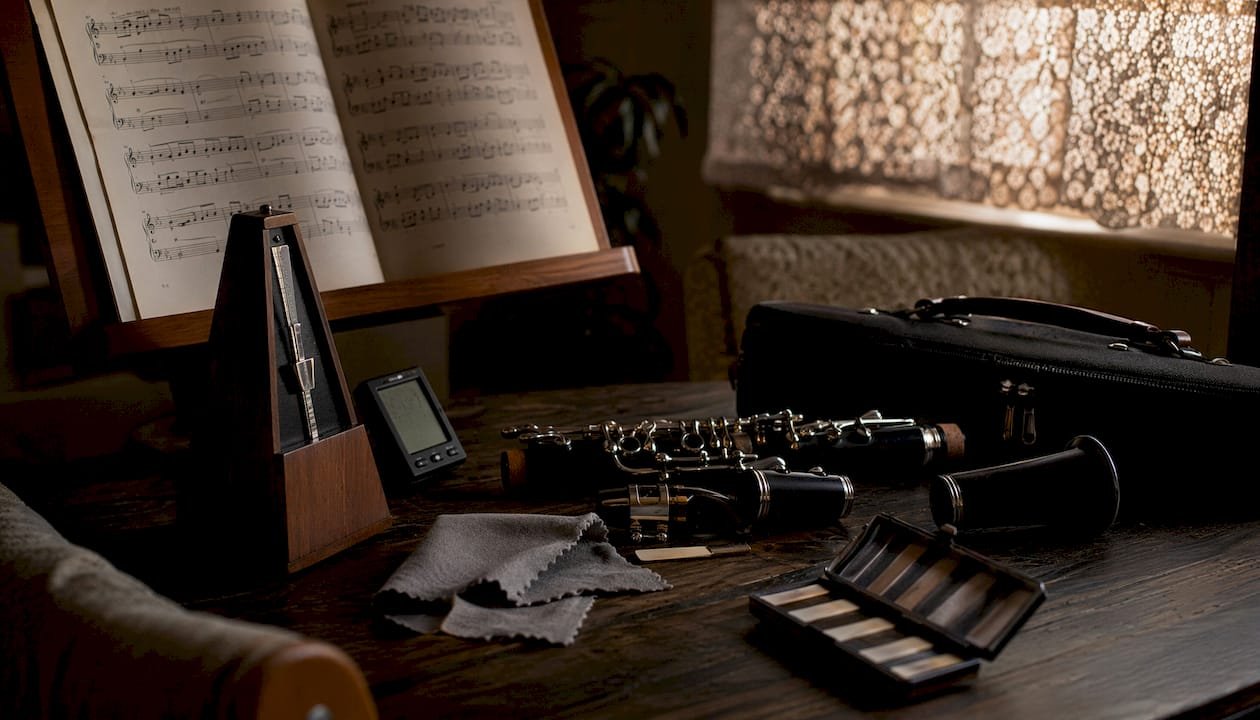
Embouchure formation is the second pillar. Larry Guy’s method teaches that the embouchure should form fully before the mouthpiece is inserted, not after. Think of it as “plugging in” a socket: the firm shape is ready first, and the mouthpiece meets it. Forming the embouchure on the instrument leads to chin bunching, uneven pressure, and a pinched tone. Practicing the shape in front of a mirror for two minutes before each session builds the muscle memory that makes this automatic.
Tongue position is the third and most underrated factor. Lip strength alone is less critical than tongue shaping for tone brightness and warmth. Arching the tongue toward an “ee” vowel shape brightens the sound; dropping it toward “ah” darkens and warms it. Professional clarinetists use the tongue as an acoustic filter, not just a tool for articulation.
- Rib-driven breath: Expand the ribs outward on the inhale, then let the intercostal muscles control the release. Never collapse the chest.
- Embouchure away from the instrument: Form the full lip shape before inserting the mouthpiece. Use a mirror to check for chin bunching.
- Tongue as a filter: Practice sustaining a note while shifting from “ee” to “ah” to hear how dramatically tone color changes.
- Relaxed neck and throat: Tension in the jaw, neck, or throat immediately degrades tone quality and causes early fatigue.
Pro Tip: Record yourself playing a single long tone, then listen back with your eyes closed. You will hear tension and unevenness that you cannot feel while playing.
Which exercises build tone quality most effectively?
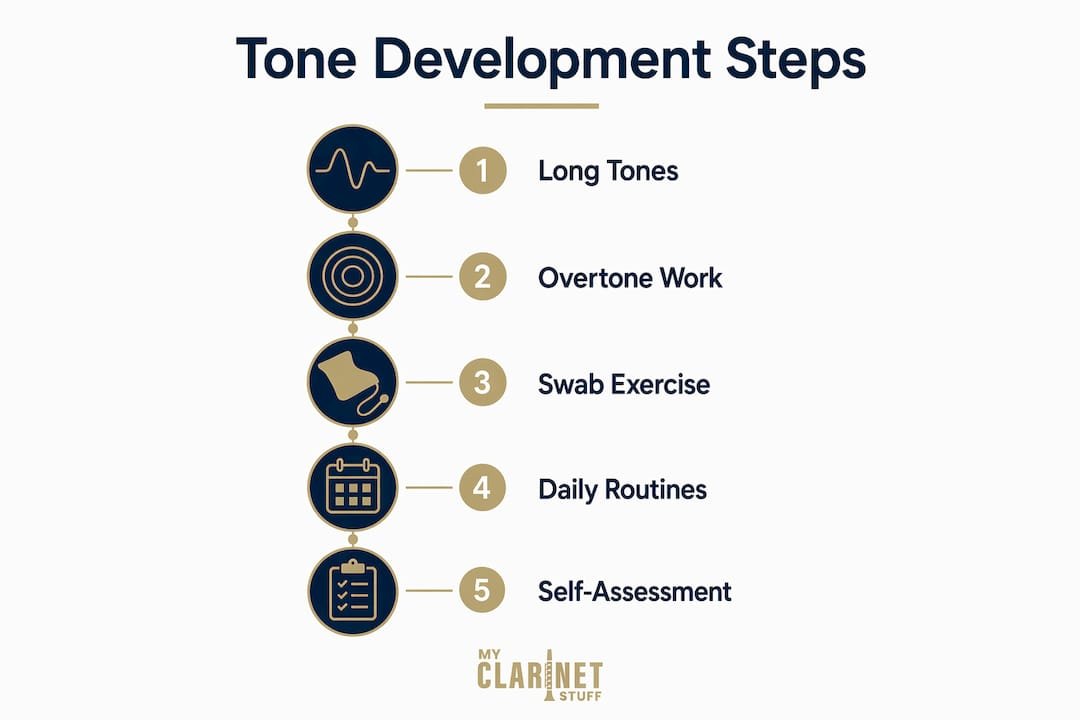
The most productive tone quality exercises for clarinet follow a clear hierarchy: long tones first, then overtone work, then scales and articulation. Each layer builds on the one before it.
Long tones
Long tones are the foundation of every serious clarinet practice routine. Play each note for 8–12 counts at a slow tempo, focusing on a consistent, centered sound from attack to release. Focused 5-minute long-tone sessions produce better tone improvement than 20 minutes of distracted practice. That finding should change how you think about your available time.
Using a tuner during long tones helps maintain pitch stability, which directly correlates with tone consistency. A wavering pitch needle tells you that your air support or embouchure is fluctuating, even when your ears have adjusted to the sound.
The Swab Exercise
The Swab Exercise is one of the most effective overtone drills for clarinet tone development. Place a cleaning swab loosely in the bell of the instrument, then attempt to produce the overtone notes (the notes that “squeak” above the fundamental). The Swab Exercise guides the tongue into the optimal high position for better tone, articulation, and response. When the tongue finds the right arch, the overtone speaks clearly. This exercise trains the tongue faster than verbal instruction alone.
Three ready-to-use daily routines
The table below matches practice time to a realistic structure. Use it as a starting point, not a rigid script.
| Time available | Routine structure | Focus |
|---|---|---|
| 5 minutes | Long tones on 3 notes | Air support and embouchure stability |
| 10 minutes | Long tones + one scale + Swab Exercise | Tone, tongue position, and response |
| 20 minutes | Warm-up + long tones + scales + articulation + short piece | Full tone and technical integration |
Pro Tip: Set a timer for each segment. When the timer ends, move on. Staying too long on one exercise creates diminishing returns and mental fatigue.
For a deeper look at how to sequence these elements, the clarinet practice workflow guide at Myclarinetstuff breaks down routine structures by skill level.
How do you troubleshoot common tone problems during practice?
Inconsistent tone is almost always traceable to one of three causes: unstable air support, embouchure tension, or a mismatch between the reed and the player’s current setup. Identifying which one is active saves hours of unfocused practice.
“Glottal stops, the unconscious closing of the throat between phrases, restrict tone and break the natural breath cycle. Allowing an expressive exhale restores rib movement and produces a more resonant, fluid tone. The fix is simple: breathe out fully before breathing in, and let the exhale be as musical as the inhale.”
Here is how to diagnose and correct the most common issues:
- Thin or airy tone: The air column is leaking around the mouthpiece. Check that the lower lip covers the bottom teeth evenly and that the embouchure seals without gripping.
- Forced or bright tone: The throat is tight. Drop the jaw slightly, think “ah,” and let the sound open up rather than pushing more air.
- Pitch instability during long tones: Air support is fluctuating. Practice breathing exercises away from the instrument: inhale for 4 counts, hold for 2, release for 8, and feel the ribs stay expanded throughout.
- Tone that degrades after 10 minutes: Muscle fatigue from overpractice is the likely cause. Start each session with a five-minute embouchure and breathing warm-up to build endurance safely.
- Inconsistency across registers: The tongue position is not adjusting between registers. Practice the “ee” to “ah” shift on a single pitch, then carry that awareness into scale work.
Reed condition also plays a direct role. A reed that is too hard for your current embouchure strength forces you to bite, which kills tone. A reed that is too soft produces a fuzzy, unfocused sound. Check the reed selection guide at Myclarinetstuff for a practical framework on matching reed strength to your playing stage.
Recording yourself once per week and listening analytically is the single most effective self-assessment tool available. Listening analytically to your own recordings heightens awareness of tone nuances that you miss in real time. Compare your recordings to professional clarinetists playing the same register to calibrate your ear.
How should you structure your daily clarinet practice for lasting improvement?
Consistency beats duration every time. Short, frequent, structured routines ranging from 5 to 45 minutes maintain and improve clarinet tone more reliably than occasional long sessions. The key is showing up daily with a clear plan, even when time is short.
A well-structured daily routine follows this sequence: warm-up, tone work, technical studies, and repertoire. Each phase serves a different function, and skipping the warm-up is the most common mistake players make.
Pro Tip: Practice in the same physical space at the same time each day. Environmental consistency reduces the mental friction of starting, which is often the biggest barrier to daily practice.
The table below compares two common approaches to daily practice structure.
| Approach | Strength | Weakness |
|---|---|---|
| Duration-focused (play for 60 minutes) | Builds endurance over time | Encourages mindless repetition without tone goals |
| Quality-focused (structured 15-minute blocks) | Maximizes improvement per minute | Requires discipline to stop and reset between blocks |
Balancing tone exercises with technical studies and repertoire prevents the common trap of practicing only what you already do well. Spend roughly 30% of your session on tone work, 30% on technical exercises like scales and articulation, and 40% on repertoire. That ratio keeps your sound development connected to real musical context.
Rest is not optional. Taking a two-minute break every 20 minutes of playing preserves embouchure muscle quality and keeps your listening sharp. Fatigue makes you stop hearing your own tone accurately, which means you practice errors without knowing it. For a complete set of warm-up strategies, the clarinet warm-up tips at Myclarinetstuff offer a structured starting point.
Key Takeaways
A focused, structured practice routine built around rib-driven breathing, pre-formed embouchure, and daily long tones is the most direct path to lasting clarinet tone improvement.
| Point | Details |
|---|---|
| Quality over duration | Five focused minutes of long tones outperform twenty minutes of distracted practice. |
| Form embouchure first | Shape your embouchure before inserting the mouthpiece to prevent chin bunching and pinched tone. |
| Tongue as acoustic filter | Shifting between “ee” and “ah” tongue positions controls tone brightness and warmth directly. |
| Rib-driven breath support | Intercostal muscle control of airflow produces resonant tone; stomach-pushing creates throat tension. |
| Daily consistency wins | Short, structured daily routines build tone more reliably than infrequent long sessions. |
What I’ve learned from watching players practice tone the wrong way
Most clarinetists I’ve worked with practice tone the same way they practice scales: they repeat it until it sounds better, then move on. That approach almost never works for tone, because tone problems are physical habits, not memory problems. You cannot think your way to a better sound. You have to feel it, hear it, and then rebuild the physical pattern that produces it.
The single most revealing exercise I use is asking a player to form their embouchure away from the instrument and hold it for 30 seconds. Most players cannot do it. Their lips drift, their chin bunches, and the shape collapses within 10 seconds. That tells me everything about why their tone is inconsistent. The embouchure is not a trained shape yet. It is a reaction to the mouthpiece, not a prepared position.
The expressive exhale concept from the International Clarinet Association changed how I think about breath and tone. Most players hold tension in their throat between phrases without knowing it. Teaching them to exhale fully before inhaling, and to treat that exhale as part of the music, opens the sound in a way that no amount of embouchure work can replicate. The breath cycle is the foundation. Everything else sits on top of it.
My honest advice: spend the first two weeks of any new practice routine doing nothing but breathing exercises and embouchure formation away from the instrument. It feels counterproductive. Players resist it. But the players who commit to it come back with a noticeably freer, more centered tone. The instrument rewards preparation, not just repetition.
— Milos
How Myclarinetstuff supports your tone development
Your practice routine builds the technique. Your equipment either supports that technique or fights it.
Myclarinetstuff carries Austrian-made Gleichweit clarinet mouthpieces, precision CNC-crafted from synthetic material for consistent response and tonal clarity across every register. Unlike traditional hard rubber, Gleichweit mouthpieces deliver the same playing characteristics every time, which means your practice gains transfer directly to performance. Use the Clarinet Mouthpiece Matchmaker to find the right mouthpiece for your tone goals, playing style, and genre. You can also browse the full clarinet equipment selection guide to match reeds, barrels, and accessories to your current setup. Fast U.S. shipping and an exclusive at-home test box program make it easy to find what works before you commit.
FAQ
What is the best daily exercise to improve clarinet tone?
Long tones are the most effective daily exercise for tone development. Play each note for 8–12 counts with a tuner, focusing on a steady, centered sound from start to finish.
How long should I practice clarinet tone exercises each day?
Five focused minutes of tone work produces measurable improvement. Daily consistency matters more than session length, so even a short structured session beats an occasional long one.
Why does my clarinet tone sound thin or airy?
A thin or airy tone usually means the embouchure is not sealing evenly around the mouthpiece, or the air column is too weak. Check your lower lip position and practice rib-driven breath support away from the instrument.
Does tongue position really affect clarinet tone?
Tongue position is one of the most direct controls over tone color. Arching the tongue toward “ee” brightens the sound, while dropping it toward “ah” warms and darkens it.
How do I know if I’m practicing tone correctly?
Record yourself once per week and compare the playback to a professional recording in the same register. Gaps in resonance, pitch stability, or consistency across registers show you exactly where to focus next.
One Response