
Most clarinetists spend years chasing the right sound, adjusting embouchure, practicing long tones, and switching reeds, yet overlook one of the most direct paths to improvement sitting right between the mouthpiece and upper joint. Custom clarinet barrels are small, precise, and surprisingly powerful. Whether you play in a community band or a professional orchestra, the barrel you use shapes your tone, your tuning, and how easily your instrument responds. This article breaks down seven concrete advantages of custom barrels and shows you how to match one to your specific playing needs.
Table of Contents
- How custom clarinet barrels transform your playing
- 1. Greater tuning and pitch stability
- 2. Enhanced tone personalization and projection
- 3. Improved response and articulation
- 4. Compatibility with mouthpieces and optimal fit
- 5. Superior intonation across registers
- 6. Custom barrels for every player: Beyond elitism
- Choosing the right custom barrel: Practical tips
- Explore your ideal clarinet barrel and setup
- Frequently asked questions
Key Takeaways
| Point | Details |
|---|---|
| Micro-level tuning control | Custom clarinet barrels enable precise adjustments for superior tuning and pitch consistency. |
| Personalized sound and fit | Material and bore options let you tailor tone and comfort to your style or ensemble needs. |
| Compatibility for all players | Custom barrels address mouthpiece fit and benefit both professionals and beginners. |
| Intonation across registers | Advanced designs deliver improved note stability throughout the clarinet’s range. |
| Accessible upgrade path | Both budget and high-end options are available, so players at every level can enjoy the advantages. |
How custom clarinet barrels transform your playing
A custom clarinet barrel is not just a connector between your mouthpiece and upper joint. It is a tunable, tone-shaping component that can be matched to your instrument, your mouthpiece, and your personal sound goals. Unlike stock barrels that ship with most instruments, custom options let you personalize response, intonation, and overall comfort in ways that feel immediately noticeable.
Many players assume custom barrels are reserved for professionals with large budgets and specific demands. That assumption is worth questioning. Clarinetists at any level can benefit from a well-chosen barrel upgrade, especially when the stock barrel creates tuning friction or tonal inconsistency. In fact, tuning and pitch stability improve measurably when fine length adjustments counteract temperature-induced fluctuations, something stock barrels rarely address.
Professionals often swap barrels not because their old one wore out, but because a new clarinet demands a different sonic match. That level of nuance is exactly what custom barrels are built for.
“When I picked up a new instrument, the first thing I changed was the barrel. The stock one was fine, but fine is not what I was after.” This perspective, common among working professionals, reflects how personalized barrel selection has become standard practice at the top level.
Here is what a custom barrel can address:
- Tonal color and warmth
- Pitch center and tuning stability
- Register evenness and response
- Mouthpiece fit and embouchure comfort
- Projection in different acoustic spaces
Exploring a clarinet barrel materials guide or reviewing tone customization options can help you identify where your current setup falls short.
1. Greater tuning and pitch stability
Tuning is often the first frustration a clarinetist encounters, and it is rarely solved by embouchure adjustment alone. Custom barrels address this at the source. Adjustable lengths, often available in 1mm increments, allow you to fine-tune pitch without pulling the barrel out awkwardly mid-performance.
Temperature is a real factor on stage. A cold rehearsal room versus a warm concert hall can shift your pitch noticeably. Fine length adjustments in custom barrels help counteract those fluctuations, keeping you centered even when conditions change.
Bore shape matters too. Bore shape optimizations such as polycylindrical or tapered designs can shift note intonation by 5 to 10 cents, which is a measurable and audible improvement in accuracy.
Here is a practical approach to improving tuning with a custom barrel:
- Record yourself playing long tones and check pitch with a tuner app.
- Identify which registers tend to run sharp or flat.
- Test barrels in 1mm length increments to find your center.
- Play in both warm and cool environments to confirm stability.
- Consult clarinet tuning tendencies for register-specific guidance.
Pro Tip: If you consistently pull your barrel out more than 3mm to tune, your current barrel length is likely wrong for your setup. A custom length could solve this immediately.
2. Enhanced tone personalization and projection
Tuning is only one piece of the puzzle. How your clarinet sounds and projects also comes down to your barrel choices. This is where custom barrels become genuinely exciting, because the options are wide and the differences are real.
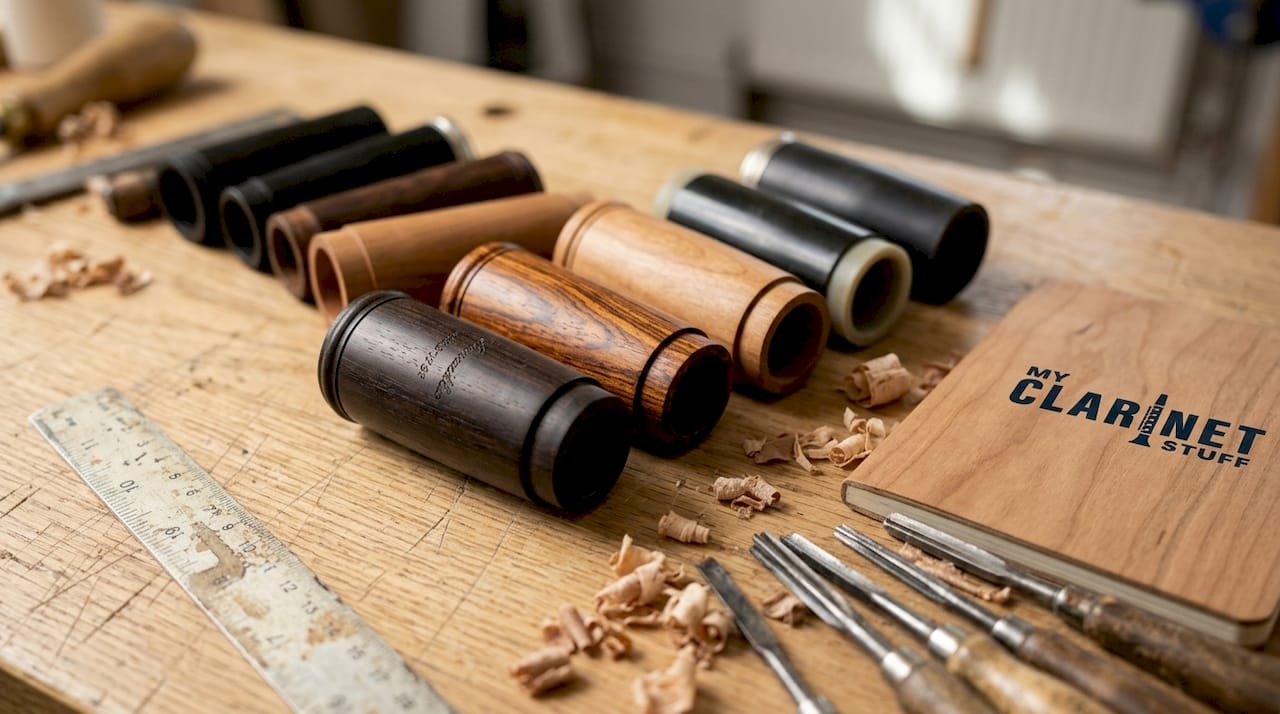
Material plays a major role. Grenadilla produces warm tones while cocobolo leans toward bright projection, and synthetic materials offer consistency that wood cannot always guarantee. Each choice shapes the character of your sound in ways you can hear immediately.
Bore geometry adds another layer. A small bore focuses the tone and increases resistance, which some players prefer for chamber music. A large bore opens up projection and suits orchestral playing. Reversed taper designs push sound forward with intensity, ideal for soloists who need to cut through an ensemble.
Here is a quick breakdown of material and bore combinations:
- Grenadilla + small bore: Warm, focused, classical
- Cocobolo + large bore: Bright, projecting, orchestral
- Synthetic + reversed taper: Consistent, forward, solo-ready
- Rosewood + standard bore: Balanced, versatile, chamber-friendly
Pro Tip: Try a reversed taper bore if you play in large halls and feel like your sound disappears before it reaches the back row. The difference in projection can be striking.
A good barrel materials guide and a review of customizing tone options will help you narrow down the right combination for your playing context.
3. Improved response and articulation
After tuning and tone, responsiveness and clarity set apart truly satisfying playability. A barrel that matches your setup well removes friction from the playing experience in ways that are hard to describe until you feel them.
Evenness across registers is one of the clearest benefits. Dead spots, those notes that feel resistant or stuffy compared to the rest of the instrument, often improve with a better-matched barrel. Greater response and articulation control across registers benefits professionals in solo, chamber, and orchestral settings, but the gains are just as real for advancing students.
Here is where improved response shows up most:
- Fast technical passages feel less labored
- Rapid tonguing becomes cleaner and more consistent
- Lyrical lines connect more smoothly across the break
- Soft dynamics respond without cracking or going flat
“The barrel is the last thing most players think about and the first thing that surprises them when they finally change it.” This observation captures how often response issues are misattributed to reeds or embouchure when the barrel is the real variable.
If you want to dig deeper into how barrel benefits translate to real playing improvements, the details are worth reviewing before your next purchase.
4. Compatibility with mouthpieces and optimal fit
Fit and function go hand in hand. How well your barrel matches your mouthpiece can make or break your experience, and this is an area where stock barrels frequently fall short.
Custom barrels come in incremental lengths to precisely match mouthpieces and clarify embouchure feel. Adjustable lengths ranging from 62 to 68mm allow for precise fitting that stock options simply cannot offer. Even a 1mm difference can shift how the mouthpiece seats and how the embouchure feels over a long rehearsal.
Here is a comparison of standard versus custom barrel fit outcomes:
| Feature | Standard barrel | Custom barrel |
|---|---|---|
| Length options | Fixed (usually 1 size) | Incremental (62 to 68mm) |
| Mouthpiece fit | Approximate | Precise |
| Embouchure comfort | Variable | Consistent |
| Tuning flexibility | Limited | High |
| Compatibility range | Narrow | Broad |
Here is a practical approach to finding the right fit:
- Measure your current barrel length and note where you pull it out.
- Identify any embouchure fatigue or mouthpiece instability.
- Request a trial fit from the barrel maker before committing.
- Review clarinet upgrade steps to understand how barrel choice fits into a broader setup improvement.
- Check mouthpiece replacement tips to confirm your mouthpiece is not the limiting factor.
Pro Tip: For tricky mouthpiece and barrel combinations, always ask about trial or return policies before purchasing. A barrel that works for one player may not suit another, even with the same mouthpiece model.
5. Superior intonation across registers
Once compatibility is achieved, intonation refinement is the next step for standout ensemble and solo work. This is where bore engineering makes a measurable difference.
Challenging intervals like twelfths are notoriously difficult to keep in tune on clarinet. Precision-engineered bores such as micro parabolic designs or inverted tapers enhance intonation across registers and specifically between twelfths. This is not a subtle effect. Players who switch to optimized bore designs often describe the instrument as suddenly feeling more in tune with itself.
| Bore design | Intonation character | Best use |
|---|---|---|
| Traditional cylindrical | Familiar, requires adjustment | General practice |
| Micro parabolic | Even across registers | Solo and chamber |
| Inverted taper | Forward, bright, stable | Orchestral projection |
| Polycylindrical | Balanced, warm | Ensemble blending |
Bore shape optimizations can shift note intonation by 5 to 10 cents, which in ensemble settings means the difference between blending and sticking out for the wrong reasons.
For more detail on how these designs affect real-world playing, the intonation barrel details page covers the specifics clearly.
6. Custom barrels for every player: Beyond elitism
Even after considering all the technical advantages, it is worth addressing a common concern directly. Custom barrels are sometimes seen as gear for professionals or enthusiasts with more money than sense. That perception is worth pushing back on.
Entry-level custom barrels exist and offer clear improvements without requiring a significant investment. The key is understanding your sound before chasing high-end upgrades. A player who knows what they are listening for will get far more value from a modest custom barrel than one who buys expensive gear without a clear goal.
Here is what the conversation around equipment and player development makes clear: benefits scale to all levels with appropriate choices. The right barrel for a high school student is not the same as the right barrel for a principal clarinetist, but both players benefit from a thoughtful match.
What every player can gain from a custom barrel:
- More consistent tuning during lessons and rehearsals
- Easier response that supports technique development
- A clearer sense of their own tonal identity
- Confidence that the equipment is not the limiting factor
The accessory guide and accessory selector at MyClarinetStuff.com are good starting points for players at any level who want to explore options without feeling overwhelmed.
Choosing the right custom barrel: Practical tips
Now that you understand the advantages and potential concerns, here is how to move forward with confidence.
Start by identifying what is frustrating you about your current setup. Is it tuning? Tone? Response? Knowing the problem makes the solution much easier to find. Then research material, bore, and length options that align with your tonal goals before spending anything.
- Identify your specific frustrations: tuning, tone, response, or fit.
- Research material and bore options that match your playing style and goals.
- Test several lengths, usually 62 to 68mm, since even 1mm can shift your pitch center noticeably.
- Seek reputable makers and always ask about return or trial policies.
- Use the clarinet upgrade guide to place your barrel choice within a broader equipment strategy.
Pro Tip: When testing multiple barrels, keep a simple written log of what you notice with each one. Tone, tuning, response, and comfort. Memory is unreliable when differences are subtle, and documentation makes the final decision much easier.
Explore your ideal clarinet barrel and setup
You now have a clear picture of what custom clarinet barrels can do and how to choose one that fits your playing. The next step is putting that knowledge to work with the right resources behind you.

At MyClarinetStuff.com, we carry barrels, mouthpieces, and accessories selected specifically for clarinetists who care about precision and sound. Our accessory selection guide helps you build a setup that works together, not just a collection of parts. If you are not sure where to start with a mouthpiece, the mouthpiece matchmaker tool walks you through the options based on your playing style. And if you want a full overview of what barrels can do before you buy, the barrel benefits overview is the place to start. We also offer an exclusive at-home test box program so you can try before you commit.
Frequently asked questions
How does a custom clarinet barrel differ from a stock barrel?
A custom barrel is built to specific tolerances, giving you control over length, bore shape, and material that stock barrels cannot offer. The result is a more precise fit for your mouthpiece and a more tailored tuning and pitch stability outcome.
Will a custom barrel work with my current mouthpiece?
Most custom barrels are available in multiple sizes and can be matched to nearly any standard mouthpiece. Adjustable lengths from 62 to 68mm cover the vast majority of setups in use today.
Are there benefits to custom barrels for beginners?
Yes. Better tuning and easier response make learning more productive, not just more enjoyable. Benefits scale to all levels when the barrel is chosen thoughtfully rather than by price alone.
What materials are best for custom clarinet barrels?
It depends on your sound goals. Grenadilla suits warm tones and cocobolo favors brightness and projection. Synthetic materials offer consistency that wood cannot always match across changing humidity and temperature.
Do custom barrels really improve intonation across registers?
Yes, and the improvement is measurable. Precision-engineered bores reduce tuning inconsistencies between registers and make difficult intervals like twelfths significantly more reliable in both practice and performance.
Recommended
- 6 Key Clarinet Barrel Benefits Every Player Should Know – My Clarinet Stuff
- 6 Key Benefits of Clarinet Customization Explained – My Clarinet Stuff
- 7 Expert Clarinet Performance Tips for Better Sound Quality – My Clarinet Stuff
- 7 Clarinet Practice Essentials for Better Sound and Skills – My Clarinet Stuff