


TL;DR:
- Effective clarinet practice relies on structured routines and proper equipment setup.
- Slow, focused practice builds tone quality and long-term skill retention.
- Prioritizing tone over speed leads to more consistent performance and musical growth.
You practice regularly, but your tone still feels inconsistent, your scales aren’t clean, and auditions leave you rattled. The problem usually isn’t how much you practice. It’s how you practice. A structured clarinet workflow organizes every minute of your session into purposeful phases, so each repetition builds on the last. This guide walks you through the essential tools, a proven step-by-step routine, smart focus techniques, and the most common mistakes players make so you can start making real progress from your very next session.
Table of Contents
- Clarinet practice essentials: Tools and setup
- Structured practice workflow: Step-by-step routine
- Slow practice and focused bursts: Unlocking accuracy
- Common workflow mistakes and troubleshooting tips
- Why tone-focused practice beats speed-based routines
- Upgrade your clarinet practice: Mouthpieces and accessories
- Frequently asked questions
Key Takeaways
| Point | Details |
|---|---|
| Structured workflow matters | Following a phased routine accelerates skill development more than random practice. |
| Tone before speed | Prioritizing sound quality lays the foundation for technical mastery and musical expression. |
| Smart gear choices | The right mouthpiece and accessories directly impact practice effectiveness and comfort. |
| Slow practice boosts accuracy | Playing at slower tempos with a metronome improves precision and reduces tension. |
| Record and reflect | Tracking progress and reviewing your practice helps you recognize and fix mistakes quickly. |
Clarinet practice essentials: Tools and setup
To start any effective practice session, you’ll need the right setup and tools. Think of your practice gear as the foundation of everything else. Without the right equipment in good condition, even the best routine will underperform.
According to a structured practice approach, effective clarinet sessions follow a pyramid of phases: warm-ups lasting 10 to 20 minutes covering long tones, breathing, and embouchure work, followed by technique work of 20 to 30 minutes focused on scales, arpeggios, and articulation, and then etudes and repertoire. That pyramid only works when your instrument and accessories are set up correctly before you even play your first note.
Here is a core checklist of what you need ready before every session:
- Mouthpiece: A consistent, well-fitted mouthpiece that supports your tone goals
- Reeds: At least three playable reeds rotated across sessions to extend their life
- Ligature: Properly fitted and seated to avoid buzz or pressure issues
- Metronome: Digital or app-based, always within reach during technique work
- Swab and cleaning cloth: To maintain the bore and mouthpiece after every use
- Practice journal: A small notebook or digital note to log what you worked on and what needs attention next session
- Tuner: Either standalone or app-based to check intonation on long tones and scales
Your mouthpiece and reed combination has a bigger impact on your sound than most beginners realize. A mouthpiece that doesn’t match your embouchure or reed strength forces you to compensate constantly, which creates tension. You can explore a full breakdown of gear that supports effective sessions through our clarinet practice essentials list, and get specific guidance on your full setup through the accessory selection guide.
| Tool | Purpose | Recommended frequency of use |
|---|---|---|
| Metronome | Tempo accuracy during technique | Every session |
| Tuner | Intonation awareness | Warm-up and long tones |
| Swab | Bore moisture removal | After every session |
| Reeds (set of 3+) | Reed rotation for longevity | Rotate daily |
| Practice journal | Session tracking and goal setting | Every session |
Pro Tip: Clean your mouthpiece with warm water and a soft brush once a week. Residue buildup changes the internal chamber shape over time and affects tone consistency more than most players expect.
Before you even reach for your instrument, check your reed for chips, warping, or excessive wear. A damaged reed makes clean articulation nearly impossible and forces bad compensatory habits that take weeks to undo. Good clarinet warm-up tips always start with this gear check because your setup determines the ceiling for everything you practice that day.
Structured practice workflow: Step-by-step routine
With your essentials in place, let’s explore how to structure a typical clarinet practice session for maximum progress. The pyramid workflow is the most widely respected model for clarinet practice, and it works because it mirrors how your body and brain learn physical skills: start easy, build complexity, and apply what you’ve learned.
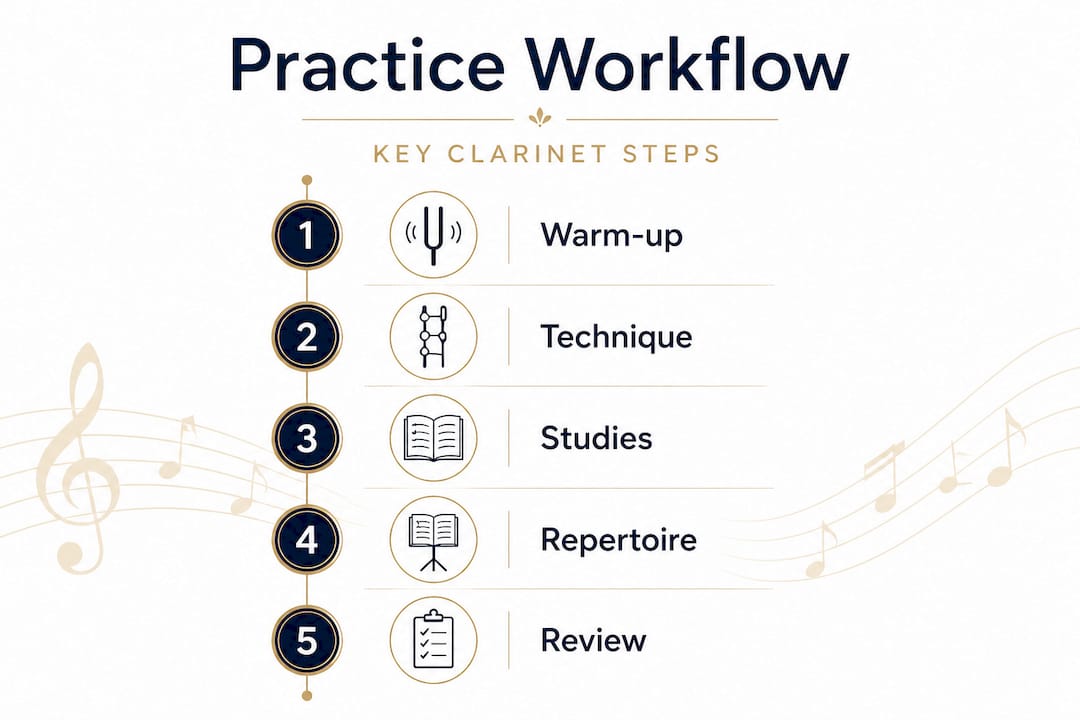
Here is how to build a 60-minute session using the pyramid model:
- Warm-up phase (10 to 15 minutes): Begin with slow long tones across your full range. Focus entirely on tone quality, not pitch or speed. Add breathing exercises and embouchure loosening before moving on.
- Technique phase (20 to 25 minutes): Work scales, arpeggios, and articulation patterns with a metronome. Start at a tempo where every note is clean and controlled.
- Etudes and studies (10 to 15 minutes): Choose an etude that targets a specific weakness. Don’t run it from top to bottom. Isolate difficult passages and work them in small loops.
- Repertoire (10 to 15 minutes): Apply your technique to a piece you’re actively learning or performing. This is where expression and musicality take center stage.
One of the most important decisions in your workflow is whether to use blocked practice or interleaved practice. Blocked practice means repeating one skill over and over before moving to the next. Interleaved practice means mixing different skills within the same session. Research consistently shows that interleaved practice feels harder in the moment but produces significantly better long-term retention.
| Practice type | Short-term feel | Long-term retention | Best used for |
|---|---|---|---|
| Blocked | Feels productive | Lower retention | Learning a brand new skill |
| Interleaved | Feels harder | Higher retention | Reinforcing multiple skills |
The best practice routines blend both approaches. Use blocked repetition when a passage is completely new, then switch to interleaved sessions once you can play it reliably. Alternating between a scale, an articulation pattern, and a short repertoire excerpt in the same session challenges your brain to recall and switch between motor patterns, which builds deeper, more durable skill.
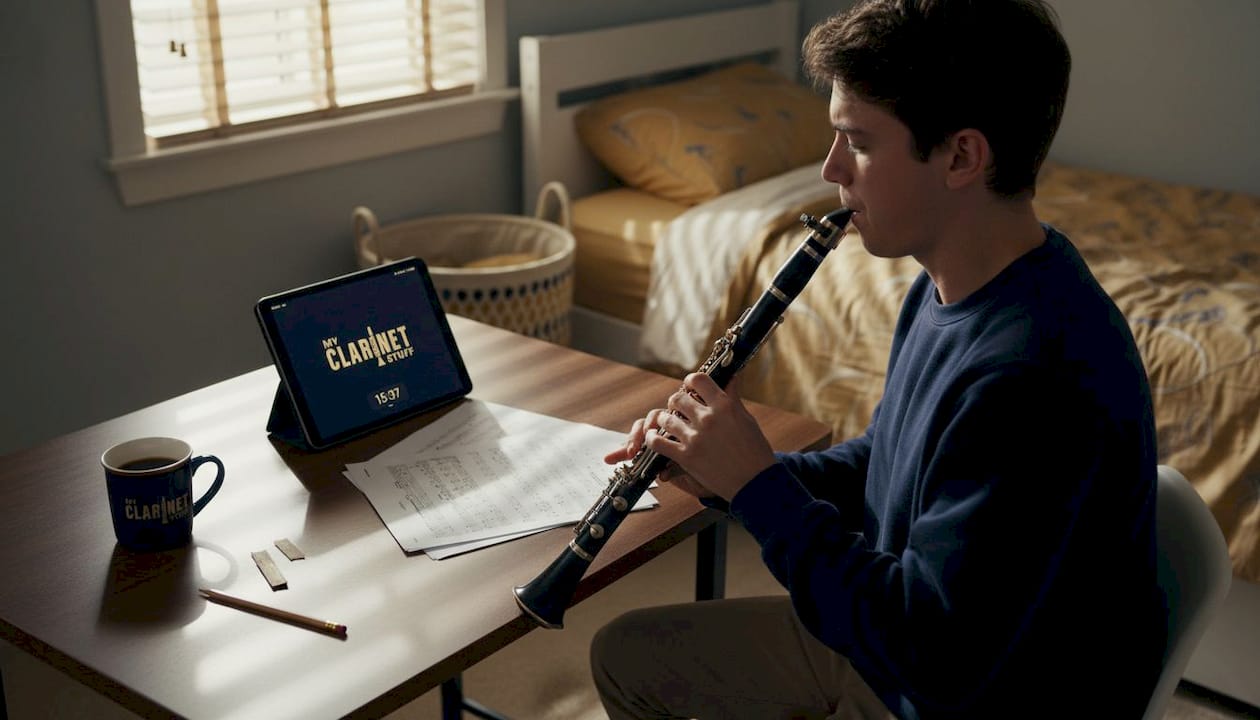
Pro Tip: Set a specific, measurable goal before every session. Not “I’ll work on scales” but “I’ll play the G major scale cleanly at quarter note equals 100 before the end of today’s session.” Specificity creates accountability and gives you a clear endpoint. Find more detailed practice tips for sound that align with this goal-setting approach.
Slow practice and focused bursts: Unlocking accuracy
Now that you have a routine, optimizing your technique comes down to practicing smartly with laser focus and purpose. This is where most students leave enormous gains on the table. They play through passages at performance tempo before they’ve built accurate neural pathways, which means they’re just reinforcing their mistakes faster and louder.
Slow practice builds accuracy and tension-free technique. The standard recommendation is to begin technique work at 50 to 60 percent of your target tempo with a metronome locked in. At that speed, you can hear every note clearly, feel whether your fingers are landing precisely, and notice any tightness in your jaw, throat, or shoulders before it becomes a habit.
Here is why this matters so much for clarinetists specifically:
- Clarinet tone is extremely sensitive to embouchure pressure. Rushing tempo increases tension before you’ve built the muscle memory to handle it correctly.
- Fast, inaccurate practice doesn’t build speed. It builds fast mistakes with added confidence.
- Metronome practice at slow tempos reveals rhythmic inaccuracies that disappear when you’re playing by feel at full speed.
- Slow runs allow you to focus on finger independence, which is one of the most common bottlenecks in scale and arpeggio work.
“Tone is always the priority. Speed is a byproduct of accuracy practiced slowly over time, not a goal pursued directly.”
Neuroscience research backs this up. Studies referenced in ICA tone and technique research support short, focused practice bursts of 20 to 25 minutes with intentional breaks rather than marathon sessions. This approach, associated with researcher Molly Gebrian’s work on music cognition, shows that mental fatigue hits harder and faster than most musicians realize. After about 25 minutes of concentrated focus, retention drops sharply.
Use this structure for your technique and etude phases: 20 minutes of focused work, followed by a 5-minute break where you step away from the instrument completely. Hydrate, walk around, or do light stretching. When you return, your brain consolidates what it just practiced, which actually accelerates skill acquisition.
You can track your progress with a sound improvement checklist after each session to measure whether your slow practice is translating into cleaner, more expressive playing over time. For players still building their equipment knowledge, the gear tips for amateurs page offers solid context on how instrument setup affects the outcomes of slow practice.
Pro Tip: Set a timer for 20 minutes and commit fully to one specific task during that window. No stopping to check your phone, no running random passages. When the timer goes off, put the clarinet down before you pick it back up.
Common workflow mistakes and troubleshooting tips
Even with a structured workflow, clarinet students can slip into bad habits. Here’s how to avoid the most common mistakes.
The biggest workflow errors tend to be predictable. Most students don’t make random mistakes. They make the same few mistakes consistently, which means once you identify yours, you can fix them systematically.
Here are the most frequent workflow mistakes and how to address each one:
- Skipping the warm-up: Playing cold forces your embouchure to compensate immediately. Always spend at least 10 minutes on long tones before any technical work, even on busy days.
- Chasing speed instead of tone: This is the most common error at every level. If your tone breaks down at a certain tempo, that tempo is too fast. Slow down until tone is clean, then build up in small increments of 4 to 5 beats per minute.
- Ignoring accessory condition: Old reeds, a warped ligature, or a dirty mouthpiece all degrade your tone and make your practice feedback unreliable. You can’t accurately judge your playing if your equipment is working against you. Check out the equipment selection guide for a systematic approach to evaluating your current setup.
- Running pieces from beginning to end without isolation: Playing through a piece repeatedly without isolating difficult measures doesn’t fix the hard spots. It just gets you really good at the easy parts.
- Practicing without a specific goal: Unfocused sessions feel productive but produce minimal results. Define your goal before you pick up the clarinet.
One of the most powerful and underused tools in any practice session is self-recording. Use your phone or a simple recorder to capture your long tones and a short repertoire passage at the end of each session. Listening back reveals intonation drift, inconsistent tone, and rhythmic habits you can’t hear while you’re playing. It also gives you a reference point to compare week over week, which is far more motivating than relying on subjective memory.
Mental visualization is another underrated strategy. Before playing through a technically difficult passage, close your eyes and hear it clearly in your head at the correct tempo and with the sound you want. Research on music cognition supports the idea that mental rehearsal activates similar neural pathways to physical practice, making it a legitimate training tool between sessions.
Interleaving different skills within a single session, as noted in the tone and technique guide, consistently outperforms blocked repetition for long-term skill retention. Students who interleave a scale, an etude excerpt, and a repertoire phrase within the same practice block retain more after 48 hours than those who practiced each skill in isolation. That is a significant difference over weeks and months of daily practice.
Why tone-focused practice beats speed-based routines
There is a persistent belief among students, especially those in competitive environments, that speed equals skill. If you can play it fast, you’re good. That belief leads to years of chasing tempos that were never the actual problem. We’ve seen it at every level.
The players who stand out in auditions and ensemble settings aren’t the fastest. They’re the most consistent. Their tone is warm and centered, their intonation is stable under pressure, and their phrasing communicates something beyond the notes. All of that is built through tone-focused practice, not speed drills.
Speed is a result. When your tone is clean at 60 beats per minute and at 80, and then at 100, you naturally arrive at performance tempo with a solid foundation rather than a shaky one. Players who work from the top down, starting fast and hoping to clean it up later, almost always develop tension-based compensation habits that eventually plateau them.
Premium mouthpieces and accessories play a genuine role in this. A mouthpiece with consistent facing length and tip opening, like Gleichweit’s CNC-crafted designs, responds predictably every session. That predictability means your practice feedback is reliable. You’re hearing your actual playing, not the variability of your equipment. The right ideal accessory setup removes equipment as a variable so that your tone work reflects your actual progress.
Record a long tone session every Friday. Compare it to the previous Friday’s recording. That simple habit, tracked over eight weeks, tells you more about your development than any competition placement or teacher comment. Tone improvement is slow and real. Speed gains are fast and fragile without it.
Upgrade your clarinet practice: Mouthpieces and accessories
For those ready to level up their practice, the right mouthpiece and accessories make a world of difference.

At MyClarinetStuff.com, we carry the full line of Austrian-made Gleichweit mouthpieces, precision CNC-crafted for consistency that hard rubber simply can’t match session to session. Whether you play Bb clarinet, bass clarinet, or are looking for a specific facing to match your reed strength and playing style, our selection resources help you narrow it down fast. We also offer an exclusive at-home test box program so you can try multiple mouthpieces in your actual practice environment before committing. Paired with quality ligatures, barrels, and practice accessories, your setup becomes a tool that works with your routine rather than against it. Visit MyClarinetStuff.com for fast U.S. shipping and personalized support.
Frequently asked questions
How long should clarinet students practice each day?
Aim for 45 to 60 minutes daily, divided across warm-ups, technique, studies, and repertoire using the pyramid workflow for balanced, purposeful progress across all skill areas.
What is the most important part of clarinet practice for beginners?
Tone production is the foundation for every technical skill that follows. All major approaches to clarinet pedagogy, including those reviewed in the ICA tone research, agree that fundamentals like long tones and embouchure control come before speed.
How can students improve their practice focus and retention?
Use focused blocks of 20 to 25 minutes with intentional breaks, and interleave different tasks within each session. Research-backed strategies also show that self-recording and mental visualization significantly boost retention between sessions.
Should students use premium mouthpieces or standard ones?
Premium mouthpieces offer improved tone consistency and comfort, but the key is matching the mouthpiece to your playing level, reed strength, and musical goals rather than simply buying the most expensive option available.
What accessories are essential for clarinet practice?
A well-fitted mouthpiece, a rotation of quality reeds, a properly seated ligature, a metronome, and a practice journal form the core of any effective setup. These tools together ensure that your practice feedback is accurate and your sessions stay organized.
Recommended
- 6 Best Clarinet Practice Routines for Serious Musicians – My Clarinet Stuff
- 7 Expert Clarinet Warm-Up Tips to Enhance Your Sound Quality – My Clarinet Stuff
- Clarinet Performance Tips Guide for Achieving Your Best Sound – My Clarinet Stuff
- 7 Clarinet Practice Essentials for Better Sound and Skills – My Clarinet Stuff
- Building Chess Study Routines for Consistent Improvement
- Streamline your player development workflow for wins – Hoop Mentality
2 Responses