


Eddie Daniels is the American clarinetist, tenor saxophonist, and flutist widely regarded as one of the most technically complete jazz clarinet players of the past half century, equally at home improvising over a swing rhythm section and performing Mozart with a symphony. Born in 1941, Daniels built his early reputation on tenor saxophone before narrowing his focus to clarinet, a shift that defined the second half of his career. Few musicians move between jazz and classical repertoire with his fluency, and that dual mastery is why students and working professionals still study his recordings today.
- Eddie Daniels spent decades testing and refining his mouthpiece setup, believing that small adjustments to facing and ligature impact tone more than brand choices.
- His most influential album, Breakthrough, features a rare pairing with the London Symphony Orchestra, marking his definitive shift into classical crossover clarinet.
- Success with his gear depends on isolating variables, with Daniels emphasizing that proper trial and error techniques outperform simply copying equipment.
- Daniels’ classical background from Juilliard informs his jazz playing, enabling him to execute Brahms passages with precision and control in improvised work.
- His versatility is demonstrated by a wide discography spanning early jazz, classical collaborations, Brazilian styles, and genre-blending projects into the 2010s.
Table of Contents
- Who Is Eddie Daniels? Early Life and Musical Training
- Career Highlights: From the Vanguard to the Concert Hall
- Essential Eddie Daniels Recordings: A Listening Guide
- What Mouthpiece and Ligature Does Eddie Daniels Use?
- Awards, Honors, and Critical Reception
- Why Study Eddie Daniels? His Legacy for Clarinetists
- A Publisher’s Take: Turning Daniels’ Gear Philosophy Into Practice
- Try a Controlled Mouthpiece Trial of Your Own
- Sources
- FAQ
Who Is Eddie Daniels? Early Life and Musical Training
Daniels was born in Brooklyn, New York, to a Romanian-Jewish family, and he picked up his first instruments as a child in a household that valued music without pushing him toward any single genre. He gravitated toward the clarinet early, and by his teenage years he was already competing at a serious level.
- He performed in a youth jazz competition tied to the Newport Jazz Festival while still in his teens, an early sign of the discipline that would define his playing.
- He trained formally at the Juilliard School, where he sharpened the classical technique that later let him move seamlessly into orchestral and chamber settings.
- That combination of self-driven jazz curiosity and rigorous conservatory training gave him a technical base most jazz clarinetists never acquire, and it explains why his tone reads as “classically trained” even inside an improvised solo.
The Juilliard years mattered less for repertoire than for discipline. A player who can execute a Brahms clarinet passage cleanly brings a different level of control to bebop lines, and Daniels’ later recordings make that connection audible.
Career Highlights: From the Vanguard to the Concert Hall
Daniels’ career breaks cleanly into phases, each defined by a different instrument or ensemble.
- The Thad Jones/Mel Lewis Orchestra years. Daniels won first prize in the 1966 International Competition for Modern Jazz in Vienna, and that same year he joined the Thad Jones/Mel Lewis Orchestra as tenor saxophonist, playing the band’s regular Monday night residency at the Village Vanguard for multiple years. That gig put him in a demanding big band chair every week, which sharpened his reading, blend, and improvisational instincts far faster than casual gigging could have.
- The studio and sideman period. Alongside the Vanguard residency, Daniels worked steadily as a studio musician, recording with a wide range of artists and building the kind of versatility that studio work demands: sight reading, stylistic adaptability, and reliability under pressure.
- The clarinet pivot. Daniels’ focus shifted decisively to clarinet in the 1980s, a change that culminated in his landmark 1985 album Breakthrough, recorded with the London Symphony Orchestra and produced during his years with GRP Records. The record’s title was not marketing bravado. It genuinely marked the moment Daniels reestablished the clarinet as a legitimate solo voice in both jazz and classical circles.
- Classical commissions. Daniels’ standing in the classical world grew to the point that composers began writing for him directly. Composer Daniel Schnyder wrote MATRIX 21 for Daniels, premiered by the Orchestre de Chambre de Lausanne with its American premiere following at the Crested Butte Music Festival in July 2010.
Essential Eddie Daniels Recordings: A Listening Guide
Building a mental map of Eddie Daniels’ discography matters more than memorizing dates. His records fall into three useful categories: early jazz work, the clarinet breakthrough era, and later genre-crossing projects.
- First Prize! (1966): His debut leader recording as a young tenor saxophonist, worth hearing to understand his early style before focusing on clarinet.
- Breakthrough (1985): The album that reset expectations for jazz clarinet, pairing Daniels with the London Symphony Orchestra.
- Memos from Paradise (1990s): A showcase of Daniels’ lyrical side and his comfort inside lush orchestral arrangements.
- Benny Rides Again (1992): A tribute-adjacent project that nods to Benny Goodman while staying firmly in Daniels’ own harmonic language.
- Heart of Brazil (2013): Proof that his stylistic range extends well past straight-ahead jazz and classical crossover into Brazilian idioms.
For a full session-by-session listing, including sideman credits stretching back decades, the MusicBrainz artist entry for Eddie Daniels and the AllMusic artist page both maintain detailed, cross-referenced credits worth cross-checking against each other.
What Mouthpiece and Ligature Does Eddie Daniels Use?
There is no single, permanent “Eddie Daniels setup” to copy, and that is the point. Daniels has spent decades refacing mouthpieces and testing variants rather than settling on one piece for life. He has historically played Backun mouthpieces built on Zinner blanks, including distinct facings for classical work (a tighter 1.03mm tip opening) versus jazz playing (a more open 1.13mm tip), though those specific Backun models are no longer in production.
In interviews discussing his equipment, Daniels has been direct about the ligature’s role, describing it as a critical link in the chain that affects how the reed vibrates and how easily a player controls pitch. His broader philosophy is worth internalizing: gear helps a player execute an idea more comfortably, but it never replaces technique.
- Change one variable at a time (facing, then ligature) rather than testing multiple pieces at once.
- Record short passages across low, middle, and altissimo registers to compare response honestly.
- Pay close attention to how easily a piece produces a controlled pianissimo in the upper register, a real stress test for facing and tip opening.
Pro Tip: Small facing adjustments often reveal more than switching brands entirely. If a mouthpiece feels close but not quite right, a slightly different opening may solve it faster than starting your search over from scratch.
If you want a structured framework for that kind of trial. This walkthrough on testing clarinet mouthpieces for tone quality lays out a comparable process.
Awards, Honors, and Critical Reception
Daniels’ peers and critics have not been shy about placing him at the top of his instrument.
- Praise from figures as significant as Leonard Bernstein and jazz critic Leonard Feather has described Daniels as effectively reinventing what the clarinet could do in a jazz context.
- DownBeat and other major jazz publications have repeatedly recognized his artistry across multiple decades of polls and reviews.
- A 1987 Los Angeles Times profile captured Daniels mid-career, discussing his near-obsessive pursuit of precision and citing Breakthrough as the recording that crystallized his crossover ambitions.
Why Study Eddie Daniels? His Legacy for Clarinetists
Daniels’ real legacy is technical, not just historical. He proved that jazz phrasing and classical tone production are not opposing skill sets. A player can develop a clean, centered classical sound and still swing convincingly, and Daniels’ recordings are the clearest evidence available.
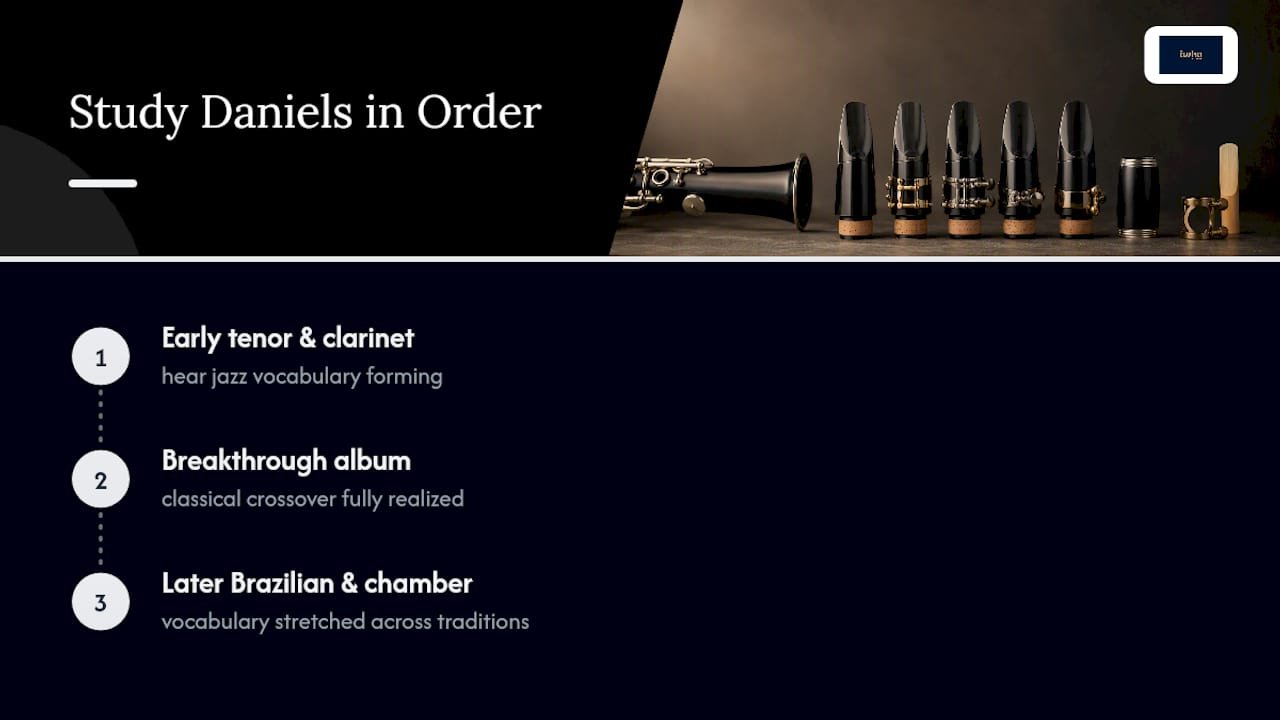
Students benefit most from listening in career order: start with his tenor sax and early clarinet work to hear his jazz vocabulary form, move into Breakthrough to hear the classical crossover fully realized, then work through his later Brazilian and chamber projects to see how far that vocabulary can stretch. Daniels remains the reference point for anyone asking whether a single clarinetist can convincingly serve both traditions.
A Publisher’s Take: Turning Daniels’ Gear Philosophy Into Practice
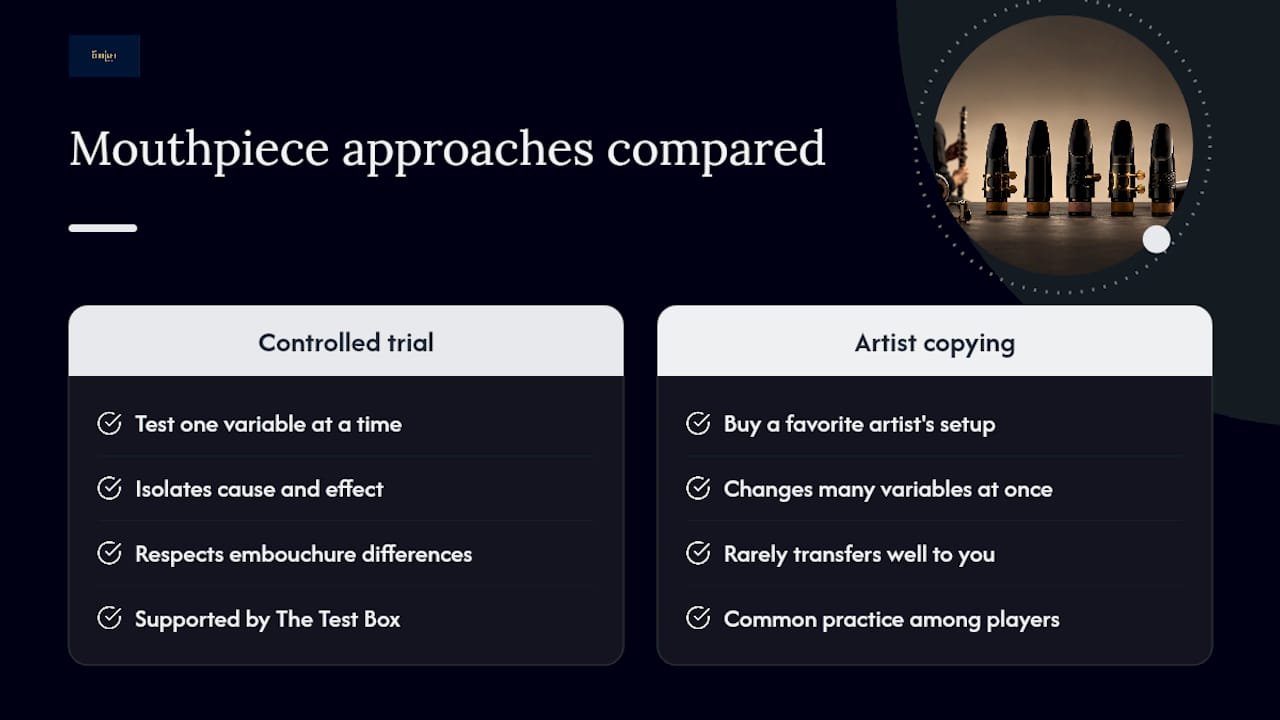
Daniels talks about mouthpieces the way a good teacher talks about scales: necessary, but not the point. His insistence on testing facings and ligatures one variable at a time is a sound method precisely because it isolates cause and effect. Most players skip this and just buy whatever a favorite artist plays.
That approach rarely transfers well, since facing, tip opening, and reed strength interact differently for every embouchure. A controlled trial, the kind The Test Box program is designed to support controlled mouthpiece trials and respects that reality instead of guessing at it.
— Milos
Try a Controlled Mouthpiece Trial of Your Own
Daniels didn’t land on his sound by guessing. He tested facings, tip openings, and ligatures against each other until the response matched what he heard in his head, and that same controlled comparison is exactly what an at-home Test Box program offers for controlled mouthpiece trials. Instead of buying one mouthpiece on a hunch, you can trial up to five CNC-crafted Gleichweit mouthpieces side by side, on your own horn, in your own practice room.

If you’re not sure where to start, the Clarinet Mouthpiece Matchmaker narrows the field based on your playing style, whether that’s classical concerto work, big band lead playing, or something closer to Daniels’ own genre-blending approach. Answer a few questions, get a shortlist, and request your Test Box to hear the differences for yourself before committing to a single piece.
Sources
- Welcome To The Home of Eddie Daniels — Bio
- Banddirector
- Eddie Daniels — MusicBrainz
- Clarinetist, center stage — LA Times (1987)
FAQ
What clarinet does Eddie Daniels play?
Daniels has played various professional clarinets over his career and has notably worked with custom Backun mouthpieces built on Zinner blanks, though he has never committed to one permanent setup, preferring to test facings and ligatures regularly.
Who is Eddie Daniels?
Eddie Daniels is an American clarinetist, tenor saxophonist, and flutist born in 1941, known for bridging jazz and classical clarinet performance after rising to prominence with the Thad Jones/Mel Lewis Orchestra in 1966.
Does Eddie Daniels play flute?
Yes, flute is among Daniels’ secondary instruments alongside tenor saxophone, though clarinet has been his primary focus and the instrument most associated with his classical crossover work since the 1980s.
Which band did Eddie Daniels play in?
Daniels rose to prominence as a tenor saxophonist with the Thad Jones/Mel Lewis Orchestra, performing the band’s Monday night residency at New York’s Village Vanguard for six years starting in 1966.
What is Eddie Daniels’ most important album?
Most critics and fans point to Breakthrough (1985), recorded with the London Symphony Orchestra, as the recording that established Daniels as a serious classical crossover voice on clarinet.