


Mouthpiece refacing is the precision reshaping of a mouthpiece’s table, rails, and facing curve to correct playability problems or fine-tune response. The general rule we recommend at Myclarinetstuff: clean and diagnose your own mouthpiece first, but leave the actual grinding and rail work to a trained technician unless you already own calibrated tools and have practiced on pieces you’re willing to ruin. Whether refacing makes sense at all depends on your mouthpiece’s material, the extent of visible damage, and what you’re actually trying to fix.
- Proper measurement and documentation are essential for a professional refacing to ensure minimal material removal and maintain a balanced facing curve.
- Cleaning a mouthpiece thoroughly before considering repair often resolves playing issues caused by dirt, warped reeds, or seating problems.
- Refacing costs vary depending on the extent of work, with minor corrections typically costing less than replacing a mouthpiece and vintage pieces often justifying higher fees.
- Technicians use precise tools like flat plates, feeler gauges, and incremental measurement methods to ensure accurate, safe adjustments, unlike unverified at-home attempts.
- CNC-crafted synthetic mouthpieces, like Gleichweit, provide consistent manufacturing that reduces the need for refacing and offers reliable performance across units.
Table of Contents
- What Is the Mouthpiece Refacing Process and When Does It Make Sense?
- How Do Professionals Measure and Reface a Mouthpiece?
- How Do You Diagnose Mouthpiece Problems Safely at Home?
- What Tools Do Refacing Technicians Use, and What Should You Avoid at Home?
- What Does Mouthpiece Refacing Cost, and How Long Does It Take?
- How Do You Choose a Qualified Mouthpiece Refacer?
- Gleichweit and Myclarinetstuff: A Manufacturing Alternative to Repeated Refacing
- How Should You Care for a Mouthpiece After Refacing?
- A Technician’s-Eye View on Why Players Rush This
- Ready for a Consistent Mouthpiece Without the Repeat Trips to a Refacer?
- Sources
What Is the Mouthpiece Refacing Process and When Does It Make Sense?
Refacing means correcting three interdependent surfaces: the table (the flat bed the reed rests against), the rails (the two sides that taper toward the tip), and the facing curve (the length and shape of that taper, which determines tip opening and reed response). A technician removes material in controlled amounts to restore flatness, symmetry, and a curve that matches how you play.
Refacing typically solves a specific set of problems, and it’s worth knowing which ones before you send a mouthpiece anywhere:
- Air leaks under the reed caused by a table that’s no longer flat, often from age, warping, or a reed clamped too tightly for years.
- Inconsistent low register response, where notes below the break feel stuffy or refuse to speak cleanly.
- Uneven response between the left and right sides, usually traced to asymmetrical rails.
- Excessive resistance or a “stuffy” feel from a facing curve that’s drifted out of its original design length.
- Reed seal that won’t hold, even with a fresh reed and proper ligature tension.
Replacement beats refacing when the mouthpiece has actual structural damage. Cracks anywhere in the body, chips at the tip or rails, or a table so warped that grinding it flat would remove too much material all point toward buying new rather than repairing. The same goes for players who’ve simply outgrown their mouthpiece’s design and want a different tip opening or facing length entirely. Refacing corrects geometry; it doesn’t change a fundamentally wrong design for your needs.
Material matters more than most players expect. Ebonite (hard rubber) refaces predictably and holds a corrected surface well over time. Injection-molded plastic mouthpieces can be refaced, but the material is often softer and less dimensionally stable, so results vary. Metal mouthpieces require entirely different abrasive techniques and are less commonly refaced by general clarinet technicians. CNC-milled synthetic mouthpieces, like the ones covered in this refacing guide, start from a more dimensionally consistent blank, which is part of why manufacturing precision matters as much as post-sale correction.
How Do Professionals Measure and Reface a Mouthpiece?
Ask a competent technician what they do before they touch a mouthpiece, and the answer is never “start sanding.” It’s measure, document, and only then remove material.
1. Inspection and documentation. The technician examines the table, rails, and tip under strong light, notes any warping or wear patterns, and often photographs the piece before doing anything else. They’ll ask what problems you’re experiencing: is it a leak, a stuffy low register, uneven sides? Reed brand and strength matter here too, since a warped or over-broken reed can mimic a facing problem that doesn’t actually exist. Documenting condition with photos and measurements before grinding lets both the shop and the player verify exactly what changed.
2. Measurement against a flat reference. This is where the process becomes genuinely technical. Technicians place the table against a glass flat plate and use light or feeler gauges to find high spots and gaps. Some shops use dial indicators for finer resolution, tracking deviations across the table surface in fractions of a millimeter. The goal is a table flat enough that a reed seals evenly across its entire width, with no rocking or light leaking through at any point.
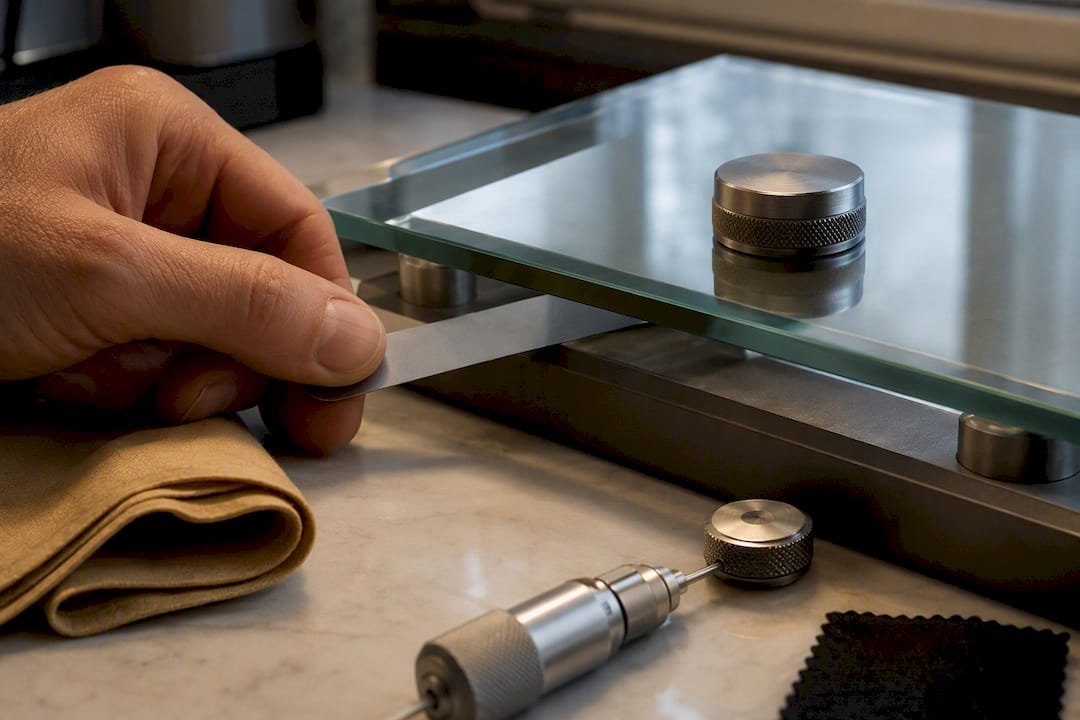
3. Table flattening. High spots get worked down first, using progressively finer abrasives on a flat surface, checking against the glass plate repeatedly. This step alone fixes many leak complaints, because a table that’s even slightly convex or concave prevents a reed from sealing no matter how good the reed is.
4. Facing and rail adjustments. This is the part players usually mean when they say “refacing.” The technician removes material from the rails in a curve, starting from the point where the reed still touches the mouthpiece and extending toward the tip, opening it gradually. Rail symmetry gets checked constantly, comparing left and right visually and with measurement tools, since a facing curve that’s even slightly lopsided causes the uneven response many players describe as “one side feels different.”
Adjustments happen incrementally. Refacers describe working in increments as small as 0.01 to 0.02 millimeters, checking the effect after each pass rather than removing material in one aggressive session.
5. Final verification. A paper test (sliding thin paper under the reed to check for gaps), a reed-seating check, and an actual play test across the full range confirm the work. A good technician plays low, middle, and high register notes, checks articulation response, and often has the player test it too before calling the job done.
Pro Tip: If you’re shipping a mouthpiece for refacing, include a note describing your reed brand, strength, and the specific symptom (leak, stuffy low end, uneven sides). That context helps the technician target the actual problem instead of guessing from measurements alone.
Why so cautious? Because rail material removed can’t be put back. A refacer who removes too much in one pass risks opening the tip too far or thinning a rail past the point where it can hold a stable curve, and at that point you’re looking at a full re-face or a replacement. The entire process is a calibrated balance between rail thickness, curve shape, and tip opening, tuned to a specific player’s embouchure and reed preference, not a generic template applied to every mouthpiece that comes through the shop.
How Do You Diagnose Mouthpiece Problems Safely at Home?
Most players who suspect they need refacing haven’t actually confirmed the mouthpiece is the problem. A surprising number of “facing issues” turn out to be dirt, a warped reed, or a ligament seated wrong, and a proper cleaning resolves them without any grinding at all.
Start with a cleaning routine that won’t damage the mouthpiece:
- Remove the reed and ligature completely.
- Soak the mouthpiece 10 to 15 minutes in warm (never hot) soapy water.
- Brush the interior gently with a soft mouthpiece brush or pipe cleaner.
- Rinse thoroughly under running water.
- Optionally disinfect lightly with isopropyl alcohol, applied briefly rather than soaked.
- Air dry for 30 to 60 minutes before reassembling.
This six-step routine clears the residue buildup that commonly mimics a facing problem, and it costs you nothing but time.
Once it’s clean and dry, run these checks:
- Paper test: slide a thin strip of paper under the reed at several points along the rails. If it slides through easily in one spot but catches in another, that’s a sign of unevenness worth having measured.
- Visual table check: hold the mouthpiece up to a light source and sight down the table for obvious warping.
- Rail symmetry check: compare both rails side by side under good light, looking for one side that appears thinner or more curved than the other.
- Reed comparison: try two or three different reeds. If the problem disappears with a different reed, the mouthpiece likely isn’t the issue.
- Low register test: play chalumeau register notes softly. A facing or table problem often shows up first as stuffy or unresponsive low notes.
- Reed seal check: press the reed against the table with light pressure and check for any visible gap or wobble.
If cleaning and a reed swap don’t resolve the symptom, and the paper test or visual check reveals a genuine inconsistency, that’s your signal to send it to a professional rather than reaching for sandpaper. Technicians frequently find that cleaning and reed issues explain apparent facing problems more often than actual table or rail damage, which is exactly why this diagnostic step comes before any repair decision.
What Tools Do Refacing Technicians Use, and What Should You Avoid at Home?
Professional refacing relies on equipment most home players simply don’t own: glass flat plates for checking table flatness, feeler gauges and sometimes dial indicators for measuring deviations in fractions of a millimeter, graduated fine abrasives for controlled material removal, and jigs that hold the mouthpiece at a consistent angle during grinding.
You can safely do quite a bit of diagnostic work at home without any of that:
- A strong light source and a piece of thin paper for gap testing.
- A soft brush and mild soap for cleaning.
- A magnifying glass to inspect the tip and rails for chips or cracks.
- A notebook (physical or digital) to track symptoms across different reeds and sessions.
What you should not do at home is attempt material removal. Coarse sandpaper removes material unevenly and can’t be controlled to the tolerances a proper reface needs. Aggressive solvents strip finishes and can cause micro-cracking in some plastics. Heat from a hair dryer or hot water, sometimes suggested as a way to “reshape” a warped mouthpiece, tends to warp ebonite further rather than fix it.
Material-specific cautions matter here. Ebonite discolors from hot water exposure, so stick to warm water and skip long vinegar soaks; short, targeted vinegar contact for mineral deposits is fine if rinsed immediately. Wooden mouthpieces need slow, even drying away from direct heat to avoid warping. Alcohol disinfection should be brief, since repeated heavy exposure dries out and can eventually crack some rubber compounds.
Pro Tip: If you own a jeweler’s loupe or a strong magnifier, use it to check the tip rail for hairline chips before you assume a response problem is a facing issue. A chip invisible to the naked eye can cause the exact symptoms players usually blame on the facing curve.
What Does Mouthpiece Refacing Cost, and How Long Does It Take?
Professional refacing costs vary by shop and by how much correction the mouthpiece actually needs, but the general pattern holds across the industry: minor facing corrections cost less than a full table-flattening-plus-rail-rework job, and both usually cost less than a new mid-range mouthpiece. Vintage or discontinued mouthpieces often justify higher spending than the piece’s resale value would suggest, simply because a matching replacement doesn’t exist anymore.
Cost drivers worth understanding before you request a quote:
- Extent of rail work required, since a full recut takes longer than a light symmetry correction.
- Whether the table needs flattening in addition to facing work, which adds a separate measurement and grinding stage.
- Restoration complexity for vintage pieces, including cleaning old material buildup and working around wear patterns that don’t exist on newer mouthpieces.
- Turnaround expectations, with standard facing corrections typically completed faster than custom or from-scratch facing curves built to a specific spec.
If your mouthpiece has sentimental value, an out-of-production model, or a facing curve you’ve spent years adjusting to, the case for paying more to preserve it is strong. If it’s a common, currently manufactured model with no special history, comparing the reface quote against a new mouthpiece’s price is worth doing before committing.
How Do You Choose a Qualified Mouthpiece Refacer?
Not every shop that offers refacing measures the same way, and the difference between a documented, incremental process and someone “eyeballing” a rail is the difference between a mouthpiece that plays better and one that’s ruined.
Before sending your mouthpiece anywhere, ask these questions:
- What tools do you use to measure table flatness and facing symmetry? A shop that mentions a glass flat plate, feeler gauges, or dial indicators is working to verifiable tolerances, not guessing.
- Will you provide before-and-after photos or measurements? Documentation protects both of you and confirms what actually changed.
- How do you handle adjustments, in small increments with rechecks, or all at once? Incremental, rechecked passes are safer for the mouthpiece.
- What’s the full price, including return shipping, and is there a guarantee or rework policy if the result doesn’t match what you asked for?
- What’s the realistic turnaround time for your current workload?
Red flags are just as telling as good answers. A refacer who can’t describe their measurement process, won’t document before-and-after condition, or talks about “just feeling it out by hand” is asking you to trust results you can’t verify. Shops that document condition with photos and measurements as a normal part of service tend to be the ones worth trusting with an irreplaceable mouthpiece.
Gleichweit and Myclarinetstuff: A Manufacturing Alternative to Repeated Refacing
Gleichweit USA LLC is the official U.S. distributor of premium Austrian-made Gleichweit clarinet mouthpieces, sold through Myclarinetstuff. The mouthpieces are CNC-crafted from synthetic material, designed and manufactured in Austria to deliver consistent performance without the piece-to-piece variability that traditional hard rubber production can introduce.
What that means in practice for anyone reading this because their current mouthpiece needs work:
- The shop sells professional Bb clarinet mouthpieces, bass clarinet mouthpieces, barrels, and clarinet accessories built on a CNC manufacturing standard.
- The at-home Test Box program lets players try multiple mouthpieces without committing sight unseen to a single model.
- Because Gleichweit mouthpieces are CNC-crafted rather than hand-finished, the facing geometry is consistent from unit to unit, reducing the piece-to-piece variation that often drives players to refacing in the first place.
- The website ships within the USA and offers personalized support for students, educators, and professional clarinetists.
Milos, who has written detailed guides on clarinet mouthpiece refacing, when to replace a mouthpiece, and a step-by-step mouthpiece break-in guide, authored this piece drawing on that same body of research into how refacing decisions actually get made.
How Should You Care for a Mouthpiece After Refacing?
A freshly refaced mouthpiece is at its most precise the day it comes back from the shop. Keeping it that way is mostly about consistency, not intensity.
Stick to a light rinse after most playing sessions, and a full clean every two to four weeks if you play frequently, using the same warm soapy water routine covered earlier. Skip the temptation to “improve” a fresh facing job with your own touch-up sanding. The whole point of paying for calibrated work is that it’s calibrated. Introducing your own abrasive pass, even a light one, can undo weeks of measured adjustment in seconds.
Store the mouthpiece in a proper cap or pouch rather than loose in a case pocket, since accidental contact with hard cases or metal parts is a common cause of new tip chips. Avoid leaving it in a hot car or near direct sunlight, particularly if it’s ebonite, since heat exposure over time is what caused warping in the first place for many pieces that end up needing a reface.
Check reed seating periodically with the same paper test described earlier. If the seal starts drifting weeks or months after a reface, and cleaning doesn’t fix it, that’s worth a follow-up conversation with whoever did the original work rather than assuming the mouthpiece has failed. Consistent care routines extend the life of the correction, not just the mouthpiece itself.
A Technician’s-Eye View on Why Players Rush This
The mistake I see described most often isn’t a bad refacing job. It’s a player who sands their own rails after watching a video, panics when the response gets worse, and then needs a full correction that costs more than a careful reface would have in the first place.
Three things actually matter here. Diagnose before you assume: clean the mouthpiece and test different reeds before blaming the facing. Document what you’re experiencing: specific symptoms, specific registers, specific reeds, because vague complaints get vague results. And when the paper test or visual check confirms a real problem, choose a technician who measures and shows you the numbers, not one who works by feel.
Refacing rewards patience and punishes shortcuts. A mouthpiece corrected in careful 0.01 millimeter increments plays better and lasts longer than one rushed through in an afternoon, whether that afternoon belongs to a technician or to you with a piece of sandpaper.
— Milos
Ready for a Consistent Mouthpiece Without the Repeat Trips to a Refacer?
If you’ve read this far because your current mouthpiece keeps drifting out of adjustment, or you’re tired of guessing whether a facing problem is really a facing problem, there’s a more direct path than another round of refacing. Myclarinetstuff’s CNC-crafted Gleichweit mouthpieces start from a manufacturing tolerance that hand-finished hard rubber can’t consistently match, which means less unit-to-unit variation for a technician to chase down later.

The Test Box program lets you try up to five mouthpieces at home before you commit, so you can compare tip openings and facing feel side by side instead of relying on a spec sheet. If refacing your current mouthpiece still makes sense after that comparison, the shop also offers custom mouthpiece copying and refacing services for players who want their existing setup corrected rather than replaced. Order a Test Box or reach out for a refacing quote through the shop to get shipping details and current turnaround times.