


TL;DR:
- Custom-made clarinet mouthpieces provide consistent tone and tailored response by eliminating variability. Testing multiple options through structured trial programs helps players find the best fit for their style and chamber preferences. Modern CNC manufacturing offers reliable, high-quality options that outperform traditional hand-crafted pieces.
For most serious players, a precision-made custom mouthpiece tested through an at-home trial program delivers the best balance of tone, consistency, and playability. The reason is straightforward: a precision-crafted design with controlled chamber geometry and a matched facing eliminates the unit-to-unit variability that plagues factory stock, so what you hear in testing is what you get every time.
- Immediate benefits: Consistent tone across all registers, a facing tailored to your embouchure and air style, and predictable reed response from session to session.
- Practical next step: Order a test box from a maker who offers multiple tip openings and facings, or contact a custom maker directly for a consultation before committing.
Pro Tip: When testing any new custom mouthpiece, keep your ligature and reed brand constant for the first two sessions. Changing all three variables at once makes it nearly impossible to isolate what the mouthpiece itself is contributing to your sound.
Table of Contents
- What does “custom” actually mean for a clarinet mouthpiece?
- How each customization variable shapes your sound
- What materials and manufacturing methods actually deliver
- How to test a custom mouthpiece properly
- What the ordering process looks like, and how test boxes fit in
- Price ranges and what drives the cost
- Setup, reed pairing, and keeping your custom mouthpiece in top condition
- Key Takeaways
- Why precision-made customs are the practical recommendation
- Try a Gleichweit test box through Myclarinetstuff
- Useful sources
What does “custom” actually mean for a clarinet mouthpiece?
The word “custom” covers a wide range of work. At one end sits refacing, where a technician reshapes the facing curve and tip opening of an existing stock mouthpiece. It is a lower-cost path to a better fit, but it works within the structural limits of the original blank. At the other end sits a from-scratch custom, where a maker designs and produces a mouthpiece to a player’s exact specifications, choosing chamber volume, bore profile, rail geometry, and facing from the ground up.
Between those two poles, you find precision-made proprietary designs, the category that brands like Gleichweit, Vandoren, Backun, D’Addario, Clark Fobes, and Brad Behn (Behn Mouthpieces) occupy. These are not mass-produced commodity pieces. Each is engineered to tight tolerances with specific tonal goals, and many offer facing options that let players dial in the fit without a full bespoke commission.
The parts a maker can customize include the chamber (volume and shape), the bore (throat diameter and profile), the facing curve and length, the tip opening, the side rails, and the tip rail. Players choose custom routes for three main reasons: they need a specific tonal character their current mouthpiece cannot deliver, they want consistency that survives touring and climate changes, or their oral cavity geometry simply does not respond well to standard facings.
How each customization variable shapes your sound
Understanding the variables before you order saves you from expensive trial-and-error. Facing geometry has the largest single impact on playability, but chamber and bore shape the tonal identity underneath it.
| Variable | What it controls | Classical tendency | Jazz/Folk tendency |
|---|---|---|---|
| Chamber volume | Tone color: dark/warm vs. bright/projecting | Smaller, more focused | Larger, more open |
| Bore/throat | Resistance and register evenness | Narrower, centered | Wider, freer blowing |
| Tip opening | Projection vs. control | Closed (narrow opening typical for classical players) | Open (wider opening preferred by many jazz players) |
| Facing length | Reed flexibility and dynamic range | Shorter, more controlled | Longer, more expressive |
| Side rails | Articulation clarity and reed seal | Narrow, even | Slightly wider |
| Tip rail | Reed vibration onset | Thin and precise | Thin to medium |
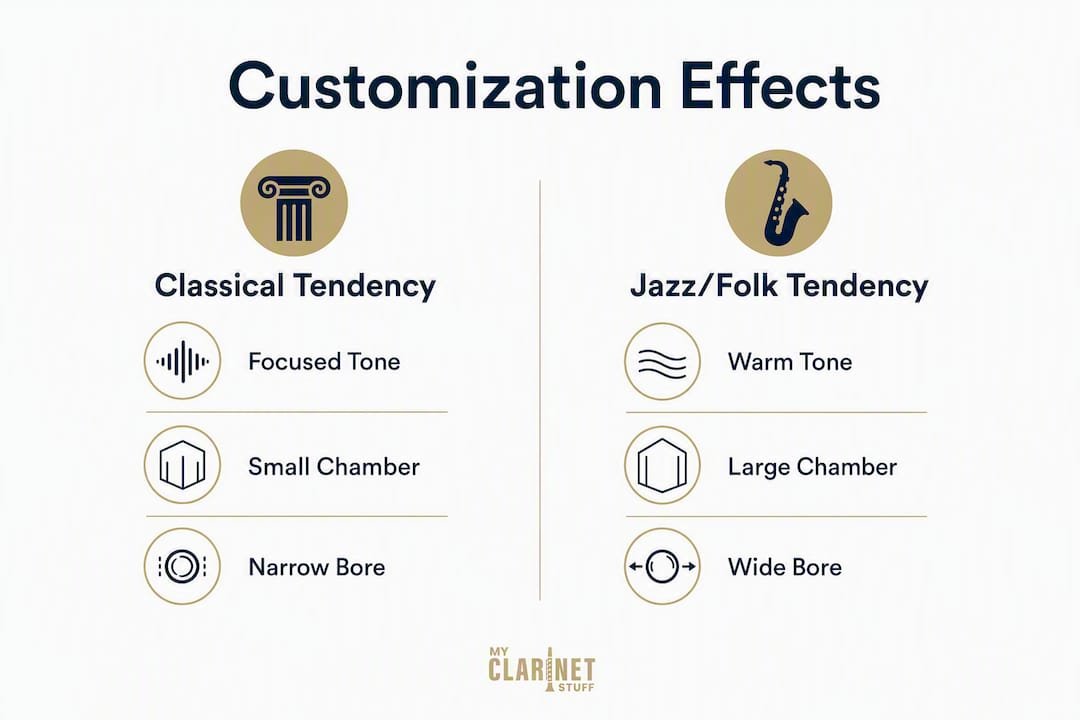
A smaller chamber concentrates the air column and produces a focused, warm tone well-suited to orchestral blend. A larger chamber opens the sound and increases projection, which is why jazz and folk players often prefer it. Bore width interacts with this: a narrower bore adds resistance that helps with intonation control in the upper register, while a wider bore reduces back-pressure and lets the reed respond more freely.
Tip opening and facing length work together. A more open tip with a longer facing gives you dynamic range and expressive flexibility but demands more embouchure control. A closed tip with a shorter facing is forgiving and consistent, which is why many orchestral players favor it. As Lynn Snyder’s practical guide points out, fixating on one metric ignores the “sum of parts” effect: chamber, rails, and facing interact, and a change to any one variable shifts the balance of the others.
Pro Tip: If you are moving from a closed-tip classical setup toward a more open jazz facing, lower your reed strength by half a number first. The longer facing vibrates more reed surface, and your current strength will likely feel stiff.
- Classical players typically benefit from a smaller chamber, narrower bore, closed tip (around 1.00–1.05 mm), and shorter facing for blend and intonation stability.
- Jazz players generally prefer a larger chamber, wider bore, open tip (1.10 mm and above), and longer facing for projection and expressive range.
- Folk and klezmer players often want a medium-to-large chamber with a freer bore that supports pitch bending and tonal flexibility.
What materials and manufacturing methods actually deliver
Ebonite (hard rubber) is the traditional professional material. It produces a warm, complex tone with good projection and a comfortable feel. Its main drawback is variability: two ebonite blanks from the same batch can respond differently, and the material is sensitive to temperature and UV exposure over time.
Modern synthetics address that variability directly. Gleichweit’s precision CNC-crafted synthetic mouthpieces, manufactured in Austria, hold tolerances that ebonite cannot match consistently. The synthetic material does not swell, warp, or oxidize with climate changes, which matters enormously for players who travel or perform in variable conditions. John Bruce Yeh, principal bass clarinet of the Chicago Symphony Orchestra, emphasizes reliability and consistency as the qualities that make switching among clarinets in performance manageable. That is exactly what CNC-produced synthetics are built to provide.
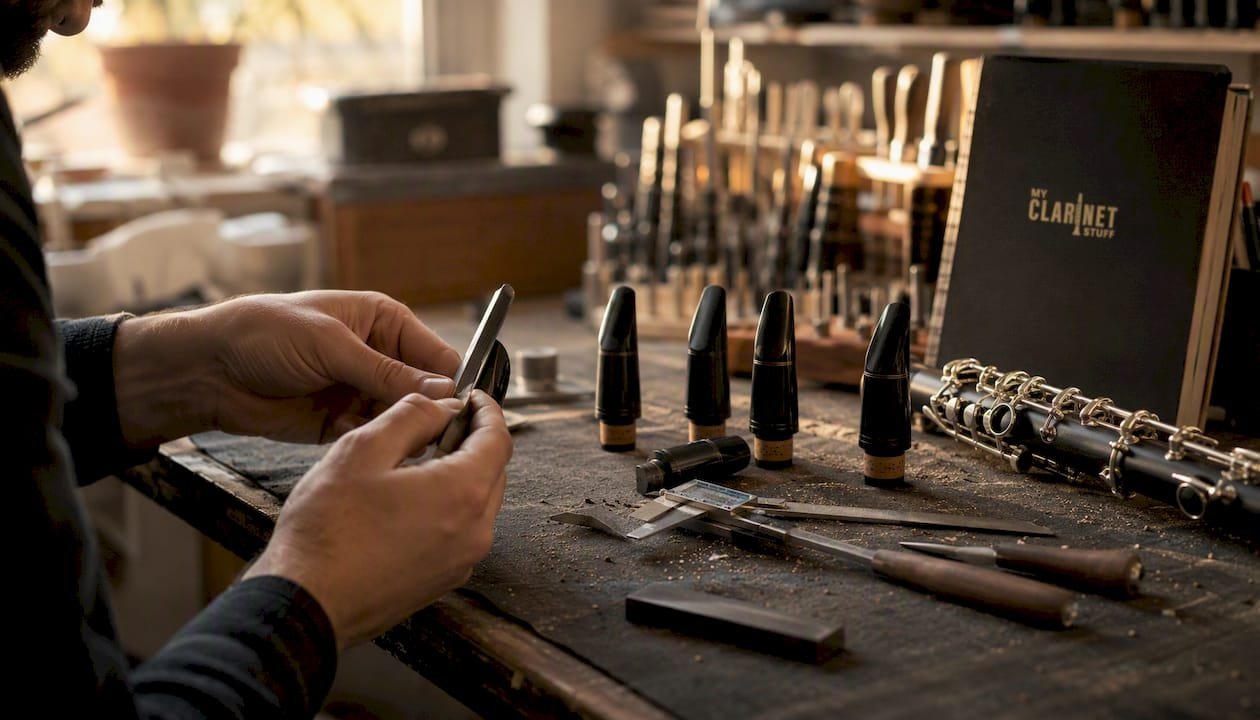
CNC machining produces the blank geometry with high repeatability. Hand-finishing still matters after that step: a skilled technician smooths the tip rail, refines the side rails, and polishes the facing curve to remove any micro-burrs that affect reed seating. The combination of CNC precision and hand-finishing is where top-rated makers separate themselves from commodity production.
How to test a custom mouthpiece properly
Testing a custom mouthpiece without a structured routine leads to decisions based on first impressions rather than real performance data. Teachers and experienced players consistently advise trying many models and prioritizing how a mouthpiece feels and sounds over obsessing about specs alone. Here is a repeatable protocol:
-
Warm up on your current mouthpiece for 10 minutes before switching. Your embouchure needs to be settled, not fresh.
-
Play long tones across all registers on the new piece. Listen for evenness of tone color and check that the throat tones (G, A, B-flat) do not thin out or go sharp.
-
Run a slurred scale from low E to high C at a moderate dynamic. Register breaks reveal facing and bore interactions immediately.
-
Test articulation with a staccato passage at two tempos. A well-fitted facing responds cleanly without clamping.
-
Check dynamic range. Play a phrase from pianissimo to fortissimo. A good custom design holds tone core at both extremes.
-
Play a musical excerpt from your actual repertoire, not just scales. Orchestral excerpt, solo etude, or ensemble passage — use the context that matches your regular playing.
-
Try at least three reed brands and two strengths before drawing conclusions. A mouthpiece that feels resistant may simply need a slightly softer reed.
-
Rate each piece on four dimensions: tone core, register evenness, response, and tuning stability. Write it down.
For at-home test boxes, plan for a minimum of five to seven days of serious playing before deciding. Order a variety pack that includes at least two tip opening sizes so you can compare directly. The Clarinet Mouthpiece Matchmaker at Myclarinetstuff is built around exactly this kind of structured trial.
Pro Tip: Set up a blind A/B test by having a trusted colleague hand you mouthpieces without telling you which is which. Confirmation bias is real, and players routinely rate a mouthpiece higher simply because they paid more for it or because a player they admire uses it.
What the ordering process looks like, and how test boxes fit in
Understanding the typical workflow helps you set realistic expectations and ask the right questions.
| Stage | What happens | Typical timeframe |
|---|---|---|
| Consultation | Discuss tonal goals, current setup, playing style | 1–3 days (email/call) |
| Facing selection | Review facing charts, tip opening options, chamber references | 1–5 days |
| Production | CNC machining and hand-finishing | 1–4 weeks (maker-dependent) |
| Test/trial | At-home test box with return policy | 7 days |
| Final delivery | Confirmed piece shipped | 2–5 business days (U.S.) |
A good consultation covers your current mouthpiece model, the reed brand and strength you use, your primary genre, and any specific complaints (thin upper register, stuffy throat tones, intonation drift). Ask the maker for a facing chart and, if possible, sample recordings on the facing you are considering. Myclarinetstuff’s U.S. distribution means that iterations, exchanges, and support calls happen without international shipping delays or customs complications, which shortens the overall cycle considerably. For more on what to ask during a consultation, this guide on consultation best practices covers the key questions in detail.
Price ranges and what drives the cost
Custom mouthpiece pricing follows a clear logic once you understand what you are paying for.
- Refacing a stock mouthpiece: Usually costs vary by technician and project complexity but is a lower-cost starting point.
- Precision-made proprietary designs (Gleichweit, Vandoren, Backun, D’Addario, Clark Fobes): Prices reflect material quality, finishing, and brand R&D.
- Fully hand-finished bespoke customs (Brad Behn and similar artisan makers): These command a premium reflecting maker craftsmanship and bespoke design.
The primary cost drivers are material (synthetic vs. ebonite vs. exotic materials), the degree of hand-finishing, custom tooling for unique chamber geometries, maker reputation, and whether a trial or test-box program is included. U.S. distribution cuts shipping costs and import fees for American buyers, which makes precision-made options from Myclarinetstuff more price-competitive than their Austrian origin might suggest. Cost does not always correlate with performance: a well-matched precision-made piece often outperforms a bespoke custom that was specified incorrectly.
Setup, reed pairing, and keeping your custom mouthpiece in top condition
After any significant mouthpiece change, resist the urge to judge the new piece on day one. Your embouchure adapts, and so does your reed selection. Start by testing at least three reed brands at your current strength, then try one half-step lighter. An open custom design with a longer facing often pairs best with a freer ligature and slightly lighter reeds, allowing the reed to vibrate fully without fighting the facing.
Ligature choice matters more than most players expect. A ligature that clamps the reed too tightly dampens the very response a custom facing was designed to produce. Experiment with at least two ligature styles before settling. For a broader look at how reeds and ligatures integrate with mouthpiece selection, the clarinet accessory selection guide at Myclarinetstuff is a practical starting point.
For cleaning, rinse synthetic mouthpieces with lukewarm water after each session and dry thoroughly before capping. Ebonite requires the same routine but should be kept away from direct sunlight and extreme heat to prevent oxidation and warping. Inspect the tip rail and side rails monthly for chips or uneven wear, especially if you use harder reeds. Any visible damage to the tip rail changes the facing geometry and warrants a professional inspection. Knowing when to replace your clarinet mouthpiece is as important as knowing how to care for it.
This article provides general guidance on mouthpiece selection and care. For instrument-specific or health-related concerns, consult a qualified teacher or instrument technician.
Key Takeaways
Precision-made custom mouthpieces tested through a structured at-home trial program give most players the best combination of tonal consistency, tailored facing, and predictable reed response.
| Point | Details |
|---|---|
| Start with a test box | Order multiple tip openings and facings; plan at least 5–7 days of serious playing before deciding. |
| Customization variables interact | Chamber, bore, rails, and facing work as a system; changing one shifts the balance of the others. |
| Material consistency matters | CNC-crafted synthetics hold tighter tolerances than ebonite and resist climate-related variability. |
| Budget realistically | Precision-made customs typically start at $100, with fully bespoke hand-finished pieces costing more. |
| Myclarinetstuff test-box program | Gleichweit’s at-home trial boxes let U.S. players test multiple facings with a clear return policy before buying. |
Why precision-made customs are the practical recommendation
There is a persistent belief in the clarinet world that only a fully bespoke, hand-carved mouthpiece represents “real” customization. That view undersells what precision manufacturing has made possible and overestimates how well most players can specify a bespoke piece on the first try.
Michael Wayne of the Boston Symphony Orchestra describes the three qualities he seeks as beautiful sound, stable pitch, and reed-friendliness. None of those qualities require a hand-carved blank. They require a design that was engineered with those goals in mind and produced consistently enough that the piece you receive matches the one you tested. That is exactly where CNC-precision manufacturing has a structural advantage over hand-carving alone.
As the official U.S. distributor of Gleichweit mouthpieces, Myclarinetstuff has a direct stake in recommending precision-made synthetics. I want to be transparent about that. What I can say honestly is that the test-box program exists precisely to let the mouthpiece prove itself without any pressure to buy. The testing protocol described in this article is objective; the recommendation to try Gleichweit is grounded in the consistency the manufacturing method delivers, not in the distribution relationship alone. Try the process, not the brand name.
Try a Gleichweit test box through Myclarinetstuff
Gleichweit’s precision CNC-crafted synthetic mouthpieces are available in the U.S. exclusively through Myclarinetstuff, with no international shipping delays or import complications. The at-home trial program is built around the testing philosophy described in this article: you receive multiple facings and tip openings, play them in your actual musical context, and return what does not fit.
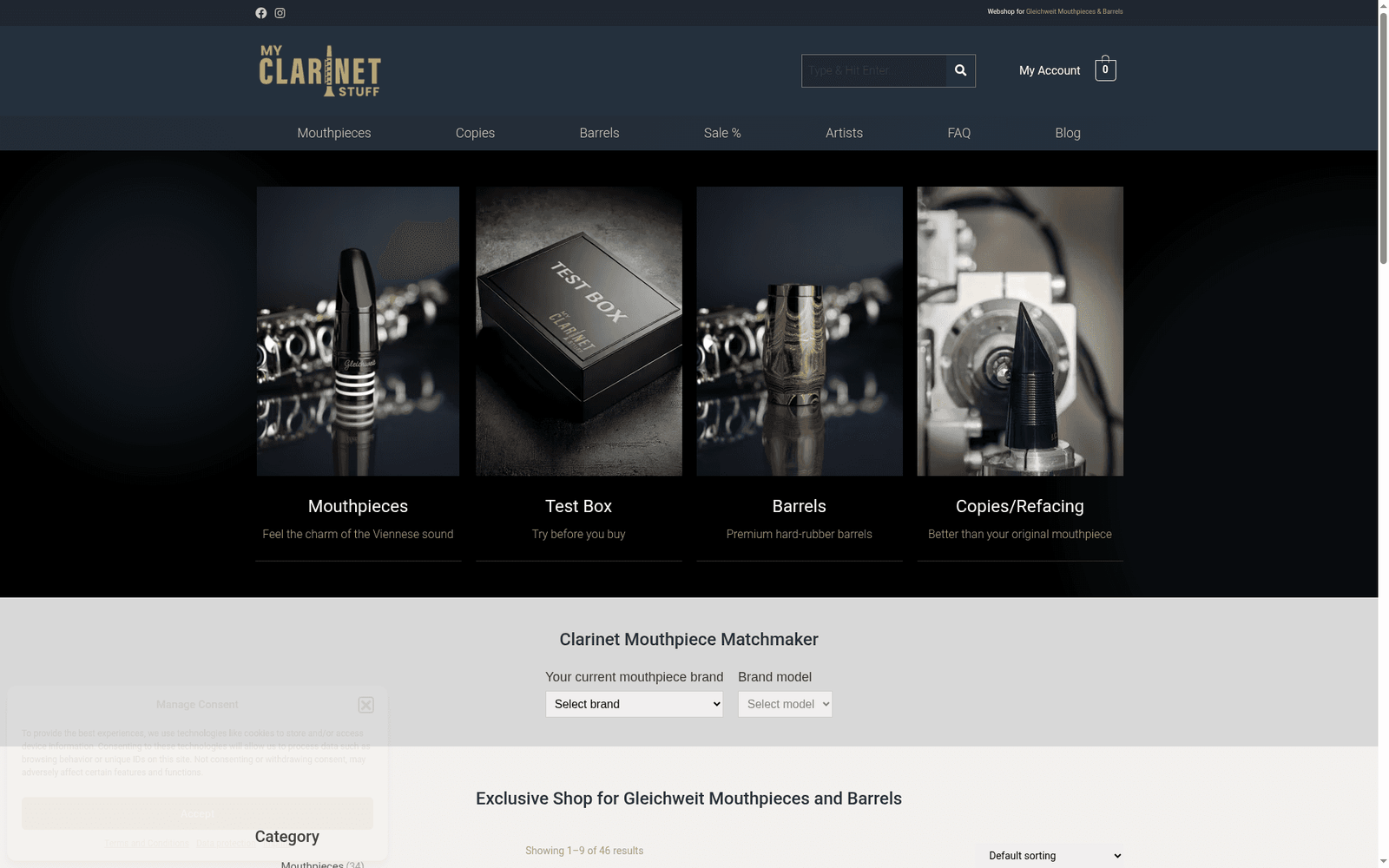
The Clarinet Mouthpiece Matchmaker helps you identify the right starting facing based on your current setup and playing style. From there, you can order a variety pack test box that covers open, medium, and closed tip openings in a single trial. Support is available for students, educators, and professional players throughout the process. Visit Myclarinetstuff.com to start your trial and find the facing that fits your playing.
Useful sources
- How to Choose a New Clarinet Mouthpiece — Jenny Maclay — Practical educator guide emphasizing trials and sound over spec-matching.
- Understanding and Selecting a Clarinet Mouthpiece — Band Director Media Group — Anatomy primer covering facing, tip opening, and side rails.
- So You Want to Buy the Same Mouthpiece as Dr. AmazingClarinetist? — Lynn Snyder — Practical warning against single-metric selection and the “sum of parts” argument.
- Clarinet Mouthpiece Matchmaker — Myclarinetstuff — Interactive tool and test-box program for U.S. players.