


TL;DR:
- Clarinet intonation is a player-controlled skill involving constant, real-time pitch adjustments across registers and dynamics. It depends on voicing, equipment setup, and practice techniques rather than instrument alone, and mastering it ensures ensemble cohesion and musical confidence. Developing ear sensitivity through targeted exercises like overtones and drone tuning is essential for consistent, in-tune playing.
Intonation is one of the most misunderstood concepts in clarinet playing. Ask ten students what is intonation for clarinet and most will say something vague about playing in tune. The reality is sharper and more specific than that. Clarinet intonation is a dynamic, player-controlled skill that demands constant adjustment across registers, dynamics, and temperature conditions. It is not fixed by your instrument alone, and no single piece of equipment will solve it for you. Understanding clarinet intonation deeply is what separates players who always seem to pull the ensemble off-center from those who lock in every note with authority.
Table of Contents
- Key takeaways
- What intonation for clarinet really means
- Physical and technical factors that shape your pitch
- Techniques and exercises to improve intonation
- Common intonation issues and how to troubleshoot them
- My perspective on learning clarinet intonation
- Get better intonation with the right setup
- FAQ
Key takeaways
| Point | Details |
|---|---|
| Intonation is player-driven | No instrument plays perfectly in tune on its own; you actively shape pitch through voicing and technique. |
| Voicing is your secret tool | Tongue position and oral cavity shaping give you real-time pitch control without squeezing your embouchure. |
| Equipment matters, but is not everything | Mouthpiece, reed, and barrel choices set your baseline, but technique fills the gap. |
| Dynamics change your pitch | Clarinet goes flat in a crescendo and sharp in a decrescendo, unlike brass. You must compensate. |
| Practice intonation deliberately | Overtone exercises and ear training build the internal pitch awareness you need to self-correct in real time. |
What intonation for clarinet really means
In musical terms, intonation refers to how accurately a player produces pitches in relation to a reference standard, typically A=440 Hz or the pitch center agreed upon within an ensemble. For clarinet specifically, this gets complicated fast.
The clarinet’s acoustic design is based on a cylindrical bore that overblows at the twelfth rather than the octave. This unusual harmonic structure means the instrument’s odd harmonic behavior makes some notes naturally sharp, some naturally flat, and certain registers especially unstable. No amount of mechanical fine-tuning will fully resolve these built-in tendencies. The player must manage them.
Here is why understanding clarinet intonation matters beyond just “sounding good”:
- Ensemble blend: When you are sharp or flat relative to your section or the piano, the sound becomes acoustically dissonant. Listeners hear it even when they cannot name it.
- Musical expression: Intentional pitch inflection is part of phrasing. But unintentional pitch drift undermines your musical line completely.
- Confidence and trust: Players who play in tune earn the trust of conductors, colleagues, and audiences. It is a marker of mature musicianship.
- Register consistency: The clarinet’s throat tones (G, A, Bb above the staff) are notoriously flat on most instruments. Knowing this ahead of time lets you compensate rather than react.
The clarinet also presents a counterintuitive dynamic challenge. Intonation shifts with volume changes: a crescendo pushes pitch flat, while a decrescendo makes notes go sharp. Brass instruments behave in the opposite direction. This means the adjustments you have practiced on another wind instrument may work against you on clarinet.
Pro Tip: Tune a sustained note with a drone and then slowly crescendo and decrescendo. Watch your tuner. That real-time drift is exactly what you need to train yourself to correct.
Physical and technical factors that shape your pitch
The role of your equipment
Equipment choice forms the foundation for intonation stability before you even put the clarinet to your lips. Your mouthpiece tip opening and facing length affect how much the reed vibrates and at what pitch center. A more open tip opening generally allows more flexibility, for better or worse. A harder reed on a narrow tip opening can push throat tones sharper. A softer reed on an open tip can destabilize the upper register.
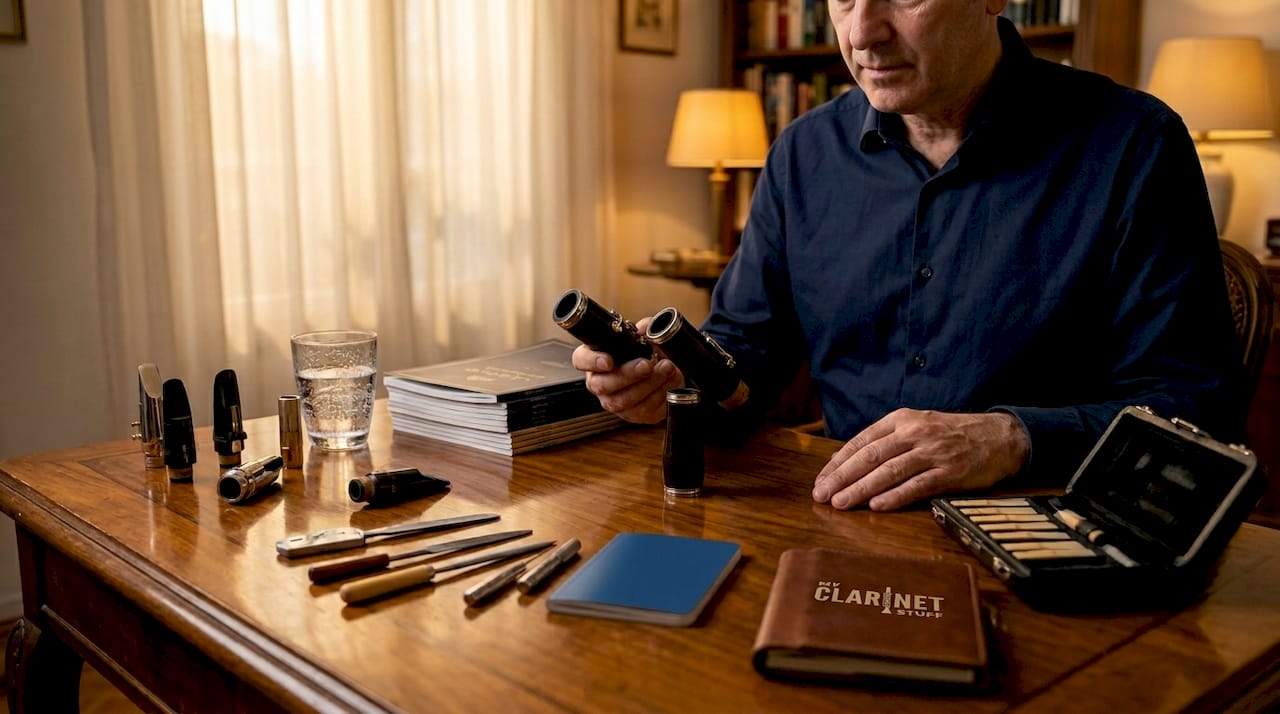
The barrel matters more than most players realize. Minor bore and bell design changes of just 0.1 to 0.2 mm can shift note tendencies by 5 to 10 cents, which is the difference between sounding in tune and sounding noticeably off. A longer barrel lowers the overall pitch. A shorter barrel raises it. This is your coarsest tuning tool.
| Equipment factor | Effect on pitch | Player action |
|---|---|---|
| Barrel length | Longer = flatter; shorter = sharper | Adjust before playing to set baseline |
| Mouthpiece tip opening | Wider allows more pitch flex | Match to your reed strength and style |
| Reed strength | Too soft = flat; too hard = sharp | Test reeds systematically across registers |
| Bore diameter | Wider bore = lower pitch center | Consider when upgrading instruments |
Embouchure and voicing
Here is where most intonation problems actually live. Many players squeeze the embouchure tighter when they hear themselves going sharp, or loosen it when flat. This works in the short term but destroys tone quality over time. Players who rely solely on embouchure tension for tuning lose the warm, resonant tone color that good clarinet playing requires.
The real tool is voicing. Voicing refers to the position of your tongue and the shape of your oral cavity inside your mouth. A high tongue position (as if saying “ee”) raises pitch and brightens tone. A lower, more open position (closer to “oh” or “aw”) lowers pitch and adds warmth. Tongue and vocal tract adjustments give you flexible pitch compensation without compromising your embouchure’s grip, flexibility, or seal.
Air support interacts with voicing constantly. Increased air pressure without voicing adjustment pushes pitch flat on clarinet. The combination of a focused oral cavity and steady, supported air is what locks notes into their center.
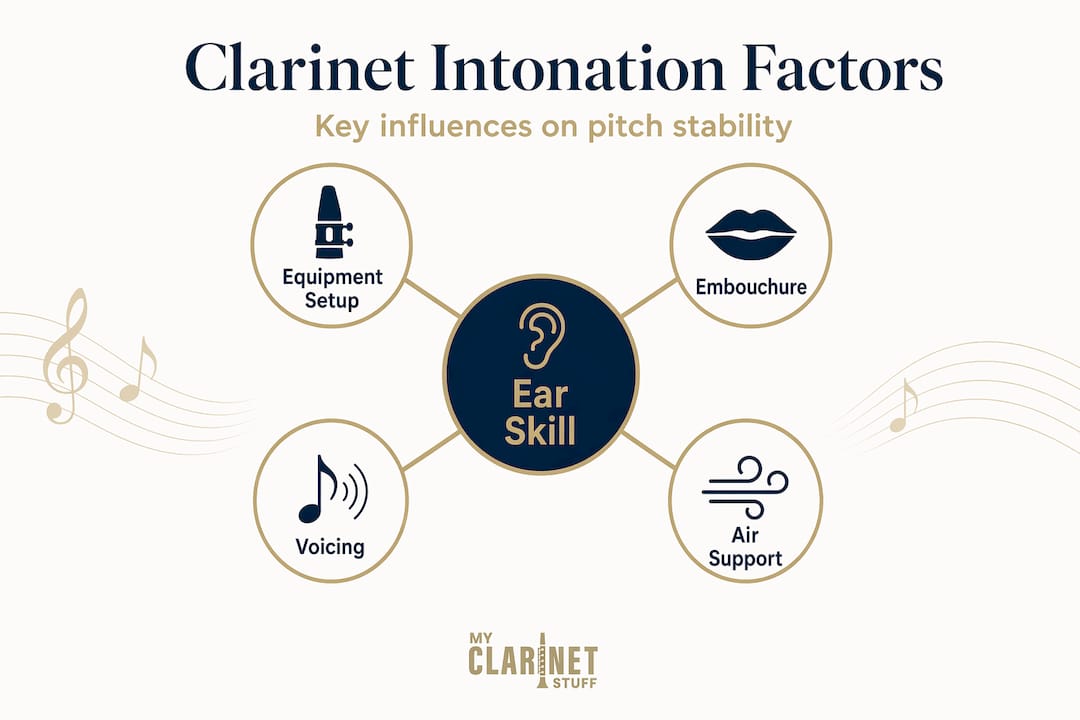
Pro Tip: Say the syllable “ee” then “oh” with a clarinet mouthpiece in your mouth and no instrument attached. Notice how your internal mouth space changes. That physical shift is exactly what voicing adjustment feels like in practice.
Techniques and exercises to improve intonation
Improving clarinet intonation is not about practicing more of the same. It requires targeted work that builds pitch awareness and physical control simultaneously. Here is a sequence that works:
-
Overtone practice. Start on a written low E or F and overblow to produce the harmonics above it without using the register key. Sustaining fundamentals and adjusting voicing to produce overtones sharpens your pitch centering and trains your oral cavity to find notes independently of fingering. Do five to ten minutes of this daily.
-
Drone tuning. Play a sustained A or Bb from a tuner, a phone app, or a keyboard. Hold notes from your most problematic register against the drone. Do not look at the tuner needle. Train your ears to hear beats, the slight wavering you hear when two pitches are close but not exactly aligned. When the beats disappear, you are in tune.
-
Alternate fingerings. Clarinet’s player-driven intonation requires using alternate and resonance fingerings as standard tools, not workarounds. The forked Bb, the side Bb, the long Eb, and half-hole fingerings all produce pitch results that standard fingerings cannot match in certain contexts. Learn at least three alternates for your sharpest and flattest notes.
-
Scales with a tuner and metronome together. This forces you to make intonation adjustments in real time without stopping to analyze every note. Play slowly at first. Move the metronome up only when every note lands cleanly in tune.
-
Long tones with dynamic swells. Play a single note, crescendo for four counts, decrescendo for four counts, and use voicing to keep the pitch centered throughout. This is the most direct way to build the habit of compensating for dynamic pitch drift.
Check out this pitch accuracy guide from Myclarinetstuff for additional exercises built around these principles.
Common intonation issues and how to troubleshoot them
Even experienced players run into stubborn intonation problems. Here are the most common ones and their actual solutions.
-
Throat tones are flat (G, A, Bb). This is nearly universal across student-level instruments. The fix is a combination of raising voicing (use that “ee” tongue position), adding a resonance fingering such as adding the right-hand index finger below the break, and considering a shorter barrel to raise the overall pitch baseline.
-
Chalumeau register notes go sharp. This often signals a reed that is too soft or a mouthpiece tip opening that is too wide for your current air support. Check your equipment setup first before making embouchure changes.
-
High clarion register pitches go sharp in loud passages. You are overbowing. Increase voicing space and reduce upper lip pressure simultaneously. The high register is highly sensitive to air speed.
-
Temperature changes during a performance. Cold air makes pitch drop. Warm air makes pitch rise. Warm up your instrument before you tune, not after. Pull out the barrel slightly in a warm hall, push in slightly in a cold environment.
-
Barrel and mouthpiece adjustments cause new problems. This is because 1mm changes to the barrel or tuning slide shift overall pitch by only 3 to 5 cents. Large pulls create uneven intonation across registers. Make small adjustments and check multiple pitches before committing.
-
Intonation collapses during pianissimo passages. Your air support is dropping off and your voicing is collapsing with it. Maintain consistent air column intensity even at soft dynamics. Think “small but fast” rather than “slow and quiet.”
For more guidance on embouchure technique as it connects to intonation, the embouchure tips guide at Myclarinetstuff covers advanced approaches that directly apply here.
My perspective on learning clarinet intonation
I have worked with and observed hundreds of clarinet players across skill levels, and the single biggest mistake I see is treating intonation like a problem to be solved once and then forgotten. Players find a barrel length that “works,” set their tuner to A=440, check a few notes, and consider themselves sorted. That is not intonation. That is tuning. They are not the same thing.
What I have found is that intonation is almost entirely an ear skill before it is a physical skill. Players who develop genuine pitch sensitivity hear problems before they manifest as flat or sharp notes. They feel the wavering of out-of-tune intervals and adjust without thinking. Getting there requires a specific kind of practice that most people avoid: slow, isolated, uncomfortable drone work where you cannot hide behind vibrato or tempo.
My honest take is that the clarinet cannot be perfectly in tune across all registers and that this is not a flaw to overcome but a characteristic to manage. The players I find most compelling to listen to are not the ones who are mechanically precise. They are the ones whose pitch choices feel intentional, whose tuning is responsive to whoever they are playing with at that moment.
If you are stuck on intonation, stop adding new exercises and spend two weeks doing only drone work and overtones. You will come out the other side with ears you did not know you had.
— Milos
Get better intonation with the right setup

At Myclarinetstuff, we know that great intonation starts with equipment that does not fight you. The Gleichweit mouthpieces available through Myclarinetstuff are CNC-precision machined in Austria to tolerances that eliminate the pitch inconsistency common in hand-finished mouthpieces. When your mouthpiece is consistent, your technique becomes the variable, and that means your practice actually transfers to performance. Use the Clarinet Mouthpiece Matchmaker to find the setup that matches your playing style, register demands, and intonation goals. You can also explore our mouthpiece selection tips if you want to understand the decision from first principles before you buy.
FAQ
What is intonation for clarinet in simple terms?
Intonation is your ability to produce notes at their correct pitch in relation to a tuning standard or other musicians. On clarinet, it requires constant active adjustment through voicing, air support, and sometimes alternate fingerings because the instrument’s design creates built-in pitch tendencies that cannot be corrected mechanically.
Why does clarinet go flat when you play louder?
The clarinet’s cylindrical bore and reed mechanics cause pitch to drop during crescendos, the opposite of brass instruments. Players must compensate by raising tongue position (voicing higher) and increasing air focus to keep pitch centered through dynamic swells.
How does embouchure affect clarinet intonation?
Embouchure sets the baseline pitch relationship between your lips, reed, and mouthpiece. However, relying on embouchure tension alone to correct pitch sacrifices tone quality. Voicing and air support are more precise and less damaging tools for real-time intonation adjustment.
What are the most out-of-tune notes on clarinet?
Throat tones, specifically open G, A, and Bb, tend to be flat on most instruments. These notes require raised voicing, resonance fingerings, and sometimes a shorter barrel to bring them up to pitch without tightening the embouchure excessively.
How do I practice clarinet intonation effectively?
Combine daily overtone exercises, drone tuning against a sustained reference pitch, and slow scales with a tuner. This builds both ear awareness and the physical voicing habits that allow real-time pitch correction during performance.
Recommended
- Clarinet Performance Tips Guide for Achieving Your Best Sound – My Clarinet Stuff
- Clarinet Tone Color: Techniques and Mouthpiece Choices – My Clarinet Stuff
- How to Improve Clarinet Tone: A Practical Guide – My Clarinet Stuff
- Clarinet registers explained: Your guide to mastering each range – My Clarinet Stuff