
Articulation is the single most misunderstood concept in clarinet playing. Most students hear the word and immediately think about tongue placement, but that’s only part of the picture. Great articulation is a coordinated system involving your air support, embouchure, and tongue working together to shape every note you play. Whether you’re performing a Mozart concerto, a jazz standard, or a folk melody, the way you articulate defines your musical voice. This guide covers what articulation really means, the main types you need to know, how to build real skill through practice, and how your equipment fits into the equation.
Table of Contents
- What is clarinet articulation?
- Types of clarinet articulation: Legato, staccato, and more
- How to develop strong clarinet articulation skills
- Clarinet setup and accessories: Do they affect articulation?
- The hidden truth about mastering clarinet articulation
- Find your perfect setup for excellent articulation
- Frequently asked questions
Key Takeaways
| Point | Details |
|---|---|
| Clarity is crucial | Precise articulation makes your playing more expressive and professional. |
| Technique plus setup | Both your practice habits and your clarinet gear influence your articulation results. |
| Adapt for style | Different genres and settings require flexible articulation approaches. |
| Practice smart | Focus on slow exercises and regular assessment to steadily improve your articulation. |
What is clarinet articulation?
Articulation on the clarinet refers to how you initiate, separate, and connect notes. It’s not just tonguing. It’s the combined result of your tongue movement, breath pressure, and embouchure shaping the attack and release of each pitch. Think of it like punctuation in writing: without it, even the most beautiful melody becomes a run-on sentence.
Proper articulation is essential for clear phrasing and stylistic accuracy on the clarinet. That applies from your very first lesson, not just when you reach an advanced level. Many beginners are told to “tongue the note” without being shown how air and embouchure support that action. The result is choppy, uneven playing that lacks musical direction.
Here are the four core articulation types every clarinetist should know:
- Legato: Notes are connected smoothly with minimal tongue interruption. The tongue barely touches the reed.
- Staccato: Notes are short and detached. The tongue makes a crisp, deliberate contact with the reed tip.
- Tenuto: Notes are held for their full value, sometimes slightly longer, with gentle emphasis.
- Accent: A sharp, strong attack at the start of a note, used for expressive impact.
Each of these requires a different coordination between tongue speed, air volume, and embouchure firmness. You can explore clarinet sound tips to understand how these elements interact with your overall tone production.
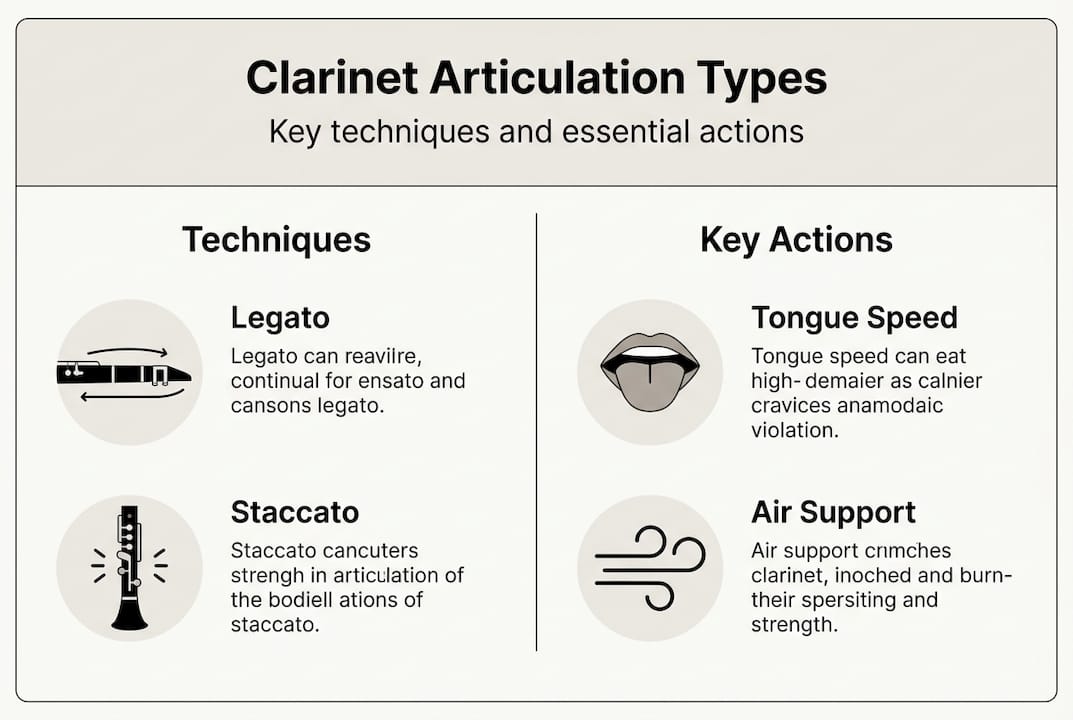
One of the biggest misconceptions is that faster tonguing automatically means better articulation. In reality, tension in the tongue creates muddy attacks. The tongue should move freely, like a small flick, while steady air keeps the sound alive between notes. Articulation teaching methods consistently emphasize that breath is the engine, and the tongue is just the valve.
Pro Tip: Before your next practice session, try playing a scale using only air, no tonguing at all. This isolates your breath support and shows you how much work your air is actually doing. Then add the tongue back in and notice the difference in control.
Building good articulation habits early, supported by clarinet warm-up advice, sets the foundation for everything from clean technical passages to expressive musical phrasing.
Types of clarinet articulation: Legato, staccato, and more
Now that we’ve established what articulation involves, let’s look at how each type functions in practice and where you’ll use them across different musical styles.
“Different styles of articulation are essential for expressive performance across musical genres.” That’s not just a theory. Classical music demands precise legato lines and controlled staccato. Jazz relies on swing articulation with a softer, more relaxed tongue. Folk music often calls for a punchy, rhythmic attack that drives the dance feel.
Here’s a quick comparison of the main articulation types:
| Articulation | Air flow | Tongue movement | Common use |
|---|---|---|---|
| Legato | Steady, continuous | Minimal, light touch | Classical phrases, lyrical passages |
| Staccato | Short bursts | Quick, firm contact | Baroque ornaments, rhythmic figures |
| Tenuto | Full, sustained | Gentle, controlled | Expressive melodies, sustained lines |
| Accent | Strong initial push | Sharp, decisive | Jazz, orchestral emphasis |
Choosing the right articulation for the musical context is a skill in itself. Here are four steps to help you make better decisions:
- Listen first. Before playing a passage, listen to professional recordings and identify what articulation they’re using.
- Mark your score. Write in articulation symbols or shorthand notes directly on your music.
- Practice in isolation. Extract a single phrase and practice it using different articulation styles to hear the contrast.
- Match the style. Ask yourself whether the music calls for a smooth classical line, a punchy jazz feel, or a rhythmic folk drive.
The clarinet articulation nuances used in a Brahms sonata are completely different from those in a klezmer tune. In classical playing, legato is often the default with staccato as a contrast. In jazz, a softer, slightly late tongue placement creates that characteristic swing feel. In folk styles, short and rhythmic articulation keeps the energy alive.
“Articulation is the grammar of music. Get it right, and your phrasing becomes a language your audience understands immediately.”
Your accessory impact on articulation is also worth considering here. A mouthpiece with a more open facing, for example, responds differently to tongue pressure than a close-facing model. Understanding this connection helps you make smarter choices about your setup.
How to develop strong clarinet articulation skills
Understanding the range of articulations is just the start. Building real skill means structured, intentional practice over time. Here’s how to approach it effectively.
Structured practice and warm-up routines are vital for mastering clarinet articulation. That means dedicating specific time in every session to articulation work, not just running through repertoire and hoping it improves.
Follow these steps to build a solid articulation practice routine:
- Start slow. Use a metronome at 60 bpm or slower. Clarity at a slow tempo always precedes speed.
- Use long tones with articulation. Play a single note and practice starting it with different articulation types: legato, staccato, tenuto. Focus on the attack quality.
- Run scales with articulation patterns. Try all slurred, all tongued, then alternating patterns like two slurred and two tongued.
- Apply to etudes. Use short etudes specifically written for articulation development. Klose and Rose etudes are excellent starting points.
- Integrate into repertoire. Once you’ve isolated the skill, bring it back into your actual pieces and notice how your phrasing improves.
- Gradually increase tempo. Only raise the metronome when you can play cleanly at the current speed for three consecutive repetitions.
Self-assessment is a skill most players underuse. Articulation exercises are more effective when you’re actively listening to your own output. Record your practice sessions and compare your articulation to recordings of professional clarinetists. You’ll hear things your ears miss in the moment.
Pro Tip: Record a short passage, then listen back and ask yourself one specific question: “Is each note starting cleanly, or is there a fuzzy attack?” Targeting one element at a time is far more productive than trying to fix everything at once.
You can also explore clarinet articulation warm-ups and accessories for better articulation to support your daily routine with the right tools and habits.
Clarinet setup and accessories: Do they affect articulation?
Great technique matters most, but your equipment plays a real supporting role. The right setup can make articulation feel natural and responsive. The wrong setup can fight you at every turn.
The right equipment can make articulation easier and more consistent. Here’s how each component factors in:
| Accessory | Articulation impact |
|---|---|
| Mouthpiece facing | Closer facing requires less tongue pressure, easier staccato |
| Reed strength | Softer reeds respond faster but can feel unstable; harder reeds need more air |
| Ligature | A free-vibrating ligature improves reed response and attack clarity |
| Barrel length | Affects intonation stability, which indirectly supports consistent articulation |
The mouthpiece is the most significant variable. A mouthpiece with a well-designed tip rail and facing curve allows the reed to vibrate freely, which means your tongue has a clean surface to work with. Synthetic mouthpieces, like those from Gleichweit, offer consistent geometry that doesn’t change with humidity or temperature, which is a real advantage when you’re trying to build reliable articulation habits.
Reed strength and cut also matter. A reed that’s too hard requires excessive tongue pressure to start notes cleanly, which tires your tongue quickly. A reed that’s too soft collapses under firm articulation and produces a weak, unfocused attack. Finding the right balance for your embouchure and mouthpiece is essential.
Here are the key things to check in your setup:
- Reed placement: The tip of the reed should align precisely with the tip of the mouthpiece. Even a small misalignment affects attack clarity.
- Ligature position: Experiment with ligature placement. Moving it slightly can change how freely the reed vibrates.
- Mouthpiece depth: How far you take the mouthpiece into your mouth affects tongue reach and control.
Pro Tip: If your articulation feels inconsistent from day to day, check your reed first. Reeds change with humidity and use. Rotating between three to five reeds and marking their condition helps you identify patterns and avoid bad reed days derailing your practice.
Explore mouthpiece impact on articulation and mouthpiece selection tips to find gear that supports your specific articulation goals. You can also check clarinet accessory tips for broader guidance on setup optimization.
The hidden truth about mastering clarinet articulation
Here’s what most articulation guides won’t tell you: the skills you build in a quiet practice room are just the beginning. What separates good clarinetists from great ones is the ability to adapt articulation in real time, on a live stage, in a reverberant hall, or in a tight chamber ensemble where every detail is exposed.
Most students obsess over tongue placement and forget that musical intention drives everything. You can have technically perfect staccato and still sound mechanical if you’re not listening to the phrase as a whole. The best clarinetists we’ve heard treat articulation as a flexible tool, not a fixed rule. They adjust based on the room, the ensemble, the conductor’s gesture, and the emotional arc of the music.
The clarinet upgrade experience often reveals this truth. When players move to better equipment, they suddenly hear nuances in their articulation they couldn’t detect before. That’s not just the gear. It’s the increased sensitivity that comes with playing something more responsive.
Experiment boldly. Try articulating a phrase five different ways and choose the one that communicates the most. Prioritize musical communication over technical perfection every time.
Find your perfect setup for excellent articulation
Building great articulation takes practice, but the right equipment removes unnecessary obstacles from your path.

At MyClarinetStuff.com, we carry precision-crafted Gleichweit mouthpieces designed to give you consistent reed response and clean attack clarity, session after session. Whether you’re working on staccato in a Beethoven symphony or swing articulation in a jazz ensemble, the right mouthpiece makes a measurable difference. Use our mouthpiece matchmaker to find the model that fits your playing style, or browse our clarinet accessory guide for reeds, ligatures, and barrels that support your articulation goals. Visit the full clarinet gear shop and find your ideal setup today.
Frequently asked questions
What does clarinet articulation mean in simple terms?
Clarinet articulation is the way you use your tongue and breath to start, separate, and shape each note for clear and expressive sound. It’s the combination of tonguing, breath, and embouchure working together.
How do I improve my staccato articulation on clarinet?
Start with slow, deliberate practice and use daily articulation exercises, gradually increasing speed only once you maintain clarity at the current tempo.
Does my clarinet mouthpiece or reed affect my articulation?
Yes. Equipment choices directly impact articulation responsiveness and clarity, with mouthpiece facing and reed strength being the two most influential variables.
What is the difference between legato and staccato on clarinet?
Legato and staccato differ in tongue movement and air support: legato connects notes smoothly, while staccato makes each note short and detached through quicker, firmer tongue contact.
Can clarinet articulation techniques be used for all music styles?
Yes, but flexible articulation approaches are needed for each genre. Classical, jazz, and folk each call for different tongue placement, air pressure, and attack style to match the musical context.