
TL;DR:
- Mouthpiece response describes how quickly and easily a clarinet setup reacts to the player’s air and embouchure. It depends on design elements like tip opening, chamber size, and bore shape, with the ideal balance tailored to individual playing style and anatomy. Systematic playtesting with consistent conditions and moisture levels helps players optimize response for better tone and control across all registers.
Specs alone don’t explain why two players using the identical mouthpiece can sound completely different. Clarinet tone is a partnership between equipment and the person holding the instrument, and the concept of mouthpiece response sits right at the center of that relationship. Player-specific playtesting consistently outperforms relying on specs alone, and experts like Brad Behn and David McClune emphasize that a balanced “working resistance” is the real goal. This article breaks down what mouthpiece response actually means, what shapes it, and how you can optimize it for your playing.
Table of Contents
- Defining mouthpiece response: What does it mean?
- How mouthpiece design shapes response
- Experience-led selection: Why playtesting matters most
- Common pitfalls and expert tips for optimizing response
- Why mouthpiece response is misunderstood and what works in practice
- Explore clarinet mouthpiece solutions for tailored response
- Frequently asked questions
Key Takeaways
| Point | Details |
|---|---|
| Response is personal | True mouthpiece response depends on your playing style, reed, and environment. |
| Design impacts performance | Facing, chamber, and tip opening define how easily and reliably your clarinet responds. |
| Hands-on testing is essential | Playtesting mouthpieces is more effective than relying solely on specs. |
| Balanced resistance matters | Optimal response provides both freedom and control for tone and articulation. |
| Moisture affects results | Reed moisture changes frequency response, so test consistently for best outcomes. |
Defining mouthpiece response: What does it mean?
Building on the importance of setup, let’s clarify what “mouthpiece response” really means for clarinetists.
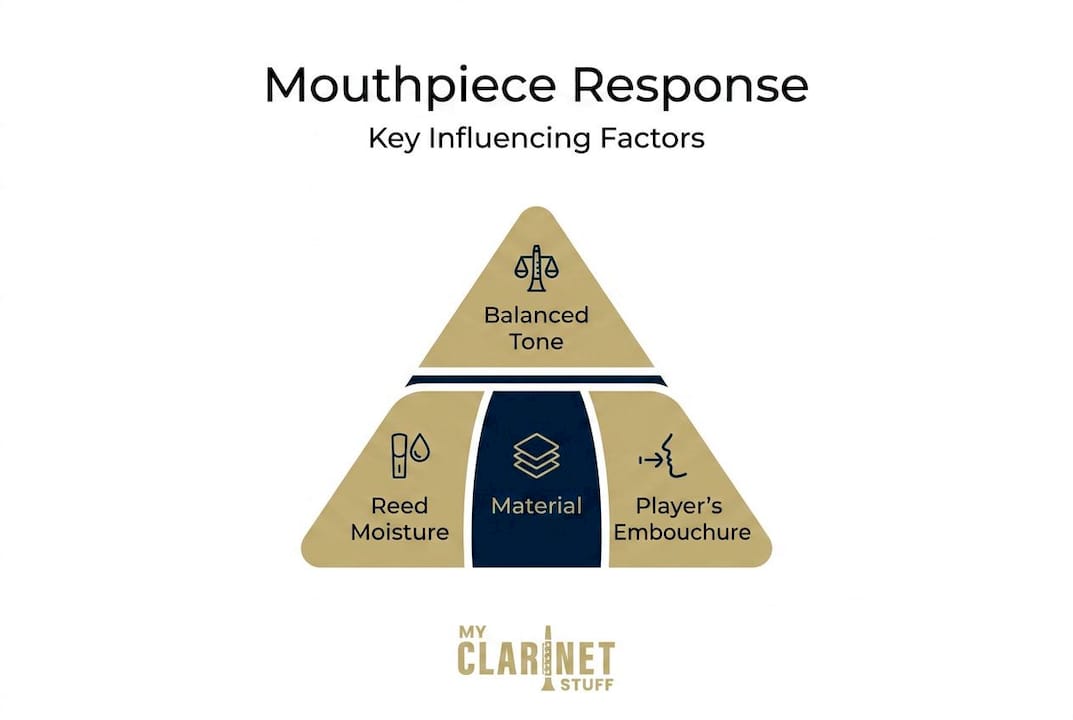
Response is the speed and ease with which your setup reacts to your air, embouchure, and articulation. When you tongue a note softly in the low register, does the sound speak immediately and cleanly? When you push into the altissimo, does the mouthpiece cooperate without choking? Those experiences are what clarinetists are describing when they talk about response. It directly shapes your clarinet sound and playability in every register, at every dynamic level.
Here are the key dimensions of mouthpiece response that clarinetists need to understand:
- Freedom vs. resistance: A free-blowing setup responds easily but can feel unpredictable at soft dynamics. A resistant setup gives more control but can tire the embouchure faster.
- Evenness across registers: Good response means the clarion doesn’t suddenly go bright and harsh while the chalumeau stays dark and controlled.
- Articulation clarity: A responsive mouthpiece lets you tongue cleanly at tempo without each note “popping” or “thudding.”
- Dynamic range: Response affects how easily you can swell from piano to forte and back without the reed shutting down.
There’s a nuance here that textbooks often skip. As saxophone doublers have noted, the clarinet by nature carries higher acoustic resistance than a saxophone. This means what feels “free” on clarinet would feel extremely resistant on alto sax. If you’re a doubler, recalibrating your expectations matters enormously. Too much resistance on a clarinet mouthpiece means you’ll need a much softer reed just to get sound out. Too little resistance, and the setup becomes unreliable, losing the kind of tonal focus that makes classical and chamber music work.
“Ideal response is not the freest or the most resistant option. It is the balance point where your technique and the mouthpiece agree on how much air equals how much sound.” — Principle shared across professional clarinet pedagogy
The important takeaway: optimize your response based on how you actually play, not on what the spec sheet promises.
How mouthpiece design shapes response
Having defined what response means, let’s examine how mouthpiece design shapes this critical characteristic.
Every measurable aspect of a mouthpiece has a direct effect on how it responds. Understanding these connections lets you have smarter conversations with teachers, retailers, and yourself when evaluating equipment.
| Design element | Effect on response | Practical implication |
|---|---|---|
| Tip opening | Wider opening increases freedom and dynamic range | Requires softer reeds or stronger embouchure |
| Facing length (lay) | Longer lay adds flexibility; shorter lay adds control | Shorter lay suits classical playing; longer lay suits jazz |
| Chamber size | Larger chamber produces darker tone, slightly more resistance | Smaller chamber brightens tone, often freer response |
| Baffle height | High baffle adds brightness and projection | Reduces resistance, can cause shrillness if too high |
| Bore shape | Cylindrical bore maintains clarinet evenness across registers | Affects upper register response significantly |
The facing and chamber interact in ways that most people don’t immediately notice. Experts consistently point to balanced working resistance as a product of how the facing geometry and chamber shape work together, not just one factor in isolation. A wide tip opening paired with a large chamber can actually produce a warm, controlled response if the facing length is right. Conversely, a narrow tip opening with a high baffle can feel frustratingly tight in the upper register. This interplay is exactly why choosing the best mouthpiece is never as simple as picking the widest or narrowest opening available.
Your embouchure adds a biological layer to all of this. Artificial mouth research has shown that the vocal tract tunes resonances in ways that reinforce the clarinet’s even harmonics when the glottis is held near-closed. In practical terms, this is why two players can use identical setups and still produce noticeably different response characteristics. Your throat shape, tongue position, and jaw pressure are all active variables.
Reed moisture matters more than most players realize. The same studies confirm that reed vibrational frequencies drop approximately 8% when the reed is fully wet compared to dry. This means a reed that feels stiff and resistant at the start of a rehearsal may feel noticeably freer thirty minutes in. If you’ve ever had the experience of “warming up” into a reed that seemed too hard at first, this is the acoustic reason.
The mouthpiece material also contributes to how response is perceived. Hard rubber and synthetic materials behave differently in terms of vibration transmission. Synthetic mouthpieces, like Gleichweit’s CNC-crafted models, eliminate the internal inconsistencies that occur naturally in hard rubber, meaning the design geometry you read on the spec sheet is actually what you’re playing. That clarity in sound design translates directly to more predictable response from one mouthpiece to the next.
Pro Tip: Wet your reed thoroughly before any serious playtest. A dry reed will give you artificially stiff resistance readings, which makes accurate comparison impossible.
Experience-led selection: Why playtesting matters most
Now that you understand the physical factors, let’s look at practical strategies for finding your ideal mouthpiece response.
No matter how much you study specs, you cannot predict with certainty how a mouthpiece will respond in your hands, on your face, with your air. Response optimization is inherently personal, and consistent setup conditions are what separate a useful playtest from a frustrating guessing game.
Here’s a simple framework for comparing mouthpieces systematically:
- Use the same brand and strength of reed for every comparison. This removes one variable from your test environment completely.
- Play in the same room, ideally at the same temperature. Humidity and temperature affect both reed response and the acoustic properties of the room.
- Record yourself rather than relying on memory. What you hear while playing and what a recording reveals are often strikingly different.
- Test all registers within a few minutes, not just the middle. Chalumeau response and altissimo response can differ dramatically on the same mouthpiece.
- Test at multiple dynamic levels. A mouthpiece that responds freely at forte may close down or thin out at pianissimo.
- Rest between mouthpieces for at least five minutes. Embouchure fatigue affects your perception of resistance more than almost any other factor.
| Factor | Controlled playtest | Uncontrolled playtest |
|---|---|---|
| Reed | Same brand, strength, age | Different brands or worn reeds |
| Room | Consistent acoustics, temperature | Multiple rooms, different humidity |
| Timing | Equal time on each mouthpiece | More time on familiar setup |
| Feedback method | Recording used | Memory only |
| Fatigue | Rested between trials | Back-to-back testing |
For a detailed approach, the guides on testing mouthpiece tone and step-by-step mouthpiece testing are worth reading before any serious mouthpiece comparison session.
Pro Tip: Write brief notes immediately after each mouthpiece trial instead of comparing everything at the end. Memory blurs fast, especially after five or six trials in one session. Focus on one word: did it feel “open,” “tight,” “even,” “bright”?
One often-ignored factor is the ligature. Swapping ligatures mid-test introduces another variable that distorts the comparison. Use your everyday ligature for every mouthpiece you test, and only change the ligature intentionally and separately. Some players have discovered through careful testing that the ligature they’ve been using was actually limiting the response of a mouthpiece they had written off prematurely. Review these tips for choosing mouthpieces to build a consistent evaluation habit.
Common pitfalls and expert tips for optimizing response
After discussing how to test mouthpieces, let’s cover common mistakes and expert guidance for optimizing your unique response.
Even experienced players fall into predictable traps when chasing better response. Recognizing these pitfalls before they waste your time and money is worth more than any single equipment upgrade.
Common mistakes clarinetists make:
- Testing mouthpieces with a new, dry reed fresh from the box
- Comparing mouthpieces across different practice sessions rather than in a single sitting
- Choosing a mouthpiece based entirely on what a famous soloist uses
- Assuming more resistance always means better tone or more control
- Ignoring the impact of the barrel on response (barrel bore affects the entire setup’s resistance balance)
- Making decisions during a high-fatigue rehearsal or after illness
Reed condition and moisture are the biggest uncontrolled variables in most informal playtests. As acoustic research confirms, a wet reed vibrates at lower frequencies than a dry one, fundamentally changing how the setup feels and responds. This is not a minor adjustment. An 8% frequency shift is audible and perceptually significant, altering whether a mouthpiece feels balanced or resistant.
The resistance balance question deserves its own focus. An overly resistant setup forces players to compensate by biting harder with the embouchure or by selecting softer reeds than their technique actually prefers. This creates a cascade of problems: embouchure fatigue, intonation instability, and tonal thinning in the upper register. On the opposite end, an extremely free setup can feel exciting in the first few minutes of practice but will frustrate you during soft passages in chamber music, where tonal reliability matters far more than raw freedom.
Understanding the role of reed choice in all of this is essential. Visit the guide on clarinet reeds and response to see how strength ratings interact with tip opening and facing length in real playing conditions.
Pro Tip: If you consistently feel like you’re fighting your mouthpiece for control at soft dynamics, try moving one reed strength harder rather than switching mouthpieces. You may find that the problem is reed-driven, not mouthpiece-driven.
One final pitfall worth naming: chasing someone else’s “perfect” response. What works beautifully for a professional orchestral clarinetist playing a Vandoren B45 with a #3.5 reed in a warm concert hall may be entirely wrong for a jazz player in a cool studio. The essential mouthpiece selection tips resource breaks this down by playing context, which is a useful starting point for narrowing your options before you even pick up a mouthpiece to test.
Why mouthpiece response is misunderstood and what works in practice
Here’s something the clarinet world doesn’t say loudly enough: the concept of “optimal response” is personal by definition. It cannot be standardized, measured on a workbench, or solved by reading a review. The gap between what players think they want and what actually helps them play better is often wide, and it’s usually exposed the moment someone hands them a mouthpiece that doesn’t match the profile they’ve been chasing on paper.
We’ve seen this repeatedly in how players approach clarinet mouthpiece types. A student will read that a certain facing length is “ideal for classical playing” and spend months convinced that any deviation from that spec is wrong. Then they try something slightly outside the standard range and discover it’s actually more responsive for their embouchure and air support style. The spec wasn’t wrong. The assumption that specs alone predict the experience was wrong.
Expert advice on working resistance consistently points toward the same conclusion: balanced resistance is more reliable than chasing either extreme. A mouthpiece that gives you just enough resistance to focus the tone, without locking down the dynamic ceiling, is the sweet spot. But that “just enough” point is completely individual. A player with a strong, developed embouchure and high-volume air support will need a different balance point than a younger student still building embouchure stamina.
The most useful shift in mindset is moving from “what is the best mouthpiece” to “what response characteristics does my playing need right now?” Those needs change as you grow. A mouthpiece that was ideal at conservatory may hold you back at the professional level. Revisiting your setup periodically, ideally once a year or when you notice your tone changing significantly, is a healthy practice. And because real playing conditions matter, controlled playtesting will always outperform any amount of online research.
Explore clarinet mouthpiece solutions for tailored response
Finding your ideal mouthpiece response doesn’t have to be a guessing game based on specs and hope.

At MyClarinetStuff.com, we carry precision-crafted Gleichweit mouthpieces made in Austria, designed to deliver consistent, predictable response across every player level and genre. Because they’re CNC-machined from synthetic material, you get the exact geometry the design specifies, every single time. No hard rubber variability. No surprises. Our exclusive at-home test box program lets you evaluate multiple mouthpieces in your own playing environment with your own reeds, so every comparison is genuinely useful. Explore our full range of Bb clarinet and bass clarinet mouthpieces, barrels, and accessories, and get personalized support from people who actually play clarinet.
Frequently asked questions
How do I know if my mouthpiece response is optimal?
If you can produce your desired tone easily at all dynamics and your reed feels balanced in resistance, your setup is likely well-matched to your playing.
What are signs of poor mouthpiece response?
Excessive resistance, unreliable tone across registers, or needing to constantly swap reeds suggests your mouthpiece isn’t responding optimally for your current setup.
Does reed moisture affect mouthpiece response?
Yes. Studies confirm that reed frequencies drop 8% when fully wet, which meaningfully changes how the setup feels and responds during playing.
Can mouthpiece specs guarantee ideal response?
No. Specs are useful starting points, but real response quality can only be confirmed through hands-on testing in your unique playing environment.
Recommended
- How to Test Clarinet Mouthpieces for Optimal Tone Quality – My Clarinet Stuff
- 5 Tips for Trying and Choosing the Best Clarinet Mouthpiece – My Clarinet Stuff
- Clarinet Tone Customization: Achieving Your Signature Sound – My Clarinet Stuff
- Important 5 Things You Need to Pay Attention to When Choosing the Best Clarinet Mouthpiece – My Clarinet Stuff