
TL;DR:
- The Gleichweit Test Box ships five mouthpieces straight to your door so you can test them in your own room, on your own clarinet, for 7 days — no store trip, no pressure, no guessing from a spec sheet. The convenience is what makes the comparison possible in the first place. And the payoff is audible: players consistently describe the moment they land on the right tip opening as a genuine transformation in tone, projection, and how easily the upper register speaks.
Most clarinetists choose a mouthpiece the hard way: a few rushed minutes in a shop, a mouthpiece recommended by a friend, or a listing bought online and hoped for. None of those methods let you hear what a mouthpiece actually does to your sound once fatigue, room noise, and sales pressure are out of the picture. The Gleichweit Test Box was built to remove that friction entirely — and once the friction is gone, the difference a well-matched mouthpiece makes becomes impossible to miss.
The old way was never convenient
Testing mouthpieces the traditional way asks a lot of a player. You have to travel to a shop that stocks more than one option, play under fluorescent lights in front of a salesperson, and form an opinion in the two or three minutes before the next customer needs the counter. There is no rest between mouthpieces, no familiar room acoustics, and no chance to sit with a choice overnight. Buying online without testing is faster, but it trades one problem for another: no comparison point at all, and a returns process if the guess is wrong.
Neither approach was ever designed around the player’s schedule or environment. That is the gap the test box model closes.
How the test box makes testing convenient
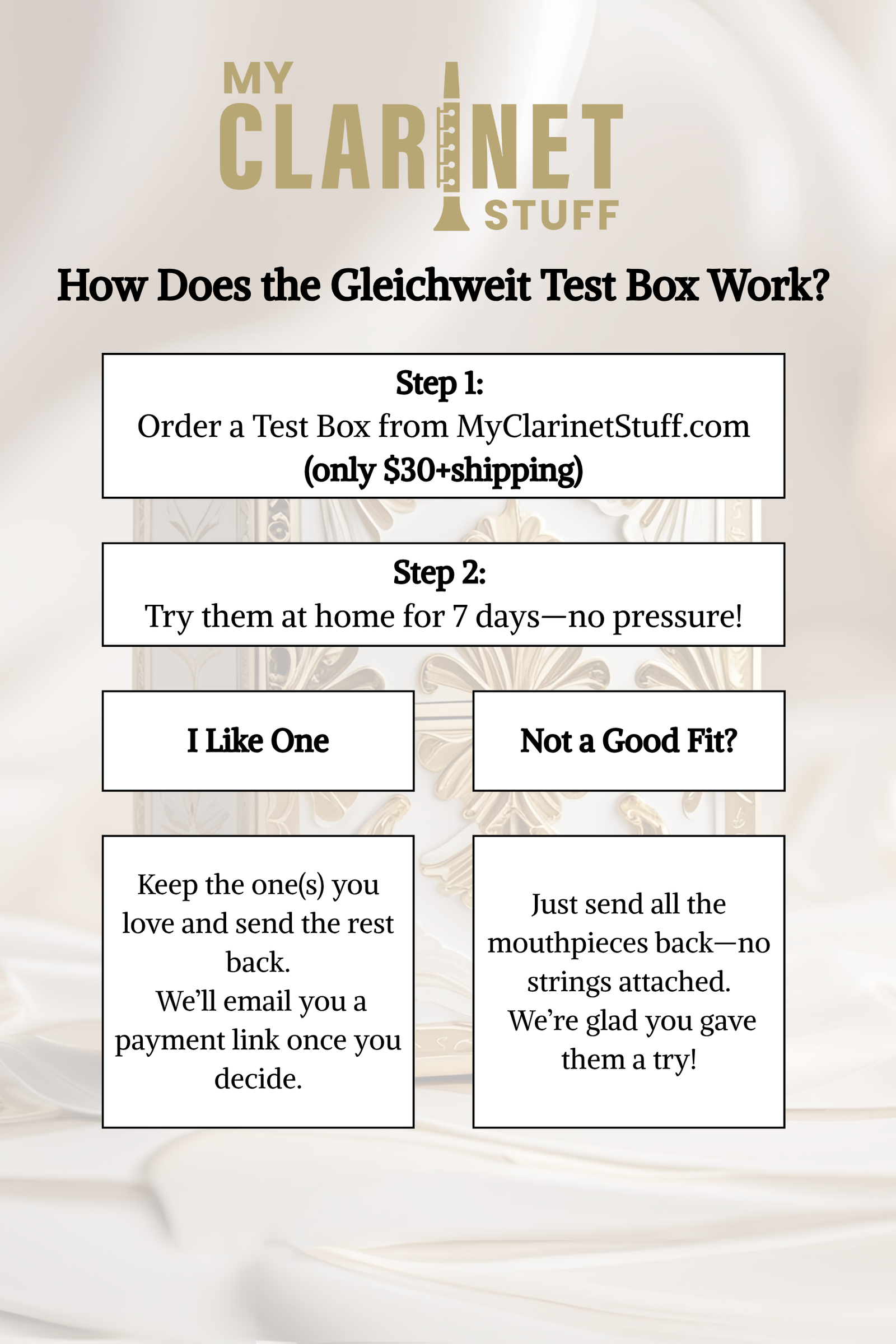
The Gleichweit Test Box turns mouthpiece selection into something you can do on your own time. It ships within 1–2 business days, and once it arrives, you have a full 7 days to play every mouthpiece inside — during your normal practice sessions, in the room you actually rehearse in, on the clarinet and reeds you already own.
The process is deliberately simple:
- Order — the box ships to your door within 1–2 business days.
- Play — try each mouthpiece in your regular practice routine for 7 days.
- Choose — settle on your favorite (or favorites) once you’ve lived with them.
- Pay — you’re only charged for whatever you decide to keep.
- Return — send the rest back yourself, using a tracked shipping service.
- No risk — no commitment and no pressure to decide in the moment.
A flat $40 test fee covers the loan itself; it is not refundable and is not credited toward a purchase. If you keep nothing, that $40 is the only charge. If you keep one or several, you’re invoiced for those at full price. There’s no return label included, so a tracked service is worth the small extra cost — it protects you if anything goes missing on the way back.
That structure is what makes the comparison meaningful. You are not choosing between “the mouthpiece I tried for ninety seconds in a shop” and “the mouthpiece I’ve never touched.” You’re choosing between five mouthpieces you’ve actually lived with for a week.
The real transformation: what changes when you find the right fit
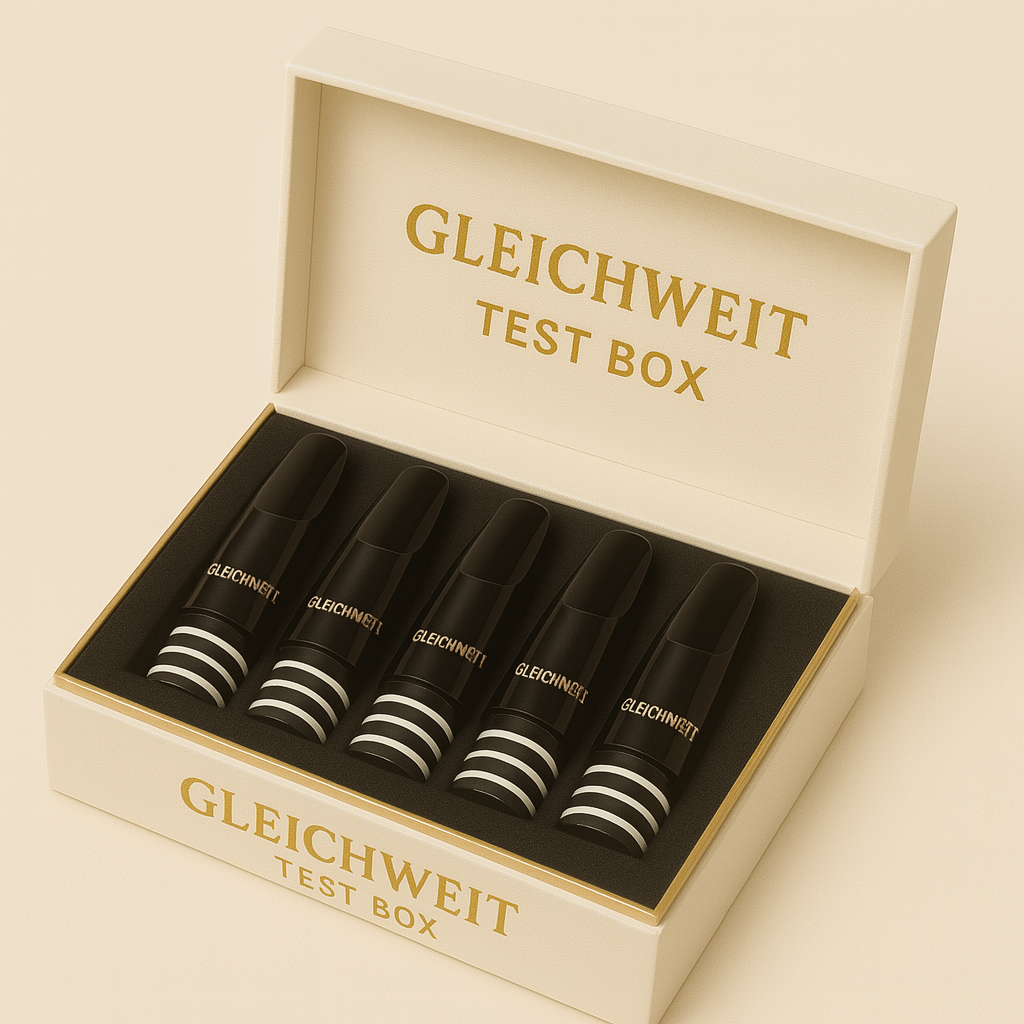
Convenience gets you to the testing table. What happens once you’re there is the part players remember. The Variety Pack spans five tip openings — from 1.16 mm to 1.40 mm — and each step across that range changes how the mouthpiece behaves in ways that are genuinely audible, not theoretical:
- Focus versus openness. A closed tip (1.16–1.20 mm) responds with less air, producing a tight, controlled tone suited to classical and orchestral playing. Move toward the open end (1.27–1.40 mm) and the sound gains volume headroom and expressive flexibility, favored in jazz and band settings.
- Upper register ease. Players upgrading from a stock mouthpiece often notice the biggest change above the staff — notes that used to require extra effort start speaking freely once the tip opening actually matches their embouchure and air support.
- Projection. Playing the same phrase on two or three mouthpieces back to back, in the same room, reveals projection differences that memory alone can’t capture. That side-by-side comparison is the entire point of testing at home rather than relying on a single in-store impression.
- Response and resistance. A tip opening that matches your reed and air support feels less like work. The wrong pairing can feel resistant or unfocused in a way that has nothing to do with your playing and everything to do with a mismatch.
The transformation isn’t subtle once you hear it. It’s the difference between a sound that fights you and one that simply does what you ask of it.
What I’ve noticed watching players find their sound
The players who get the most out of the test box aren’t the ones who blow through all five mouthpieces in one sitting. They’re the ones who take the convenience seriously — they spread the week out, play long tones instead of showpieces, and notice where the sound sits in the room rather than how impressive it feels in the first thirty seconds.
The transformation usually shows up around day three or four, not day one. That’s when a mouthpiece that felt unremarkable on the first try suddenly opens up, or when a player realizes the “easy” one from day one was actually just familiar, not better. Removing the store, the clock, and the salesperson from the equation is what lets that slower, truer impression surface.
— Milos
Key Takeaways
| Point | Details |
|---|---|
| Convenience drives accuracy | Testing at home, on your own schedule and instrument, removes the noise and time pressure that make in-store trials unreliable. |
| 7-day window | The testing period starts the day the box arrives, giving you time to hear differences that a single session can’t reveal. |
| Pay only for what you keep | A flat $40 test fee covers the loan; you’re invoiced separately, at full price, only for mouthpieces you decide to keep. |
| The transformation is in the details | Projection, upper-register ease, and response change noticeably across the tip opening range — differences that are hard to judge quickly but easy to hear over a week. |
| Return shipping is on you | There’s no prepaid label; use a tracked service to protect yourself if a package goes missing. |
FAQ
How long do I get to test the mouthpieces?
Seven days, starting the day the box arrives at your door — not the day it ships.
What does the $40 test fee cover?
It covers the 7-day loan of the mouthpieces. It’s not refundable and isn’t credited toward anything you decide to buy.
What if I don’t like any of them?
Return all five within the 7-day window and you won’t be charged for any mouthpiece — just the $40 test fee.
Do you cover return shipping?
No, return shipping is at your own expense. We recommend a tracked service, since you’re responsible if the package is lost or damaged on the way back.
Try it at home
If you’re not sure where you fall on the tip opening spectrum, the Gleichweit Test Box Variety Pack is the fastest way to find out — five mouthpieces, one shipment, a full week to listen for yourself. Already know you lean closed or open? The Closed Tip and Medium Tip boxes let you go deeper within that range.
One Response