


TL;DR:
- The basset horn is a clarinet family instrument pitched in F, with a four-octave range and a smoky, vocal timbre. Historically developed in the 1760s, Mozart used it extensively in his sacred and chamber works, giving it a distinctive repertoire. It features a narrow bore, extended low keys, and a bent body, requiring precise mouthpiece matching and dedicated maintenance for optimal sound.
A basset horn is a lower member of the clarinet family, typically pitched in F with extended keywork that reaches written low C (sounding F below the staff). It transposes a perfect fifth downward, so written C sounds as F. The usable range spans roughly four octaves, from written low C up to C6, giving it a depth that standard soprano clarinets simply cannot reach. Three names anchor its story: Wolfgang Amadeus Mozart, who wrote some of the most celebrated parts for the instrument; Anton Mayrhofer, one of the early builders credited with its development; and Schwenk & Seggelke, the German workshop producing respected modern examples today.
Quick reference:
- Pitch: F (transposes a perfect fifth down)
- Written range: Low C to C6 (approximately four octaves)
- Sounding range: F (below the bass staff) to F5
- Bore: Narrow cylindrical, typically ~15.5–16.0 mm on small-bore models
- Key historical figure: Anton Mayrhofer (inventor, 1760s–1770s)
- Signature repertoire: Mozart’s Masonic and sacred works
Table of Contents
- How the basset horn is built and why it sounds the way it does
- Origins and historical development of the basset horn
- Where you will encounter the basset horn: key works and listening recommendations
- Leading performers, builders, and ensembles to know
- How the basset horn differs from the Bb clarinet, alto clarinet, and basset clarinet
- Is the basset horn hard to play? Technique and practice tips
- Contemporary uses and recordings worth studying
- Mouthpiece, bore, and reed selection for the basset horn
- When to choose the basset horn and next steps for players
- Key Takeaways
- The basset horn deserves more attention than it gets
- Ready to find the right mouthpiece for your low-clarinet setup?
- Useful sources for further study
How the basset horn is built and why it sounds the way it does
The body shape is the first thing you notice. Unlike the straight tube of a Bb clarinet, the basset horn traditionally features a bent or angled body, often with a curved metal crook connecting the mouthpiece to the upper joint. Modern instruments from makers like Schwenk & Seggelke use a straight or gently angled design in both German and French system configurations, with grenadilla or synthetic materials replacing the older boxwood.
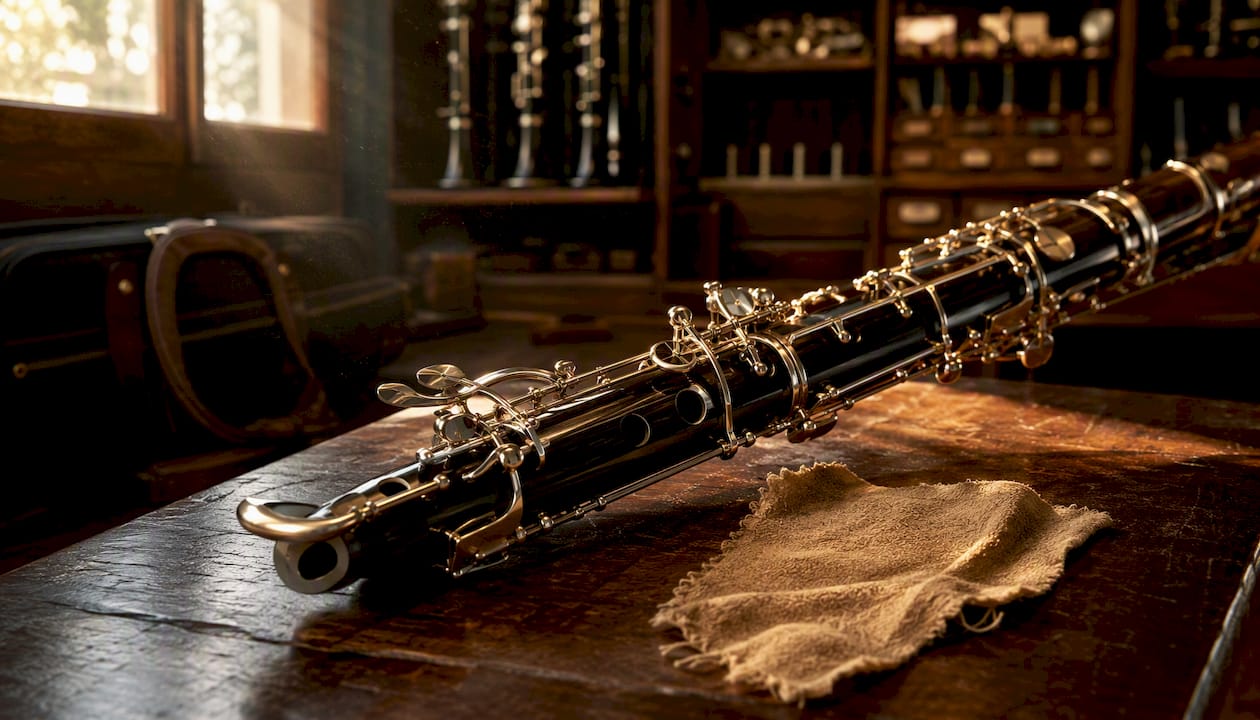
The narrow cylindrical bore is what defines the instrument’s voice. Small-bore models measure approximately 15.5–16.0 mm, producing the smoky, veiled, almost vocal timbre that players and listeners associate with the classical sound. That narrowness creates more resistance than an alto clarinet, which rewards a relaxed throat and a carefully matched mouthpiece facing. Push too hard and the low register thins out; support the air column correctly and the tone blooms.
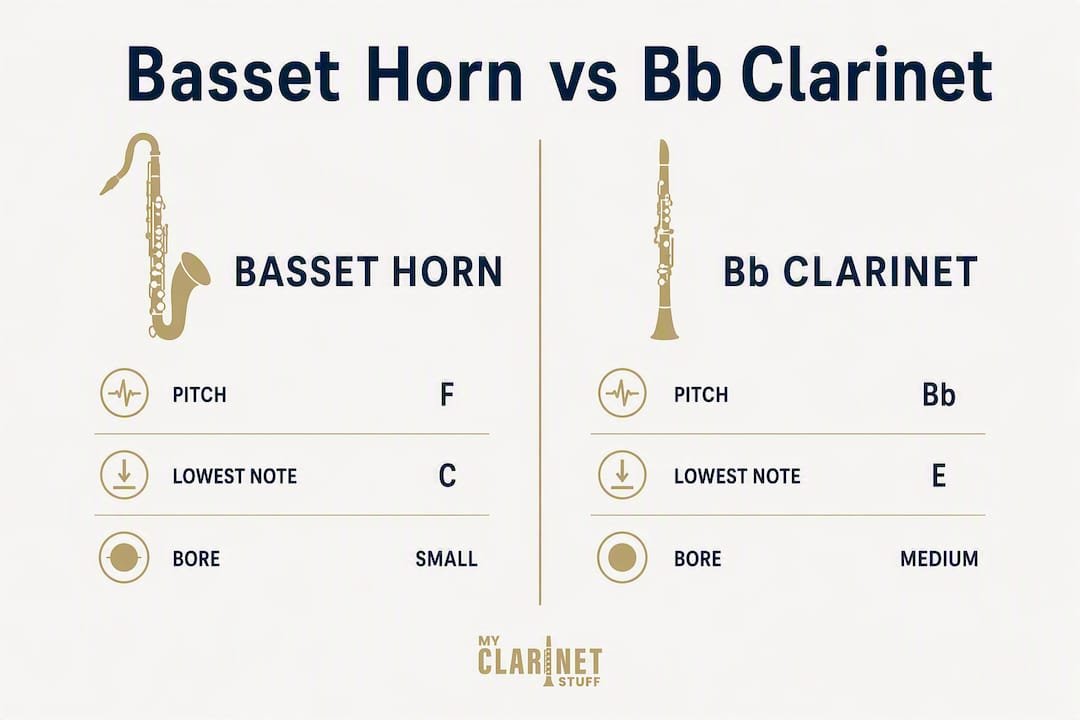
The basset extension is the mechanical heart of the instrument. Extra keys below the standard clarinet keywork allow the player to reach written low C, D, and E, with the mechanism typically housed in a separate barrel or box at the bottom of the instrument. These keys require a wider hand stretch than a Bb clarinet, and the pads on the extension are more susceptible to condensation. That is a practical concern, not just a theoretical one.
| Feature | Basset Horn | Bb Clarinet |
|---|---|---|
| Pitch/key | F | Bb |
| Lowest written note | C (sounding F) | E (sounding D) |
| Bore diameter (approx.) | 15.5–16.0 mm (small-bore) | ~14.6–15.0 mm |
| Body shape | Bent/angled with crook | Straight |
| Extended low keys | Yes (low C, D, E) | No |
| Timbre character | Smoky, veiled, vocal | Bright, projecting |
Pro Tip: Swab the basset extension after every long rest in a rehearsal, not just at the end of a session. Condensation in the low-key pads is the most common cause of missed low notes in performance, and a quick pass with a pull-through swab takes ten seconds.
Origins and historical development of the basset horn
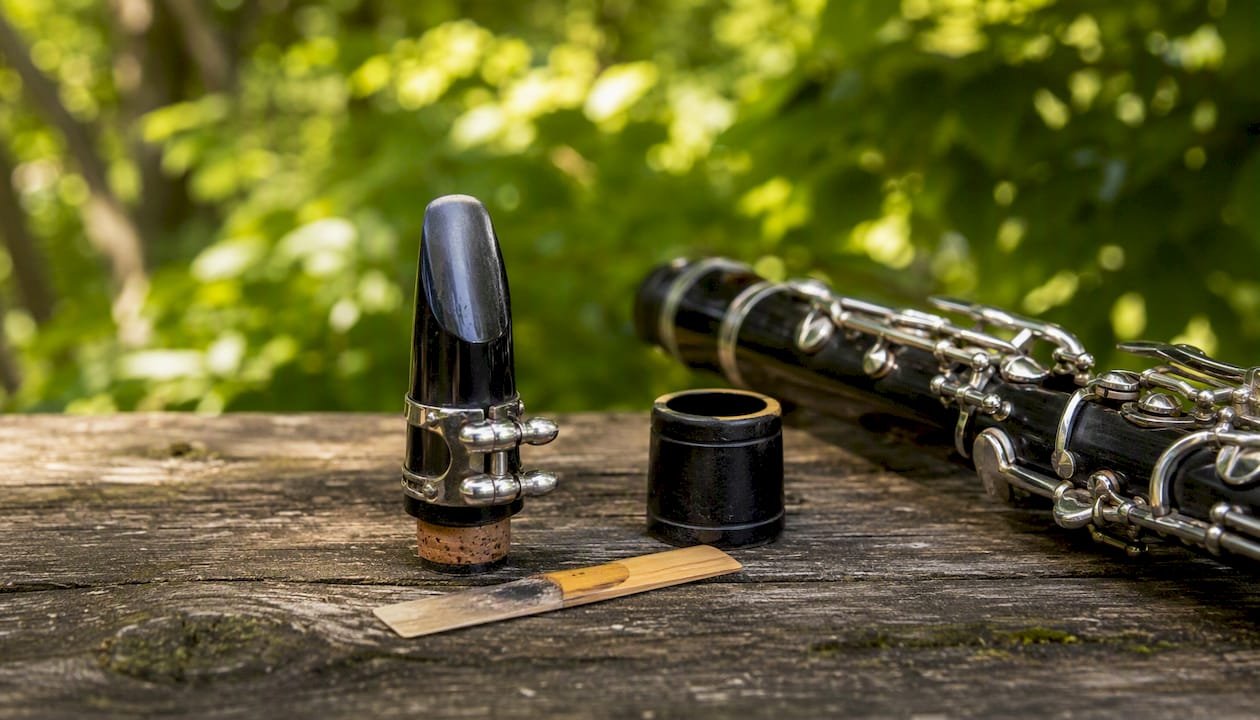
The basset horn emerged in the 1760s–1770s, with Anton and Michael Mayrhofer of Passau most frequently cited as its originators. The earliest instruments had a curved, sickle-shaped body that gave the instrument its name: “basset” from the Italian for “little bass,” and “horn” from the curved shape rather than any connection to the brass family.
The name stuck even as the shape changed. By the late 18th century, builders were experimenting with angled and box-shaped designs that were easier to construct and more reliable mechanically. The curved horn body gradually gave way to the angular forms that Mozart’s contemporaries would have recognized.
Mozart’s engagement with the instrument was not accidental. He encountered it through his Masonic connections and found its introspective, middle-dark register perfectly suited to the gravity of lodge music and sacred works. He exploited the instrument’s extended low register in chamber and sacred pieces, writing parts that would have been impossible on a standard clarinet of the period. That association gave the basset horn a repertoire identity that outlasted its inventor.
The 19th century brought decline. The instrument was largely displaced by the alto clarinet and the bass clarinet as orchestral writing evolved. Occasional appearances in Brahms and Richard Strauss kept it alive in score, but it was rarely heard in concert halls. The modern revival began in the mid-20th century, driven partly by the early music movement and partly by performers who recognized the instrument’s unique expressive range. Today, makers like Schwenk & Seggelke produce instruments that meet both historical-performance and contemporary standards.
Where you will encounter the basset horn: key works and listening recommendations
Mozart is the starting point for any serious study of basset horn repertoire. His works include the Maurerische Trauermusik (K. 477), the Requiem (K. 626), and several of the late Masonic Cantatas, all of which feature prominent basset horn parts. The Serenade in C minor (K. 388, arranged for winds) and the Gran Partita (K. 361) also include the instrument in ensemble contexts. These works remain the core audition and study repertoire for any player approaching the instrument.
Beyond Mozart, the repertoire expands in useful directions:
- Richard Strauss used basset horns in Elektra (1909), one of the few major orchestral scores to call for the instrument by name.
- Karlheinz Stockhausen wrote extensively for the basset horn in his LICHT cycle, with Suzanne Stephens as the dedicatee of several works.
- Paul Hindemith and Camille Saint-Saëns both included the instrument in chamber contexts.
- For contemporary solo literature, look to works written for Sabine Meyer, whose recordings have expanded the modern repertoire considerably.
For listening, these recordings give you the clearest picture of what the instrument actually sounds like:
- Suzanne Stephens performing Stockhausen’s basset horn works (Deutsche Grammophon catalog) for extended contemporary technique
- Sabine Meyer’s Mozart recordings with the Ensemble Wien-Berlin for classical ensemble context
- Period-instrument recordings of the Gran Partita (K. 361) for historical timbre and blend
Reliable scores and critical editions are available through Bärenreiter (for Mozart) and Universal Edition (for 20th-century works). For study parts and audition excerpts, the Neue Mozart Ausgabe, available through the Mozarteum Foundation, is the standard academic reference.
Leading performers, builders, and ensembles to know
The two names that appear most often in basset horn pedagogy are Suzanne Stephens and Sabine Meyer, and they represent genuinely different traditions.
- Suzanne Stephens — built her career around contemporary music, working closely with Karlheinz Stockhausen for decades. Her technical command of the instrument’s extended range and her recordings of Stockhausen’s solo works are the primary reference for any player approaching that repertoire.
For ensemble contexts, the basset horn appears most often in Harmonie ensembles (classical wind octets), period-instrument orchestras, and contemporary chamber groups. University music libraries and conservatory collections in the U.S. often hold recordings from all three contexts, and streaming platforms carry the major commercial releases from Stephens and Meyer.
How the basset horn differs from the Bb clarinet, alto clarinet, and basset clarinet
This is the comparison that matters most for doubling decisions and ensemble assignments.
| Instrument | Key | Lowest written note | Bore (approx.) | Extended low keys | Typical role |
|---|---|---|---|---|---|
| Basset horn | F | C (sounding F) | 15.5–16.0 mm | Yes | Chamber, sacred, contemporary |
| Bb clarinet | Bb | E (sounding D) | ~14.6–15.0 mm | No | Orchestral, solo, chamber |
| Alto clarinet | Eb | Eb (sounding Gb) | ~18.0 mm | No | Band, ensemble doubling |
| Basset clarinet | Bb or A | C (sounding Bb/A) | ~14.6–15.0 mm | Yes | Mozart concerto/quintet |
The alto clarinet’s lowest written note is Eb, sounding Gb, which sits one semitone higher than the basset horn’s low end. The bore difference is more significant: the alto clarinet’s ~18.0 mm bore produces a fuller, more projecting sound that behaves differently under the fingers. Players who move from alto to basset horn often find the resistance profile surprising.
The basset clarinet is the closest relative. It shares the extended low-C keywork concept but is pitched in Bb or A, making it a soprano instrument with a downward extension rather than a true alto. Mozart’s Clarinet Concerto (K. 622) and Clarinet Quintet (K. 581) were written for the basset clarinet, not the basset horn, a distinction that matters for both historical accuracy and practical performance.
Practical guidance for ensemble decisions:
- Choose the basset horn over the alto clarinet when the part calls for F transposition, historical Mozart/Strauss repertoire, or a veiled, introspective timbre.
- Choose the alto clarinet when the ensemble needs Eb transposition, stronger projection in a large band, or a more robust low-end blend.
- The basset horn is rarely a direct substitute for the bass clarinet; the ranges overlap but the timbral roles are distinct.
Is the basset horn hard to play? Technique and practice tips
The honest answer: it is not dramatically harder than the Bb clarinet, but the differences are specific enough that unprepared players run into problems quickly. The extended keywork demands a wider hand stretch, and the narrow bore creates a resistance profile that rewards a relaxed throat rather than the firmer support many Bb clarinetists default to.
The most common mistake is overblowing. Transitioning clarinetists often treat the basset horn like a Bb clarinet, pushing too much air pressure and producing a thin, bright tone in the low register. The fix is throat relaxation and a slightly slower, warmer air column, not less air overall.
Suggested practice progression:
- Start with slow chromatic scales from written low E down to low C, listening for evenness of tone across the extension keys.
- Practice the Bb clarinet Klosé etudes transposed to the basset horn’s written range before moving to instrument-specific material.
- Work through the Mozart Gran Partita second clarinet/basset horn parts at half tempo, focusing on blend and intonation in the chalumeau register.
- Add long tones on the three lowest notes (C, D, E) daily until the pad response feels reliable and the tone centers without effort.
Technique adjustments worth noting:
- Embouchure: slightly more relaxed jaw pressure than Bb clarinet; the instrument responds to voicing changes (think “oh” rather than “ee” in the oral cavity).
- Air support: consistent column, not increased pressure; the bore does the work if the throat stays open.
- Reed choice: a medium-soft reed on a medium-facing mouthpiece tends to give the most centered low-register response.
Maintenance habits matter more here than on a Bb clarinet. The basset extension mechanism is mechanically delicate, and a sticky pad on the low C key will silence the entire extension in performance.
Pro Tip: Bring a small pad-drying paper (cigarette paper works well) and a drop of key oil to every rehearsal. If a low key sticks mid-rehearsal, slip the paper under the pad, press gently, and release. It takes five seconds and saves the performance.
Contemporary uses and recordings worth studying
The basset horn has found a genuine second life in contemporary music. Stockhausen’s LICHT cycle remains the most ambitious modern use of the instrument, but chamber composers across the U.S. and Europe have written for it with increasing frequency since the 1990s. University new-music ensembles occasionally program it, and several American conservatories now include basset horn study as part of their historical performance or chamber music tracks.
For visual learners, YouTube carries several useful demonstration videos:
- Conservatory masterclass recordings showing hand position on the extended keywork and crook placement
- Side-by-side tone comparisons between basset horn and alto clarinet (useful for understanding the bore difference in practice)
- Period-instrument ensemble recordings that show the instrument in its natural Harmonie context
Active listening checklist for practice:
- Tone color in the low register: does the player achieve warmth without muddiness?
- Low-register projection: can the basset horn cut through the ensemble on the low C and D without forcing?
- Phrasing across the break: how does the player manage the transition between the chalumeau and clarion registers?
- Intonation on the extension keys: the lowest three notes tend to pull flat; listen for how experienced players compensate.
For scores and parts, the Library of Congress and most major university music libraries carry the standard Mozart editions. Contemporary works are available through publishers including Universal Edition, Schott, and Boosey & Hawkes.
Mouthpiece, bore, and reed selection for the basset horn
The mouthpiece question is where many players get stuck. Small-bore basset horns are commonly played with a Bb/A clarinet mouthpiece in historical-performance practice, and that approach works well when the goal is a classical, veiled sound. A purpose-built F/basset-horn mouthpiece offers more resistance consistency across the full range, which matters for players who spend significant time in the low extension.
Small-bore instruments (~15.5–16.0 mm) align with the classical sound ideal; large-bore instruments (~18.0 mm and above) push toward alto clarinet projection and a fuller, less veiled tone. The choice depends on your repertoire: classical Mozart and Strauss favor small-bore, while contemporary works that demand projection in larger ensembles may benefit from a larger bore.
Key setup considerations:
- Tip opening: — a medium tip opening (roughly equivalent to a Bb clarinet medium facing) gives the most flexibility across the full range; very open facings tend to destabilize the low extension.
For players exploring professional mouthpiece features before committing to a purchase, an at-home test box program lets you compare facings and tip openings in your own practice space, which is far more informative than a five-minute shop trial.
Pro Tip: If you are doubling from Bb clarinet, try your current Bb mouthpiece on the basset horn first before buying a new one. Many players find it works well on small-bore instruments, and it gives you a useful baseline for comparing purpose-built options.
When to choose the basset horn and next steps for players
The basset horn is the right instrument for three types of players: doublers who need F transposition for historical repertoire, chamber specialists drawn to Mozart’s wind music and the Harmonie tradition, and historical-performance players building a period woodwind toolkit. It is not a general-purpose substitute for the alto or bass clarinet, but within its specific repertoire, nothing else sounds like it.
Next steps if you want to pursue it:
- Rental: — professional-grade basset horns are rarely available from general music retailers; contact a specialist woodwind shop or reach out directly to makers like Schwenk & Seggelke for rental or trial options.
- Scores: start with the Bärenreiter Mozart editions and the Neue Mozart Ausgabe for historical parts; use the clarinet buying guide for broader instrument selection context.
Regular servicing of the extended keywork is non-negotiable: plan for at least one professional overhaul per year if you play the instrument regularly.
Key Takeaways
The basset horn is a clarinet-family instrument pitched in F with a four-octave written range, a narrow bore that produces a smoky timbre, and an extended low register that defines its unique place in Mozart’s chamber and sacred repertoire.
| Point | Details |
|---|---|
| Pitch and transposition | Pitched in F; written notes sound a perfect fifth lower, with a range from written low C to C6. |
| Bore and timbre | Small-bore models (~15.5–16.0 mm) produce the characteristic smoky, veiled tone; large-bore models project more like an alto clarinet. |
| Historical identity | Anton Mayrhofer developed the instrument in the 1760s–1770s; Mozart’s Masonic and sacred works remain its defining repertoire. |
| Key players and makers | Suzanne Stephens and Sabine Meyer are the primary recording references; Schwenk & Seggelke produce respected modern instruments. |
| Mouthpiece and setup | Myclarinetstuff’s at-home test box program lets you compare mouthpiece facings for low-clarinet setups before committing to a purchase. |
The basset horn deserves more attention than it gets
The instrument sits in an odd position in American clarinet culture. Most conservatory students encounter it in a footnote about Mozart, play through the Gran Partita once, and move on. That is a missed opportunity. The basset horn’s narrow bore and extended range give it a voice that no other woodwind replicates, and the repertoire, from Mozart’s Masonic works to Stockhausen’s LICHT cycle, is genuinely rewarding to play.
The equipment question is where players often go wrong. Treating the basset horn as a slightly longer Bb clarinet and using whatever mouthpiece is on hand produces predictably mediocre results. The instrument responds to specific mouthpiece matching and embouchure adjustment in ways that are immediately audible. A small-bore instrument with a well-matched medium-facing mouthpiece and a relaxed throat will produce a tone that justifies every hour of practice. A mismatched setup will not, regardless of how skilled the player is.
My affiliation with Gleichweit USA LLC (Myclarinetstuff) means I think about mouthpiece consistency and testing more than most. The principle applies directly here: the only way to know whether a mouthpiece works on your specific basset horn is to test it systematically, in your own space, over multiple sessions. That is not a sales pitch; it is how instrument setup actually works.
Ready to find the right mouthpiece for your low-clarinet setup?
If the basset horn’s extended low register has you thinking about mouthpiece matching, you are asking exactly the right question. Myclarinetstuff carries the Gleichweit Test Box Variety Pack, which lets you test multiple tip openings and facings at home before committing to a single mouthpiece. For players doubling on bass clarinet or exploring low-clarinet setups, the Clarinet Mouthpiece Matchmaker walks you through a personalized recommendation based on your playing style, repertoire, and instrument.
Gleichweit mouthpieces are CNC-crafted in Austria and distributed exclusively in the U.S. through Myclarinetstuff, with fast domestic shipping and direct support for students, educators, and professionals. Visit myclarinetstuff.com to browse the full range, check the FAQ, or start your test-box trial today.
Useful sources for further study
These references cover the basset horn’s history, construction, and repertoire in depth. Use the academic sources for citation-grade research and the recordings for practical listening.
- Basset horn — Wikipedia: Comprehensive overview of construction, history, and range; a reliable starting point for technical specs and historical variants.
- Basset horn — Britannica: Concise encyclopedia entry with solid coverage of the Mayrhofer origin story and 18th-century development; good for academic citation.
- Mozart and the Basset Horn — Research Catalogue (Mario Ruska): Focused study of Mozart’s use of the instrument in Masonic and sacred contexts; the primary reference for repertoire and compositional intent.
- Exploring the basset horn — Martin Frères: Practitioner-focused article covering timbre, mouthpiece selection, and maintenance; best for equipment and technique sections.
- The Basset Clarinet: Instruments, Makers, and Patents — Academia.edu: Scholarly chapter distinguishing the basset clarinet from the basset horn; essential for understanding the K. 581 and K. 622 instrument question.
- Basset Horns, Altos and Bass Clarinets — The Bate Collection, Oxford: Museum collection notes with physical instrument descriptions; useful for construction and historical instrument comparison.
- University of North Texas — Basset Horn Development Study: Full academic study tracing the instrument’s development from early specimens to modern examples; the most thorough single source for history and physical characteristics.