


High-end clarinet gear most often delivers clearer tone, more stable intonation, and faster response, and those advantages of high-end clarinet gear give advancing players more confidence and less guesswork on stage. The gear that makes the biggest difference first is almost always the mouthpiece, reed, and ligature setup, not the clarinet body itself. It’s worth it for advancing students and working professionals who test changes one at a time instead of swapping everything at once.
TL;DR:
- Upgrading the mouthpiece, reed, and ligature yields the most significant improvements in tone, response, and intonation stability compared to other clarinet components.
- Modern manufacturing tolerances and dense woods like grenadilla significantly enhance sound quality and consistency, especially in formal performance settings.
- Testing gear sequentially through trial programs and at-home comparison tools reduces wasted expense and ensures the chosen upgrade genuinely fits the player’s needs.
- Proper maintenance of high-end clarinets, including daily swabbing and humidity control, is essential to preserve performance and resale value over time.
- The best initial upgrade priority is the mouthpiece, followed by reed and ligature adjustments, with mechanical work and barrel changes coming after, to maximize impact.
Table of Contents
- What Are the Real Advantages of High-End Clarinet Gear?
- Which Component Upgrade Gives You the Biggest Gain First?
- Why Do Grenadilla and Manufacturing Tolerances Matter?
- How Should You Test and Prioritize Your Next Upgrade?
- What Maintenance Does Premium Gear Actually Require?
- How Myclarinetstuff Helps You Test Before You Commit
- Your Next-Week Upgrade Checklist
- Does High-End Gear Change How You Play Different Genres?
- Does Premium Gear Matter More on Stage and in the Studio?
- Why the “Buy the Best Clarinet First” Advice Gets It Backwards
- Ready to Test Your Next Mouthpiece Before You Buy?
- Sources
What Are the Real Advantages of High-End Clarinet Gear?
Tone color comes from how a mouthpiece chamber and baffle shape the air column before it ever reaches the bore. A larger chamber tends to darken and warm the sound, while a smaller chamber with a higher baffle focuses and brightens the tone, which is why two players on identical clarinets can sound completely different. Premium instruments extend that shaping further down the bore, with undercut tone holes and profiling that even out the harmonic content across all three registers instead of favoring the middle one.
Intonation stability is where manufacturing tolerance shows up most clearly. Tighter tolerances in bore diameter and tone-hole placement produce more predictable pitch center from note to note, which matters more in recording and orchestral contexts where a tuner and a conductor both notice drift that a practice room forgives. Advancing players feel this on exposed long tones and orchestral projection passages, exactly where a shaky pitch center gets exposed.
Response and dynamic range benefit from the same precision. Advancing models commonly show more secure soft entrances, more even articulation at low volume, and a stronger low-register core after an upgrade, according to guidance in the Complete Guide to Professional Clarinets. That shows up in three specific spots:
- Pianissimo passages that used to crack or refuse to speak now start cleanly.
- Exposed long notes hold pitch instead of drifting sharp or flat as air support changes.
- Orchestral tutti sections project without forcing, so the tone carries past the section instead of getting buried.
Ergonomics rounds out the list, and it’s the advantage players notice off the clarinet as much as on it. Adjustable thumb rests and refined keywork geometry reduce right hand fatigue during long rehearsals, an effect documented in customization case notes covering ergonomic adjustments. A clarinet that doesn’t fight your hand shape lets you focus practice time on music instead of managing discomfort.
Which Component Upgrade Gives You the Biggest Gain First?
Not every upgrade earns equal attention, and spending your budget in the wrong order wastes both money and practice time. Here’s the sequence that actually moves the needle, ranked by impact:
- Mouthpiece. Chamber size, baffle height, and facing length control more of your tone and response than almost anything else you can buy, and mouthpiece and reed choice deliver the fastest, largest gains available to a working clarinetist. A facing that’s too short feels stuffy no matter how good your reed is; one that’s too long turns unstable in the upper register.
- Reed strength and cut. A reed has to match the mouthpiece’s tip opening and facing curve, not just your personal preference for a number. Moving to a more open mouthpiece usually calls for a softer reed to keep response consistent, and the reverse is true for closer facings.
- Ligature. This is a fine-tuning tool, not a tone-transforming one. Different ligature designs change how evenly the reed vibrates against the mouthpiece table, which affects color and stability more than raw volume.
- Barrel. A barrel swap adjusts pitch tendency and can warm or brighten the overall color, useful once the mouthpiece and reed are already dialed in.
- Mechanical work. Pad seating, spring tension, and thumb-rest position affect playability directly. Careful voicing and pad work reduce dead spots and smooth register transitions, and this is squarely a technician’s job.
Pro Tip: Change one variable at a time. If you swap mouthpiece and reed strength in the same session, you won’t know which one caused the improvement, or the problem.
Cost-to-impact guidance is simple: a mouthpiece upgrade in the low hundreds of dollars typically outperforms a barrel swap costing the same amount, because the mouthpiece controls more of the sound-producing mechanism. Save mechanical overhauls for when a technician identifies a specific playability issue, not as a first move.
Why Do Grenadilla and Manufacturing Tolerances Matter?
Grenadilla, also called African blackwood, is dense enough (roughly 1.1 to 1.3 grams per cubic centimeter) that it behaves differently under vibration than injection-molded plastic. That density is why advanced models built from grenadilla produce richer overtones and steadier projection than typical plastic-bodied instruments, assuming the wood is properly maintained and acclimated.
- Grenadilla rewards players with color and complexity but demands humidity management to avoid cracking.
- Plastic and composite bodies sacrifice some overtone richness but resist humidity swings and temperature shock, making them a sound pick for outdoor gigs, marching settings, or climates with big seasonal swings.
- Bore profiling and undercutting balance the registers so the clarion doesn’t overpower the chalumeau, or vice versa.
- CNC machining paired with hand finishing produces the tight, repeatable tolerances that make one instrument, or one mouthpiece, behave consistently from unit to unit.
A composite instrument or mouthpiece isn’t a compromise so much as a different set of trade-offs. For touring players or students who can’t control practice-room humidity, a well-made composite often outperforms a neglected wood instrument.
How Should You Test and Prioritize Your Next Upgrade?
Trial and error with real gear beats theorizing from specs, because individual physiology, embouchure, and tone concept interact with mouthpiece design in ways that are hard to predict on paper. Forum discussions among experienced players consistently point toward trialing mouthpieces in person or through structured trial programs rather than buying on reputation alone.
- Establish a baseline recording. Use the same mic, same tuner, and same reed strength every time you test, so the only variable that changes is the piece of gear.
- Test the mouthpiece first. It has the largest effect on tone and response, so isolate it before touching anything else.
- Move to reed and ligature adjustments. Once the mouthpiece is chosen, fine-tune reed strength and ligature to match its facing.
- Bring in the barrel and mechanical work last. These are refinements, not foundation choices.
Pro Tip: Log your tuner readings for the same five notes across every mouthpiece you try. Patterns in sharp or flat tendencies reveal facing and chamber differences faster than your ear alone will.
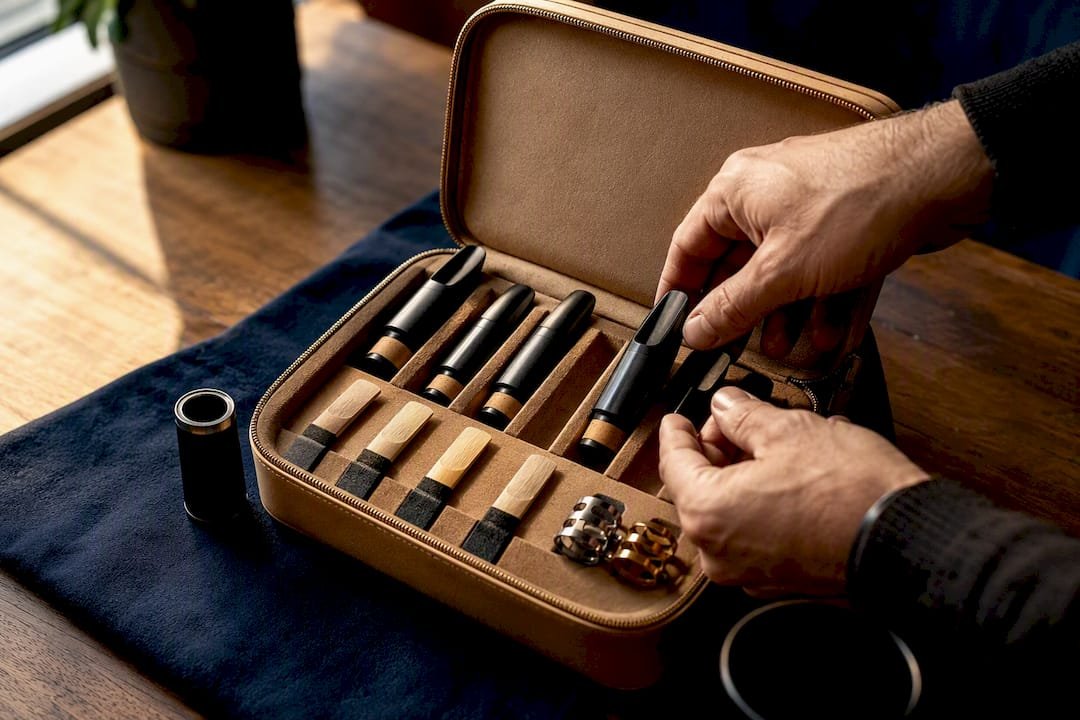
An at-home test box, where several mouthpieces arrive for direct comparison on your own clarinet, removes the guesswork of judging an instrument you’ve only played for two minutes in a shop. If pitch problems persist across every mouthpiece you try, the issue likely isn’t the mouthpiece. Persistent flat notes in the same spot on every setup, or pads that visibly leak air, mean it’s time to call a technician instead of buying more gear.
What Maintenance Does Premium Gear Actually Require?
Grenadilla instruments need daily attention that plastic bodies can mostly skip. Swabbing after every session, gradual break-in for new instruments, and humidity control all protect the wood from cracking, and skipping these steps shortens the instrument’s working life fast.
- Swab the bore after each playing session to remove moisture before it soaks into the wood grain.
- Oil the bore periodically on new or dry instruments, following your technician’s schedule rather than guessing.
- Store the instrument in stable humidity, away from car trunks and radiators.
- Schedule annual professional maintenance checks to catch pad wear before it affects intonation.
Professional setup work protects your investment more than any single accessory. Voicing and pad work preserve intonation and response over years of playing, and a premium clarinet that’s never been serviced will eventually play worse than a well-maintained student model. Resale value follows the same logic: a grenadilla clarinet with documented service history holds value far better than one with unknown maintenance. If your climate makes wood care impractical, a quality composite is a legitimate long-term choice, not a downgrade in disguise.
How Myclarinetstuff Helps You Test Before You Commit
Guessing at a mouthpiece from a spec sheet is how players end up with an expensive piece of gear that never quite fits their embouchure. An at-home Test Box program can help you compare several mouthpieces on your own clarinet, in your own practice room, before spending money on the wrong one.
- The Test Box approach mirrors the audition-first workflow serious players already use for reeds and barrels.
- Author Milos writes for Myclarinetstuff with a focus on helping players sequence upgrades sensibly rather than buying everything at once.
- Gleichweit mouthpieces, the brand behind Myclarinetstuff’s catalog, are CNC-crafted in Austria for consistency from piece to piece.
- Every recommendation on the site ties back to the same principle covered above: test the mouthpiece first, everything else second.
Your Next-Week Upgrade Checklist
Start simple. Record a baseline of five long tones and a scale on your current setup, using the same mic and tuner every time. Try one mouthpiece change and record the same passage again. Then try one reed strength change, separately, and record it a third time.
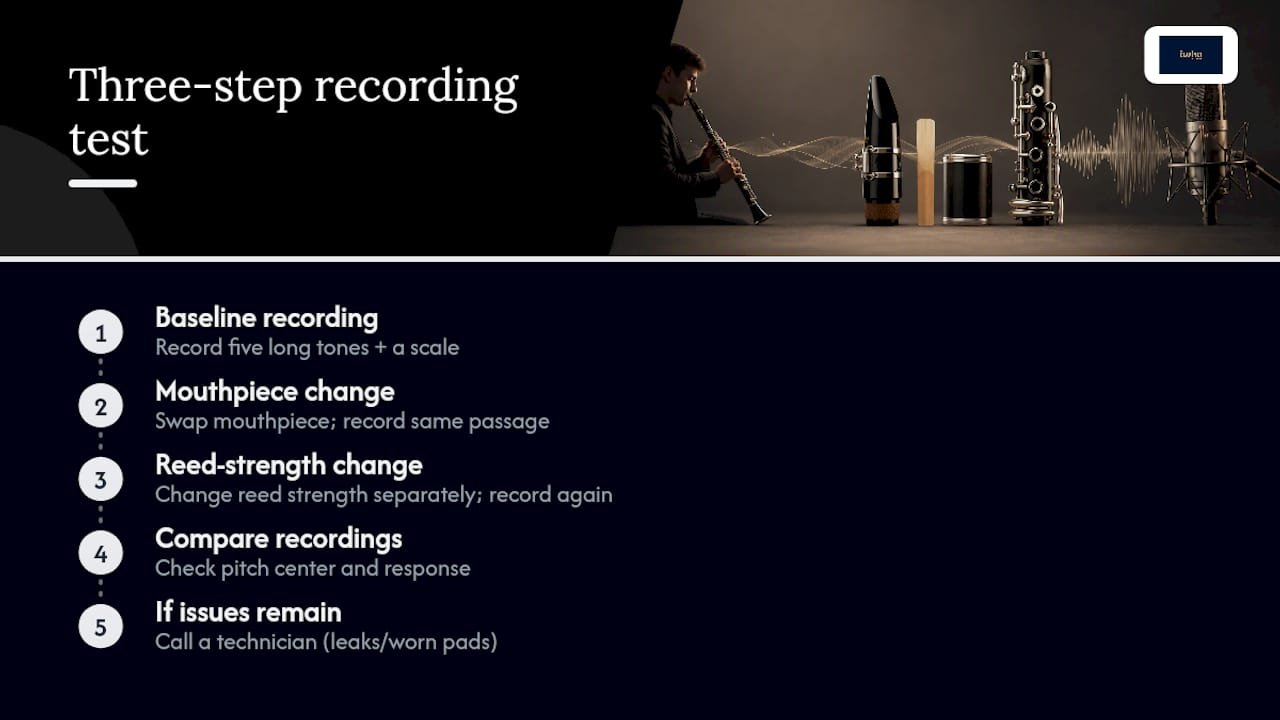
Compare all three recordings for pitch center and response. If problems persist no matter what you swap, call a technician; leaks and worn pads aren’t a gear problem. For deeper reference, the mouthpiece maintenance workflow and a stepwise upgrade guide both walk through this process in more detail.
Does High-End Gear Change How You Play Different Genres?
Classical playing rewards the tonal complexity that dense grenadilla and precise bore work provide. Orchestral and chamber repertoire demands wide dynamic range, seamless register transitions, and a tone that blends within a section while still projecting solo lines, and that’s exactly where premium gear’s harmonic richness pays off.
Jazz clarinetists often want something different: more edge, more immediate response, and a brighter core that cuts through a rhythm section. A smaller chamber with a higher baffle serves that goal better than the darker, warmer setup a classical player might choose, which is why mouthpiece selection in jazz contexts leans toward brightness over blend.
Folk and klezmer traditions sit somewhere in between, often favoring free reed-like flexibility and expressive pitch bending that responds well to a facing with slightly more resistance. Marching and outdoor settings flip the priority list entirely: durability and pitch stability under temperature swings matter more than subtle tone color, which is exactly where a composite mouthpiece or barrel earns its place instead of counting as a compromise. The gear that’s “best” always depends on the genre’s demands, not a universal ranking of quality.
Does Premium Gear Matter More on Stage and in the Studio?
Concert halls forgive very little. A slightly sharp note that disappears in a practice room becomes audible the moment it’s projected across a 1,500 seat hall with natural reverb carrying every imperfection to the back row. The intonation stability that comes from tighter manufacturing tolerances isn’t a luxury in that setting; it’s what keeps a solo passage from standing out for the wrong reason.
Recording studios are even less forgiving. A close mic placement captures reed noise, key clicks, and pitch drift that an audience would never notice live, which is exactly why manufacturing predictability matters more in recording and orchestral contexts than it does in casual playing. A mouthpiece that produces a slightly uneven tone across registers becomes an editing headache when a producer has to comp together the cleanest take from a dozen takes.
Adapting to new gear before a performance takes real time, and players commonly need two to six weeks to adjust embouchure and air support to a new mouthpiece’s resistance profile. Bringing untested gear into a high-stakes recording session or audition without that adjustment window is a common and avoidable mistake.
Why the “Buy the Best Clarinet First” Advice Gets It Backwards
Conventional advice tells players to save up and buy the best clarinet body they can afford. That’s not wrong, exactly, but it puts the money in the wrong place first. The research on this is consistent: mouthpiece and reed setup drive more of the audible improvement than the clarinet body does, and a mismatched mouthpiece on a professional clarinet will sound worse than a well-matched mouthpiece on a mid-tier one.
The bigger failure in how players approach upgrades is skipping the testing step entirely. Buying a mouthpiece because a favorite player uses it, without trying it on your own clarinet with your own embouchure, is how gear closets fill up with expensive pieces nobody plays. Physiology and tone concept vary enough between players that a mouthpiece can transform one clarinetist’s sound and do nothing for another.
If you take one thing from this article, prioritize sequence over spending. Test the mouthpiece first, log what changes, and only then move to reed, ligature, barrel, and mechanical work in that order.
— Milos
Ready to Test Your Next Mouthpiece Before You Buy?
Myclarinetstuff exists for exactly the upgrade sequence covered above: mouthpiece first, tested on your own clarinet, before you spend a dollar on anything else. The Gleichweit Test Box lets you compare up to five CNC-crafted Austrian mouthpieces at home, side by side, using the same reed and the same embouchure you already play with every day.
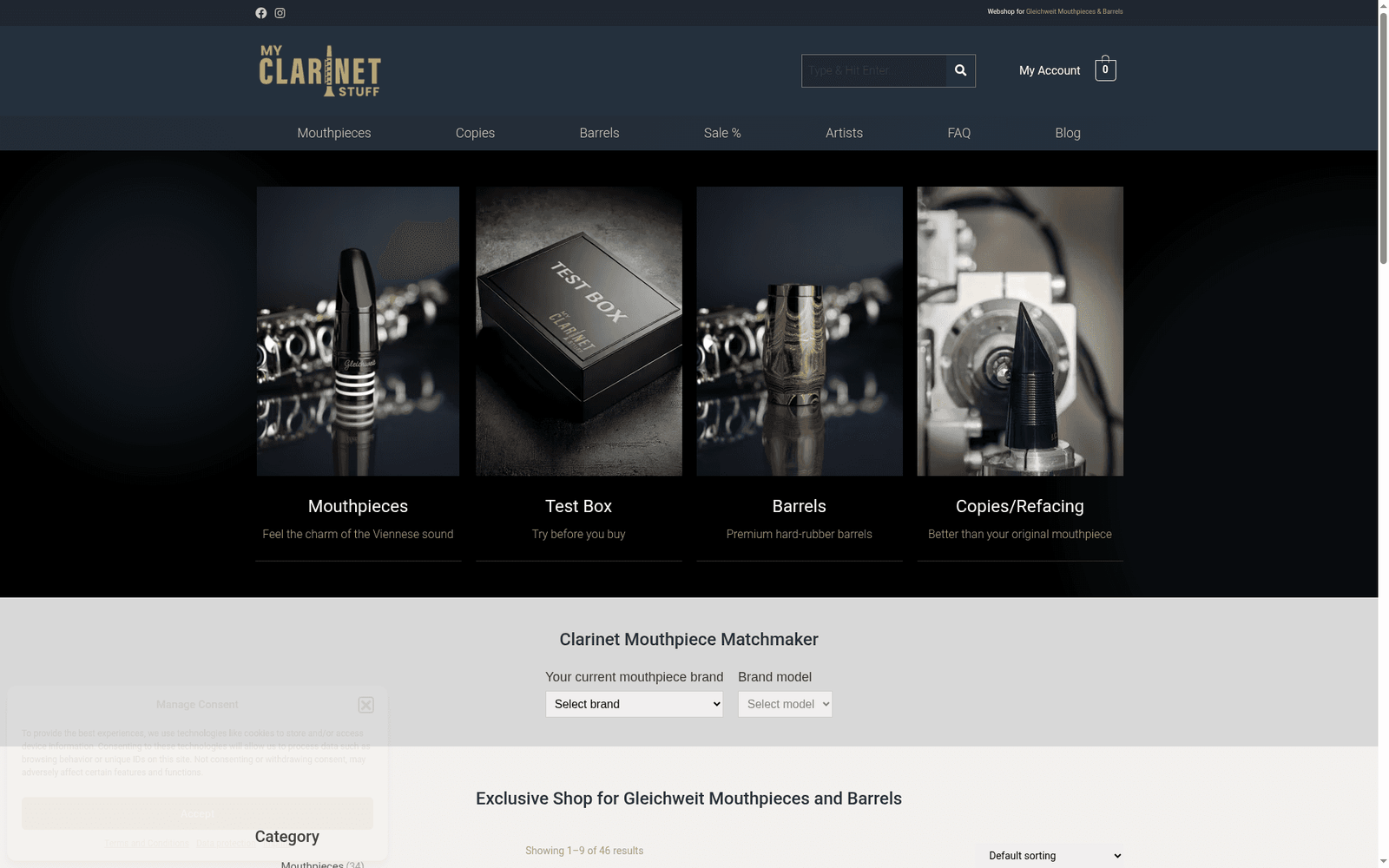
That’s a meaningfully different starting point than ordering a single mouthpiece online and hoping the specs match your tone concept. If you’re an advancing student narrowing down a facing and chamber size, or a working professional chasing more stable intonation for an upcoming recording session, the Clarinet Mouthpiece Matchmaker walks you through the same priorities laid out in this article, matched to your specific playing style. Start there, request your Test Box, and record your baseline before it arrives.
Sources
- Advanced clarinet models differ from student instruments by using dense tonewoods such as grenadilla.
- The Complete Guide to Professional Clarinets