


TL;DR:
- The clarinet has three distinct registers: chalumeau, clarion, and altissimo, each with unique tone and technical demands.
- Mastery requires continuous voicing adjustments and awareness of tongue position, not just memorizing pitch ranges.
- Effective practice focuses on register-slurs, tone control, and equipment suited to each register for seamless transitions.
Every clarinetist hits that moment where a phrase falls apart between the low and high notes, not because of fingering, but because the sound itself changes character. The clarinet is unique among woodwind instruments in having three dramatically distinct registers, each with its own tone color, technical demands, and expressive potential. Understanding exactly what separates the chalumeau, clarion, and altissimo registers gives you a roadmap for solving real playing problems. This guide breaks down each register in practical detail so you can develop better voicing awareness, smoother transitions, and a more consistent sound from the lowest E to the highest altissimo peaks.
Table of Contents
- Clarinet register basics: The chalumeau, clarion, and altissimo ranges
- Chalumeau register: Deep and mellow foundation
- Clarion register: Bright and powerful middle
- Altissimo register: Excitement and advanced technique
- What most clarinet guides miss about register mastery
- Enhance your clarinet experience with expert tools and resources
- Frequently asked questions
Key Takeaways
| Point | Details |
|---|---|
| Identifying registers | Clarinet registers—chalumeau, clarion, and altissimo—each have unique ranges and sonic qualities. |
| Voicing strategy | Successful register transitions rely on adjusting tongue position and voicing depending on pitch. |
| Practice for mastery | Regular register-slur exercises and voicing awareness are the keys to seamless clarinet performance. |
| Advanced technique tips | Altissimo demands precise overblowing control and can be mastered through targeted practice and partials awareness. |
Clarinet register basics: The chalumeau, clarion, and altissimo ranges
Before you can master each register, you need to understand why the clarinet has such distinct tonal zones in the first place. Unlike a flute or oboe, the clarinet is a cylindrical bore instrument that behaves like a stopped pipe acoustically. This means it overblows at the twelfth rather than the octave, creating registers that are a full interval apart rather than just an octave. This acoustic fact is the reason why the clarinet sounds so different in its low, middle, and high ranges. Learning a deeper tone customization guide will help you see how these physics translate directly into how you adjust your embouchure and voicing for each zone.
Here is a quick reference table summarizing the three main registers:
| Register | Approximate Pitch Range | Tone Character | Primary Technical Demand |
|---|---|---|---|
| Chalumeau | Low E to Bb (written) | Dark, mellow, resonant | High tongue position, open throat |
| Clarion | B natural to C (third space) | Bright, singing, expressive | Adjusted voicing, register key use |
| Altissimo | C# and above | Piercing, energetic, brilliant | Precise overblowing, lowered tongue |
Key features that define each register include:
- Pitch separation: Each register is approximately a twelfth apart due to the clarinet’s cylindrical bore physics
- Tone color shift: Moving up registers changes sound character dramatically, from dark to brilliant
- Voicing requirements: Each register demands a different tongue position and throat shape
- Fingering complexity: Altissimo uses alternate and cross fingerings not present in lower registers
- Reed and mouthpiece sensitivity: Equipment responds differently across registers, especially regarding sound quality factors
“Tone production and register control heavily depend on voicing adjustments and the need to modify tongue position as pitch ascends through clarion and into altissimo.” — ICA Committees, Tone and Technique Part I
Understanding this foundational framework gives you a practical lens for diagnosing your own playing. When a note cracks on the break, or the altissimo sounds shrill and pinched, the problem almost always traces back to one of these three register-specific demands. Let’s explore each one in depth.
Chalumeau register: Deep and mellow foundation
The chalumeau register spans from low E to approximately Bb, written pitch, and it is named after the chalumeau, an early predecessor to the modern clarinet. This register has a haunting, velvety quality that composers from Mozart to contemporary jazz writers have used to create intimate, introspective moments. When you hear a clarinet playing a slow, dark melody underneath a string section, that is almost certainly the chalumeau register at work.
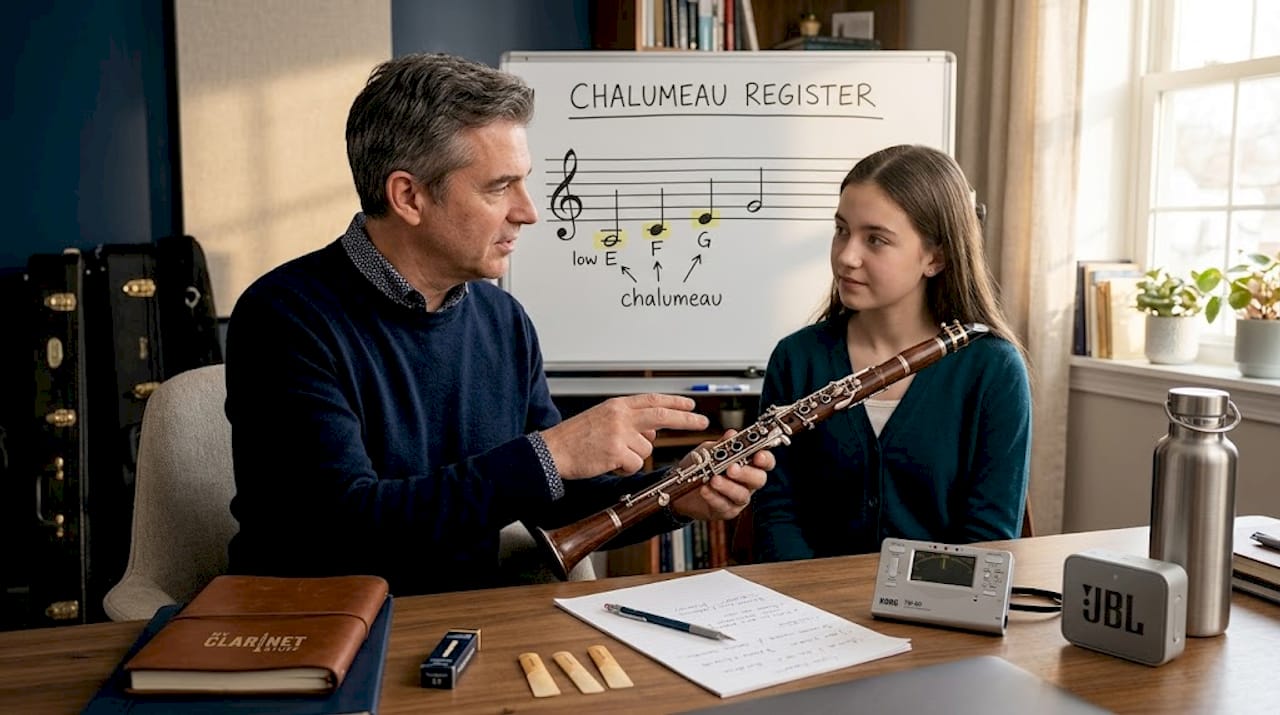
Producing a great chalumeau sound requires more deliberate setup than many players realize. The tongue sits high in the mouth, almost as if you were voicing the syllable “ee” or “ih,” which helps focus the airstream and create the warm, centered tone this register is known for. You also need a relaxed, open throat rather than a squeezed embouchure. Too much jaw pressure in the chalumeau range kills the natural resonance of the register. Good mouthpiece selection tips matter here because a mouthpiece with the right facing and tip opening helps chalumeau notes speak freely without over-blowing.
Ultrasound studies find tongue position is typically high throughout the chalumeau range, then descends as pitch ascends into clarion and altissimo, confirming that voicing is not static but constantly changing.
Chalumeau register: Strengths and challenges
- Strengths: Natural warmth and resonance, forgiving on the embouchure, excellent for lyrical phrasing and dynamic contrast
- Strengths: Responds well to subtle breath support adjustments, great for blending with lower instruments in ensemble settings
- Challenges: Low notes (low E, F, F#) require more breath pressure and can feel stuffy if the throat closes
- Challenges: The “throat tones” (G, Ab, A, Bb) sit at the top of the chalumeau range and are notoriously thin and unfocused without careful voicing
- Challenges: Dynamics are harder to control in this register without losing tonal center
Pro Tip: When practicing chalumeau long tones, experiment with gradually adjusting the height of your tongue while sustaining a note. You will hear the tone quality shift noticeably. Finding the sweet spot for your own anatomy is one of the fastest ways to develop a richer chalumeau sound. Use this exercise before working on any repertoire that stays in the low register.
For practical development, try these chalumeau practice ideas: sustain single notes from low G to Bb with a tuner and focus on keeping vibration in the bell; practice register slurs from chalumeau to clarion and back slowly, paying attention to where the tongue shifts; and use dynamics as a tool, playing a simple scale pianissimo to develop air control without adding jaw pressure. The performance tips guide offers more structured approaches to building register-specific tone control.
Clarion register: Bright and powerful middle
The clarion register begins at B natural above the staff break and extends to approximately high C, the third space C in written pitch. This is the expressive core of the clarinet. Most of the melodic writing you encounter in orchestral, chamber, and solo clarinet literature sits squarely in the clarion register. It is where the instrument’s voice feels most direct, projecting with a singing quality that cuts through texture.
Making the switch from chalumeau to clarion, known as crossing the break, is the technical milestone most beginners struggle with the longest. The register key opens to vent the lower harmonics, and suddenly the tongue position, air speed, and embouchure all need to shift simultaneously. Voicing changes are not optional here. As research on register-slur technique confirms, voicing must be adjusted as pitch ascends through clarion, and dedicated register-slur work is one of the most effective remedies.
Here is a direct comparison of chalumeau versus clarion characteristics:
| Feature | Chalumeau | Clarion |
|---|---|---|
| Tone color | Dark, mellow, intimate | Bright, clear, singing |
| Air speed | Slower, focused stream | Faster, more directed |
| Tongue position | High (“ee” vowel) | Slightly lower (“ay” vowel) |
| Dynamic range | Softer dynamics feel natural | Full dynamic range available |
| Register key | Not used | Register key opens |
| Ensemble role | Blending, color, bass lines | Melody, expression, solos |
Understanding how your mouthpiece material affects projection in the clarion register is essential because this is where tonal differences between equipment choices become most audible to audiences.
Practice strategies for clarion development:
- Practice the crossing-the-break exercise slowly: alternate B natural and C in the clarion with Ab and Bb in chalumeau, focusing on smooth voicing transitions
- Work long tones from C to high G chromatically, checking intonation with a tuner at each pitch
- Use articulated scales in the clarion range to connect finger coordination with voicing adjustments
- Practice dynamic swells (crescendo and decrescendo) on sustained clarion notes to develop expressive control
- Record yourself playing a simple clarion melody and listen for any tonal inconsistency between adjacent notes
The clarinet’s even-numbered partials explain why the clarion register has such a different brightness compared to chalumeau. Because the clarinet suppresses even-numbered partials in the chalumeau, adding the register key shifts which partials are most active, fundamentally changing the tone color.
Pro Tip: If your clarion notes sound tight or pinched compared to your chalumeau tone, try using the syllable “ay” instead of “ee” internally while playing. This subtle tongue drop can open up the sound considerably and improve intonation on throat tones like A and Bb.
When you test clarinet mouthpieces, always pay attention to how they perform specifically in the clarion range. A mouthpiece that sounds lush in chalumeau may choke in the clarion if the facing does not support faster air speeds.
Altissimo register: Excitement and advanced technique
The altissimo register begins at approximately C# above high C and continues upward through notes that push the limits of the instrument. Depending on the player, practical altissimo can reach G or even higher, though most orchestral writing stays within a more conservative range. The altissimo is where the clarinet becomes genuinely thrilling to listen to, with a brilliant, cutting sound that commands attention.
Getting there requires a completely different set of physical adjustments than the lower registers. The tongue position, which was high in chalumeau and slightly lower in clarion, must descend further in a controlled way to allow faster airflow and precise overblowing. According to research on voicing and register control, the tongue descends as pitch ascends through clarion and altissimo, and controlling this movement is the defining technical challenge of the upper register. Understanding the role of clarinet partials helps explain why altissimo fingerings often involve opening keys that would seem counterintuitive.
Altissimo practice strategies that actually work:
- Harmonic exercises: Play a chalumeau note and then gently overblow to produce the altissimo equivalent without changing fingering. This trains the embouchure and voicing to find the partial naturally
- Scale work in thirds: Practice altissimo scales in thirds rather than stepwise to build finger independence in an unfamiliar zone
- Long tone focus: Sustain altissimo notes with minimal vibrato and maximum focus on pitch stability before adding any musical expression
- Diminuendo practice: Learn to decrescendo on altissimo notes without losing pitch, which is one of the hardest skills in this register
- Slow repertoire excerpts: Take known altissimo passages from your repertoire at half tempo, isolating the voicing at each note change
“Mastering altissimo is less about knowing the fingerings and more about developing the neuromuscular memory to shift voicing on a note-by-note basis. It is genuinely a different skill set from playing in the chalumeau or clarion.” — Advanced clarinet technique perspective, ICA resources
The performance tips for altissimo and a structured sound improvement checklist offer practical frameworks for tracking your progress in this demanding register. Most players find altissimo development is slow but non-linear. There are weeks of frustrating stagnation followed by sudden breakthroughs.
What most clarinet guides miss about register mastery
Most register guides focus on pitch ranges and give you a chart. Memorize where chalumeau ends, where clarion begins, where altissimo starts. That information is useful, but it misses the deeper truth about what register mastery actually requires.
The real work is developing continuous voicing awareness, not just at register transitions but throughout every single note you play. Your tongue is not static inside any given register. It is constantly making micro-adjustments as you ascend and descend through intervals, and players who understand this develop tone consistency that charts simply cannot give you. The tone and technique research from the ICA confirms what great players have always known intuitively: voicing is a dynamic, ongoing process, not a setting you choose and forget.
The other piece most guides skip is the relationship between partials and register character. Knowing that altissimo requires overblowing to a higher partial is interesting acoustics, but understanding why it changes the tone color helps you make smarter musical decisions. Exploring tone shaping insights that connect equipment and technique gives you a fuller picture.
Pro Tip: Replace 20 minutes of scale practice each week with focused register-slur exercises. The neuromuscular learning from slur work transfers directly to cleaner passages, better intonation, and more expressive playing faster than rote scale repetition does.
Enhance your clarinet experience with expert tools and resources
Understanding how registers work is a powerful start, but your equipment is equally central to how your sound comes together across all three registers. A mouthpiece that performs brilliantly in chalumeau but chokes in altissimo, or one that projects in clarion but sounds thin in the low register, is working against you.

At MyClarinetStuff.com, we offer Austrian-made Gleichweit synthetic mouthpieces precision CNC-crafted for consistency across the full clarinet range. Our at-home test box program lets you compare mouthpieces in your actual practice environment, hearing exactly how each one responds in chalumeau, clarion, and altissimo before you commit. Browse our mouthpiece guides, accessory recommendations, and register-specific resources to build a setup that supports your technique at every level. Fast shipping across the USA and personalized support from players who understand exactly what you are working on.
Frequently asked questions
What are the main registers of the clarinet?
The main clarinet registers are chalumeau (low), clarion (middle), and altissimo (high), each with distinct pitch ranges and tone qualities that require different voicing and technical approaches.
How does tongue position affect clarinet register transitions?
Tongue position is high in the chalumeau register and lowers as you move into clarion and altissimo, directly impacting tone production and register control. Ultrasound studies confirm tongue position is typically high throughout chalumeau and descends as pitch ascends.
Why is the altissimo register difficult for clarinetists?
The altissimo register demands precise voicing, control of overblowing, and advanced technique, making it challenging to achieve clear tone and accurate pitch. The clarinet’s acoustic behavior via partials means different registers emphasize different harmonics, and altissimo requires exact control of these higher partials.
How can clarinetists improve their register transitions?
Targeted register-slur practice and voicing awareness are essential for smooth transitions between registers. Register-slur work and consistent voicing adjustments are among the most effective tools for building seamless register control across the full range of the instrument.