


TL;DR:
- Most clarinetists rely on quick in-store tests that are often misleading due to unfamiliar environments and insufficient time. Extended multi-day trials in real playing conditions reveal true performance differences, aiding better gear choices. Proper testing integrates physical feedback, recording, and consistent protocols, preventing costly mistakes and improving sound quality over time.
Most clarinetists assume a quick blow on a new mouthpiece tells them everything they need to know. It doesn’t. Understanding why clarinetists need test options changes how you approach every gear decision you make. A five-minute store trial in a noisy back room, nervous and rushed, gives you almost no useful information. Your embouchure isn’t warmed up, the acoustics are wrong, and you’re playing something unfamiliar. The mouthpiece that felt awkward in that moment might be exactly what transforms your sound at home, in rehearsal, or on stage.
Table of Contents
- Key takeaways
- Why clarinetists need test options: an honest look
- Why testing over several days actually matters
- What vibrations and sensation tell you during a trial
- Step-by-step test strategies for clarinetists
- What happens when you skip proper testing
- My honest take on testing
- Find your perfect mouthpiece with Myclarinetstuff
- FAQ
Key takeaways
| Point | Details |
|---|---|
| Quick trials mislead you | A brief in-store test lacks the realistic conditions needed to assess tone, intonation, and comfort accurately. |
| Multi-day trials change everything | Testing over several days in lessons and rehearsals reveals real performance differences that short sessions hide. |
| Sensation matters in testing | Vibrational feedback through your teeth and skull affects your embouchure, making physical feel a legitimate part of any assessment. |
| Consistent protocols beat random tries | Using the same warm-up, mouthpiece, and reed across sessions produces fair, repeatable comparisons you can actually trust. |
| Skipping tests costs money and time | Poor gear choices from insufficient testing lead to intonation problems, frustration, and expensive returns. |
Why clarinetists need test options: an honest look
Testing clarinet equipment is not a luxury reserved for professionals. It is the single most practical thing any player can do before committing to a mouthpiece, reed, or ligature. The challenge is that most players do not have enough options for how they test.
Here is what’s actually available to you:
- In-store trials. You pick up a mouthpiece, play a few scales, and make a snap judgment. The environment is unfamiliar, your reeds may not match the facing, and the sales pressure doesn’t help. These trials have their place for a first impression, but they rarely reveal what you actually need to know.
- Remote multi-day trial programs. Services like Rodriguez Musical Services offer 5-day testing periods where two hand-selected instruments ship directly to your door, insured, so you can play them during actual lessons and rehearsals. This is the closest thing to a real-world evaluation.
- At-home personal test setups. You play every candidate mouthpiece with your usual reeds on your own instrument in your practice space. This controls for variables you already know and isolates the one thing you’re testing.
- Structured side-by-side comparison sessions. Professional clarinetists often try several instruments before choosing, and trial services help narrow the selection through direct parallel play.
Each of these options serves a different player and a different goal. The point is to have access to more than one approach. Relying on a single rushed in-store try is like taste-testing one bite of a dish you’ve never cooked before and deciding whether you’ll eat it for years.
Why testing over several days actually matters
A lot happens to your playing between day one and day five with a new mouthpiece. Your embouchure adjusts. You start to hear things you missed on day one. Fatigue affects tone. You encounter repertoire that exposes weaknesses.
Short tests miss all of this. They only capture your first reaction, which is often based more on novelty or nervousness than on genuine performance data. Extended testing lets you evaluate a mouthpiece across rehearsals, private lessons, and your own practice routine. That’s when real differences show up in tuning stability, dynamic range, and how the mouthpiece responds when your air support drops late in a long session.
Pro Tip: Play the same two or three excerpts across every test day and context. This gives you a reliable baseline to compare results without having to rely solely on memory.
Remote trial programs that ship instruments to your home address this problem directly. Insured shipping and refundable deposits lower your financial risk and make it possible to test under normal playing conditions without stepping into a store. That matters because your living room, your stand, and your usual reeds are the only environment that tells you the truth about a mouthpiece.

A consistent testing protocol with controlled variables yields better results than random plays. This is not an opinion. It is a documented pattern among players who tested gear seriously and arrived at decisions they were still happy with a year later.
What vibrations and sensation tell you during a trial
Here is something most articles on mouthpiece testing leave out entirely. When you play, you are not just hearing your sound. You are feeling it.
Vibrational feedback travels through the mouthpiece and ligature into your teeth and skull. That sensation directly influences your embouchure adjustments and changes how you perceive the quality of the sound you’re producing. It is a form of proprioceptive feedback that operates below conscious awareness most of the time.
A practical example makes this concrete. A recent ligature trial found that:
“The Kodama II ligature caused players to perceive a more radiant sensation despite no difference in recorded sound.” — Jazzocrat Clarinet Ligature Trial
What does that mean for your testing? It means the way a mouthpiece or ligature feels is a legitimate data point, not a distraction. But it also means you need to separate feel from function during your clarinet performance assessment. If you feel great but your recordings reveal muddy tone, you are chasing sensation instead of sound. If your recordings are excellent but the mouthpiece feels dead under your teeth, you may eventually fight it on stage.
The goal is to find equipment where your physical feedback and your recorded output agree. That alignment is what makes a mouthpiece genuinely yours.
Step-by-step test strategies for clarinetists
Random attempts with different equipment produce unreliable data. Here’s a method that actually works:
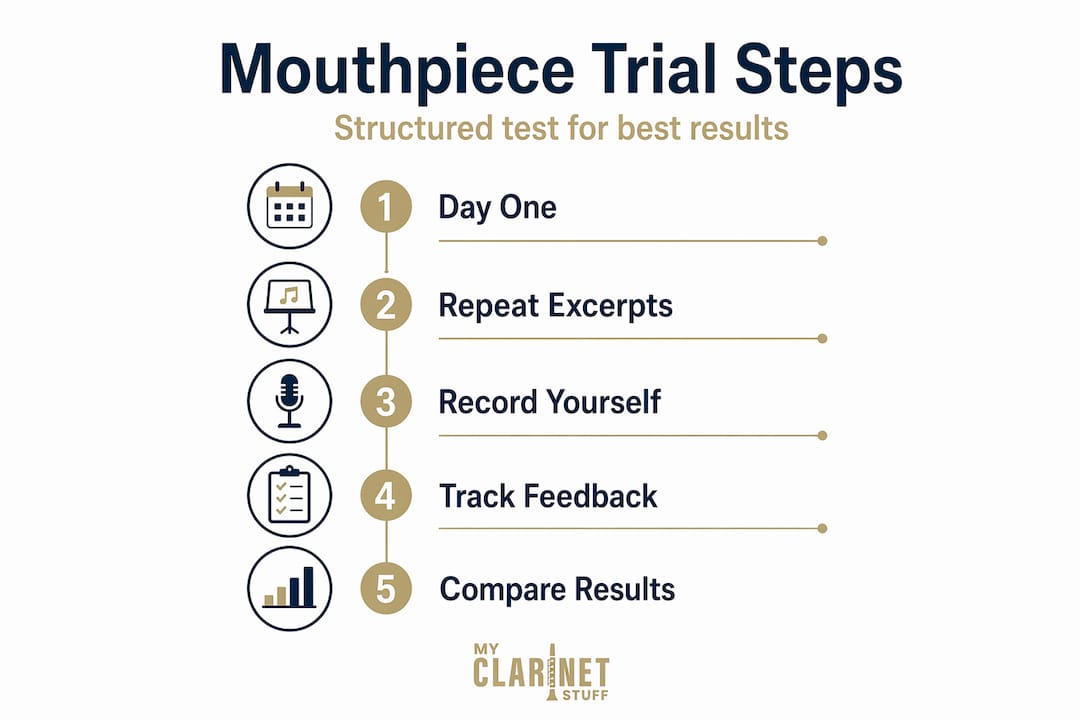
- Set a baseline. Before testing anything new, record yourself playing three excerpts with your current setup. Use the same room, microphone position, and reed strength every time.
- Introduce one variable at a time. Test a new mouthpiece with your existing reeds and ligature first. Once you have impressions there, you can experiment with reed strength. Changing multiple things at once makes it impossible to know what caused any difference you hear.
- Test across at least 3 to 5 reeds per model. Scoring reeds on tone, response, and articulation across structured short sessions over several days accounts for the natural variability in cane and gives you a reliable average rather than a fluke.
- Record every session. This is non-negotiable. Your perception of your own playing is heavily influenced by physical sensation and expectation. Recording lets you evaluate tone and response with fresh ears, often days later.
- Take written notes immediately after each session. Rate each option on intonation, ease of response, dynamic flexibility, and how it felt physically. Numbers and short phrases work better than long descriptions.
- Rotate equipment to avoid order bias. Always test items in a different sequence across sessions. The mouthpiece you try first always sounds fresher simply because you are not yet fatigued.
- Give it more than one day. Your first impression and your day-three impression are often completely different. A step-by-step mouthpiece testing guide reinforces this: using the same warm-up routine and recording impressions is what separates useful data from noise.
Pro Tip: Use a simple 1-to-5 scale across four categories for each session: tone quality, intonation stability, physical response, and overall comfort. Average your scores across days. The mouthpiece with the highest consistent average wins, not the one that had one great moment.
What happens when you skip proper testing
Skipping thorough testing feels like saving time. It usually costs more time than it saves.
Players who buy mouthpieces or instruments without real trials frequently run into these problems:
- Intonation surprises. A mouthpiece that played in tune in a warm store may pull sharp in a cold rehearsal hall. You would only catch this in extended multi-context testing.
- Tone inconsistency. Poor equipment choices lead to inconsistent tone and reduced performance satisfaction, problems that take time and money to fix.
- Embouchure fatigue. A mouthpiece with the wrong facing length for your embouchure is not always obvious in a short test. After thirty minutes of rehearsal, you will know.
- Wasted money on returns. Without a trial period, returns are often complicated and sometimes not possible at all.
Here is a direct comparison of what the two approaches actually look like:
| Factor | No structured testing | Structured test options |
|---|---|---|
| Time investment upfront | Minutes | Days |
| Intonation accuracy | Unknown until too late | Verified across contexts |
| Confidence in purchase | Low | High |
| Risk of returns or regret | High | Low |
| Embouchure compatibility | Guesswork | Assessed through real playing |
The importance of test options for clarinetists becomes clearest at the moment you realize a mouthpiece you bought last month is fighting you every rehearsal. Students lose confidence. Professionals lose performance quality. The fix is always the same: test properly before you buy.
My honest take on testing
I’ll be direct: I underestimated testing for years. I assumed my ear was good enough to judge a mouthpiece in fifteen minutes, and I paid for that confidence repeatedly. Wrong facings, mouthpieces that felt wonderful in isolation and fell apart in ensemble settings, ligatures I bought because they looked serious.
What changed my approach was using an extended trial program for the first time. Having five or more days with a mouthpiece in my actual playing environment, using my own reeds and ligature, playing through real repertoire rather than warm-up scales, was a completely different experience. I could hear things on day three that were invisible on day one. My recorded sessions revealed tone differences I had rationalized away in real time.
The harder lesson was learning to trust my recordings over my in-the-moment sensations. The mouthpiece that felt the most alive under my teeth wasn’t always the one that sounded best from across the room. Balancing those two inputs, physical feel and objective audio, is genuinely difficult. But having time to do it is what makes it possible at all.
My advice: treat testing as part of your practice, not an interruption to it. The time you invest in a proper trial will pay back every time you pick up your clarinet.
— Milos
Find your perfect mouthpiece with Myclarinetstuff

At Myclarinetstuff, we built our Clarinet Mouthpiece Matchmaker specifically because we know how hard it is to choose without real options. Answer a few questions about your playing style, experience level, and tonal goals, and we’ll match you with Gleichweit mouthpieces suited to your specific needs. Our Austrian-made CNC-crafted mouthpieces eliminate the variability of traditional hard rubber, so what you test is what you get every time.
Beyond the Matchmaker, you can explore our mouthpiece types overview to understand your options before you test, or check out our accessory selection guide for ligatures and barrels. We offer fast U.S. shipping and personal support for students, educators, and professionals. You should never have to guess your way into gear this important.
FAQ
Why do clarinetists need test options before buying?
Quick trials rarely reveal how a mouthpiece performs across different playing contexts. Multi-day testing under realistic conditions exposes intonation issues, tone inconsistencies, and embouchure compatibility that short store trials miss entirely.
How long should a clarinet mouthpiece trial last?
Most structured trial programs recommend at least five days. This gives you enough time to test across lessons, rehearsals, and practice sessions where performance differences become clear.
Does recording yourself actually help during testing?
Yes. Recording test sessions lets you evaluate tone and response objectively, separate from the physical sensations that can skew your real-time perception of how you sound.
What is the biggest mistake clarinetists make when testing equipment?
Changing multiple variables at once. Testing a new mouthpiece with new reeds and a new ligature simultaneously makes it impossible to know which component caused any difference you hear. Test one thing at a time.
Can beginners benefit from structured test options?
Absolutely. Beginners benefit from testing just as much as professionals because a mouthpiece that fights a developing embouchure builds bad habits from day one. Good testing habits start early and pay dividends at every skill level.