
TL;DR:
- Clarinet overblows at the twelfth due to its cylindrical bore favoring odd harmonics, specifically the 3rd. Proper technique involves fast, focused air and precise voicing to smoothly transition registers using the register key. Maintaining well-aligned equipment and practicing overtone exercises are essential for clean register jumps and optimal performance.
Most woodwind players assume overblowing works the same way across instruments. For clarinet students, that assumption causes real confusion. What is clarinet overblowing, exactly? It’s the acoustic jump that happens when you increase air speed and engage the register key, causing the instrument to leap from one register to another. But unlike the flute or oboe, which jump a neat octave, the clarinet overblows at the twelfth. That’s an octave plus a fifth. Understanding why this happens, and how to control it, is one of the most important skills you can develop as a clarinettist.
Table of Contents
- Key Takeaways
- The physics of clarinet overblowing
- The register key and how it works
- Techniques for successful clarinet overblowing
- Practical exercises to master overblowing
- How the clarinet compares to other woodwinds
- My honest take on mastering the register break
- Gear that supports your register transitions
- FAQ
Key Takeaways
| Point | Details |
|---|---|
| Clarinet overblows at the twelfth | Unlike most woodwinds, the clarinet jumps 12 intervals up, not an octave, due to its cylindrical bore. |
| The register key is critical | It weakens the fundamental frequency so the 3rd harmonic can speak clearly during overblowing. |
| Voicing beats volume | Fast, focused air with proper tongue position produces cleaner register breaks than simply blowing harder. |
| Overtone exercises reveal weaknesses | Practicing overtones diagnoses embouchure and air support problems before they become habits. |
| Equipment affects register response | Mouthpiece design and register key mechanics directly influence how smoothly overblowing works. |
The physics of clarinet overblowing
To understand why the clarinet behaves differently, you need a basic grasp of how its bore produces sound. The clarinet is a cylindrical, closed-end tube. The mouthpiece end is acoustically “closed” by the reed, and the bore stays the same diameter from top to bottom. That design has a profound consequence for the harmonic series the instrument produces.
A closed cylindrical tube favors only odd-numbered harmonics. That means the clarinet resonates strongly on the 1st, 3rd, and 5th harmonics, while suppressing the 2nd, 4th, and 6th. Here is why that matters for overblowing:
- 1st harmonic: The fundamental note you play in the chalumeau register
- 3rd harmonic: The first available overblow, which lands a twelfth above the fundamental
- 5th harmonic: The next partial, used in extended technique and altissimo playing
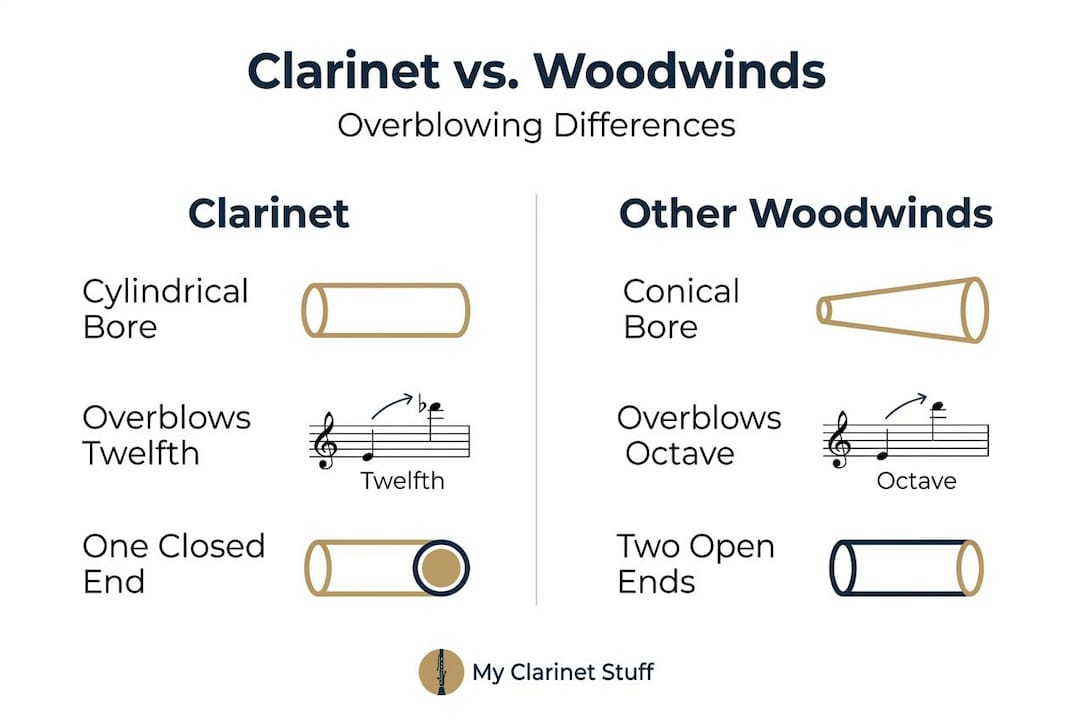
Contrast this with a conical bore instrument like the oboe or saxophone. Those instruments overblow at the octave because their bore shape supports even harmonics, making the 2nd harmonic the natural first destination when air speed increases.
“The clarinet’s cylindrical bore and closed-end mouthpiece design are the reason it favors odd harmonics, producing a characteristic woody tone unlike any other woodwind.” — acoustic physics, applied to practice
When you open the register key and increase air speed, you are suppressing the 1st harmonic and nudging the instrument to vibrate in the pattern of the 3rd harmonic instead. That’s the jump to the twelfth. The math works out cleanly: an octave (7 half steps in ratio terms, 12 semitones) plus a perfect fifth (7 semitones) equals a major twelfth. This is not a quirk or a flaw. It is the clarinet’s acoustic identity, and every fingering system for the instrument is built around it.
The register key and how it works
The register key does one specific job: it opens a small vent hole near a pressure node of the 3rd harmonic. By venting at that point, it weakens the fundamental frequency just enough to let the higher partial take over. Think of it like removing the foundation of a building so the second floor becomes the ground floor instead.
Proper register key use requires smooth, anticipatory motion. If you engage the key too slowly, or at the wrong moment, the note cracks. If you open it without adjusting your air and voicing at the same time, you get a squeak.
The physical design of the register key matters more than most students realize:
- Vent size: A larger vent produces faster register breaks but can brighten the tone and destabilize intonation
- Placement: Even a millimeter of misalignment can cause the 3rd harmonic to speak unevenly
- Pad condition: Pad leaks or misaligned vents disrupt smooth register breaks and produce squeaks or stuffy tones
- Key height: If the pad opens too far or not enough, response and pitch stability both suffer
This is why clarinet maintenance is not optional. A leaking register key pad will undermine even the most technically refined overblowing technique. You can read more about keeping your instrument in top shape with this clarinet maintenance guide from Myclarinetstuff.
Pro Tip: Before blaming your technique for squeaky register breaks, have a technician check your register key pad and vent alignment. Many “technique problems” are actually mechanical ones.
Techniques for successful clarinet overblowing
Here is where understanding clarinet overblowing shifts from theory to practice. The two most common mistakes students make are blowing harder and tightening the embouchure. Both create the opposite of what you want.
Successful overblowing depends on fast, focused air rather than sheer volume. Think of the difference between a wide, slow river and a narrow, fast stream. The narrow stream moves with more force even with less water. Your air needs to be that stream.
The second element is voicing. Voicing means shaping the inside of your oral cavity to reinforce specific harmonics. For the clarinet’s 3rd harmonic, you want to raise the back of the tongue as if saying “ee” rather than “ah.” This raises the resonant frequency of your oral cavity to match the partial you want to produce.
Here is a step-by-step approach to building the technique:
- Start with a slow low G. Hold it for 10 seconds with a focused, steady tone. Do not press hard on the reed. Let the air do the work.
- Gradually increase air speed while keeping the volume the same. You are looking for speed, not loudness.
- Shift your tongue to “ee” position and feel the resonance change inside your mouth.
- Open the register key at the same moment you complete the voicing shift. The note should jump cleanly to D above the staff.
- Hold the upper note for 5 seconds, then reverse the process to return to the chalumeau register.
Pro Tip: Record yourself doing this exercise. Squeaks almost always happen at a predictable moment in the sequence, and hearing the recording tells you exactly where your coordination breaks down.
A common pitfall is forcing the transition with extra embouchure pressure. Biting down tightens the reed and actually chokes the 3rd harmonic. Relax your jaw, speed up your air, and let voicing do the work.
Practical exercises to master overblowing
Understanding the theory is one thing. Building muscle memory through targeted clarinet overblowing exercises is another. The goal is to make smooth register transitions automatic.
| Exercise | Focus area | What to listen for |
|---|---|---|
| Low note sustain with air speed increase | Air speed control | Steady tone before any register change |
| Overtone slurs without register key | Voicing and oral resonance | Clean jump to 12th using only tongue position |
| Slow register key transitions | Timing and coordination | No cracks or squeaks at the transition point |
| Scale passages crossing the break | Integration | Even tone color across both registers |
The overtone exercise without the register key is particularly powerful. Overtone exercises are effective diagnostic tools. If you cannot jump to the 12th on a low E without the register key using only voicing and air speed, your technique has a gap that the register key is covering up. Finding that gap is the point.
Start in the chalumeau register on low E. Sustain the note, then try to produce the B a twelfth above using only your air and oral cavity. No register key. When you succeed, even partially, you are training the coordination that makes register key transitions smooth and reliable.
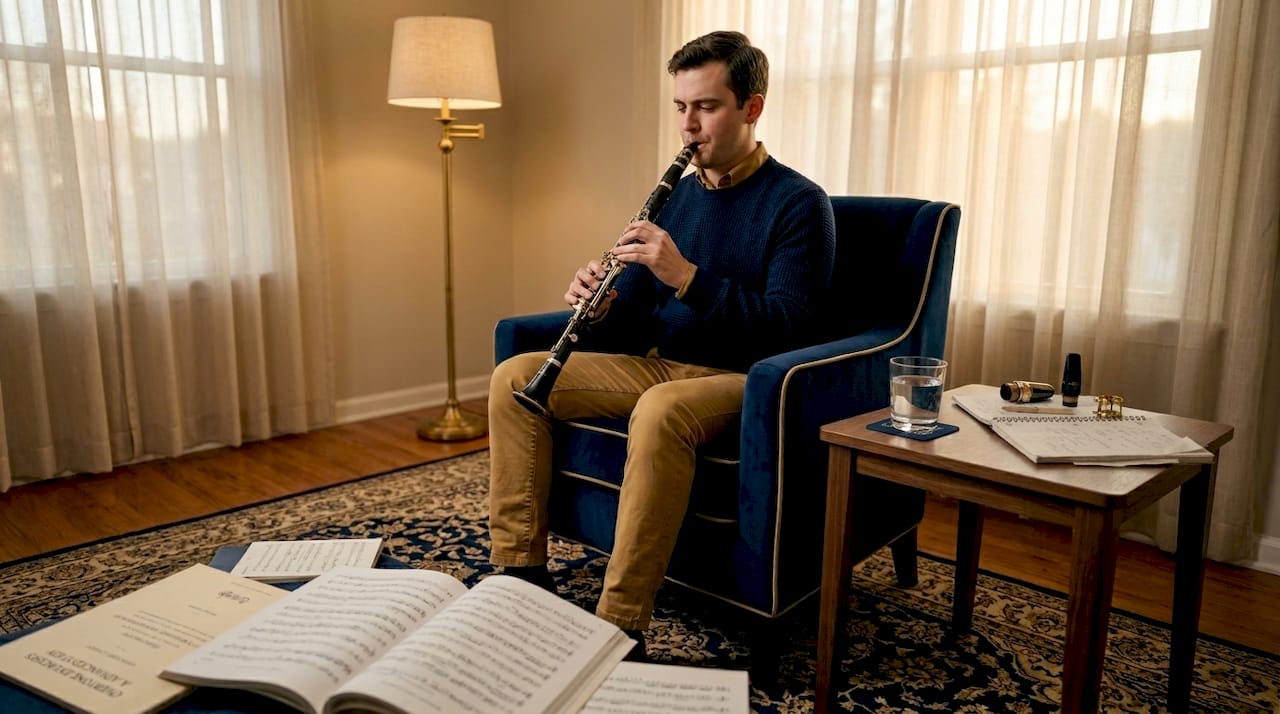
Students should hold low notes for 8 to 12 seconds, focusing on a steady, centered sound before attempting the jump. Rushing this preparation is the most common reason the exercise fails.
For diagnosing problems during practice, use your clarinet sound troubleshooting instincts. If you squeak consistently on the same note, the problem is usually mechanical or related to timing. If you squeak unpredictably, the problem is usually air support or embouchure consistency.
How the clarinet compares to other woodwinds
Seeing the clarinet’s overblowing behavior next to other instruments makes the contrast vivid. The clarinet is genuinely unusual in the woodwind family.
| Instrument | Bore type | Overblows at | Reason |
|---|---|---|---|
| Clarinet | Cylindrical, closed end | 12th (3rd harmonic) | Odd harmonics only |
| Flute | Cylindrical, open both ends | Octave (2nd harmonic) | Even and odd harmonics |
| Oboe | Conical | Octave (2nd harmonic) | Conical bore supports even harmonics |
| Saxophone | Conical | Octave (2nd harmonic) | Conical bore despite similar reed |
The saxophone comparison surprises many students. Despite using a single reed like the clarinet, the saxophone’s conical bore causes it to overblow at the octave, not the twelfth. The reed type is far less important than the bore geometry when it comes to overblowing behavior.
The flute is open at both ends, which means it supports both odd and even harmonics. This makes its 2nd harmonic the first available partial, landing cleanly at the octave. Same physics, different starting conditions.
For the clarinet, the practical implication is significant. Because the jump is a twelfth rather than an octave, the fingering system requires a larger set of keys and more complex cross-fingering patterns to cover the gap. The clarinet’s harmonic series produces a characteristic woody tone that also means register breaks are more audible and require more careful management than on the flute or oboe. This is not a weakness. It is what gives the clarinet its unique voice.
My honest take on mastering the register break
I’ve seen students spend years fighting the register break when the answer was sitting right in front of them: voicing. In my experience, air volume gets the blame for squeaks far more often than it deserves. The real culprit is an oral cavity that’s not resonating at the right frequency for the 3rd harmonic.
What I’ve learned from watching students work through overtone exercises is that failing to overblow cleanly is always a signal, not a problem. It tells you exactly where the coordination breaks down. Most players skip this diagnostic step because it’s uncomfortable to produce imperfect sounds in practice. That discomfort is the point.
My honest advice: stop trying to make register transitions sound good immediately. Spend two weeks doing slow, ugly overtone slurs without the register key. Let yourself squeak. Pay attention to where in the sequence the squeak happens. Then fix that one thing. You’ll learn more about understanding clarinet overblowing from that process than from any scale exercise you’ve ever played.
The clarinet’s odd-numbered partials have challenged players for centuries. Modern technique gives us the tools to work with that physics intentionally. Use them.
— Milos
Gear that supports your register transitions

Your technique can only go as far as your equipment allows. At Myclarinetstuff, we work with clarinetists at every level to find setups that support clean register breaks and consistent tone. A mouthpiece with the wrong facing length or chamber size adds unnecessary resistance right at the moment you need free-speaking airflow for overblowing. Use the Clarinet Mouthpiece Matchmaker to find options matched to your playing style and register needs. Gleichweit mouthpieces, precision CNC-crafted in Austria, deliver consistent response that doesn’t change from one piece to the next. If you’re also looking at your full setup, the clarinet accessory guide at Myclarinetstuff covers barrels, ligatures, and accessories that affect how freely your instrument speaks across registers.
FAQ
What is clarinet overblowing?
Clarinet overblowing is the acoustic phenomenon where increasing air speed and engaging the register key causes the instrument to jump a twelfth above the fundamental note. It occurs because the clarinet’s cylindrical, closed-end bore supports only odd harmonics, making the 3rd harmonic the first available overtone.
Why does the clarinet overblow at the twelfth instead of the octave?
The clarinet overblows at the twelfth because its cylindrical bore, closed at one end by the reed, suppresses even-numbered harmonics and favors the 1st, 3rd, and 5th partials. The 3rd harmonic lands a twelfth above the fundamental, unlike conical bore instruments that overblow at the octave.
How do you overblow a clarinet cleanly without squeaking?
Clean overblowing requires fast, focused air combined with proper voicing. Raise the back of your tongue to an “ee” position and open the register key in one coordinated motion. Avoid biting down or blowing harder, as both create squeaks rather than clear register breaks.
What are the best clarinet overblowing exercises for beginners?
Start by sustaining low chalumeau register notes for 8 to 12 seconds with steady, centered air before attempting the register jump. Overtone slurs without the register key are especially effective because they force your voicing and air speed to do the work the key normally assists.
How does the register key affect clarinet overblowing?
The register key opens a vent near a pressure node of the 3rd harmonic, which weakens the fundamental frequency and allows the higher partial to speak. Pad leaks, misaligned vents, or incorrect key height all disrupt this process and cause squeaks or unstable notes during overblowing.