
TL;DR:
- A clarinet ligature holds the reed against the mouthpiece, affecting vibration boundaries and sound production. Its primary role is mechanical, with minimal impact on tone, which is mainly determined by the mouthpiece and reed pairing. Selecting a ligature should be based on stability and feel rather than supposed tonal differences.
A clarinet ligature is the device that clamps the reed against the mouthpiece, creating the boundary conditions that make sound production possible. Without a properly fitted ligature, the reed cannot vibrate freely, and your tone suffers immediately. The role of ligature in clarinet performance extends beyond simply holding the reed in place. It affects reed stability, articulation consistency, intonation feedback, and playing feel. Brands like Rovner and Vandoren have built entire product lines around these differences. This guide cuts through the marketing noise and gives you evidence-based answers.
How does the ligature physically affect reed vibration and tone?
The ligature’s primary function is to hold the reed securely against the mouthpiece table, setting the correct vibration boundaries for sound. When the reed seats properly, it can vibrate along its full length from the tip to the point of contact. That free vibration is what produces a clear, resonant tone.
Ligature tension is the most critical mechanical variable in this equation. Firm tension holds the reed steady during fast passages and articulation. Too much tension chokes the reed, restricts vibration, and produces a muffled, dead sound. Too little tension lets the reed shift during playing, which breaks up your tone and makes intonation inconsistent.
Ligature placement matters just as much as tension. The correct position is roughly halfway down the reed, which keeps the tip completely free to vibrate. Placing the ligature too close to the tip restricts the most active part of the reed and kills your response.
- Align the reed tip flush with the mouthpiece tip before sliding the ligature on
- Position the ligature body halfway down the reed, not near the tip
- Tighten screws until the reed is firm but not compressed
- Check that the reed does not shift when you apply tongue pressure
Pro Tip: Tighten the ligature screw until you feel resistance, then stop. If you can still slide the reed with moderate finger pressure, tighten slightly more. If the reed feels locked solid and your tone sounds flat or dull, back off a quarter turn.
Does ligature choice actually change your clarinet tone?
The short answer is: far less than manufacturers claim. Controlled 2026 trials testing 11 different ligatures found no measurable tonal or resistance differences when reed clamping was held consistent across models. That finding directly contradicts the marketing language around brightness, darkness, and projection that most ligature brands use.
Benjamin Allen, writing for Jazzocrat, puts it plainly: the ligature is acoustically passive. It does not resonate. It does not add color. It holds the reed. The mouthpiece and reed match dominate tone quality by a wide margin.
“Many marketing claims attributing brightness, darkness, or projection differences to ligature choice lack scientific support, with player experience differences often linked to reed stability effects.” — Jazzocrat, 2026
That does not mean all ligatures feel the same. Players consistently report differences in tactile feedback, reed response, and how the instrument feels under the fingers. Those perceptions are real. They just do not translate into measurable differences in the sound the audience hears. The ligature contributes roughly 3–5% of overall sound character, with the mouthpiece and reed pairing accounting for the rest.
The practical implication is clear. If you are chasing a tonal change, upgrade your mouthpiece or try a different reed strength before spending money on a new ligature. The tone color you want comes primarily from those two variables.
What are the practical differences between ligature materials?
Even if ligature materials do not change your audience-perceived tone, they do change how the instrument feels and how reliably the reed stays in position. Those differences matter, especially during long rehearsals or demanding repertoire.
| Material | Contact type | Clamping character | Player-perceived feel |
|---|---|---|---|
| Metal | Point or narrow band | Firm, strong grip | Bright response, direct articulation |
| Fabric / cloth | Wrap-around | Light, distributed pressure | Warmer feel, softer attack |
| Leather | Wrap-around | Medium, slightly flexible | Balanced feel, good reed stability |
| Wooden reed plate (e.g., Kodama II) | Full surface contact | Rigid, stable | Strong proprioceptive feedback |
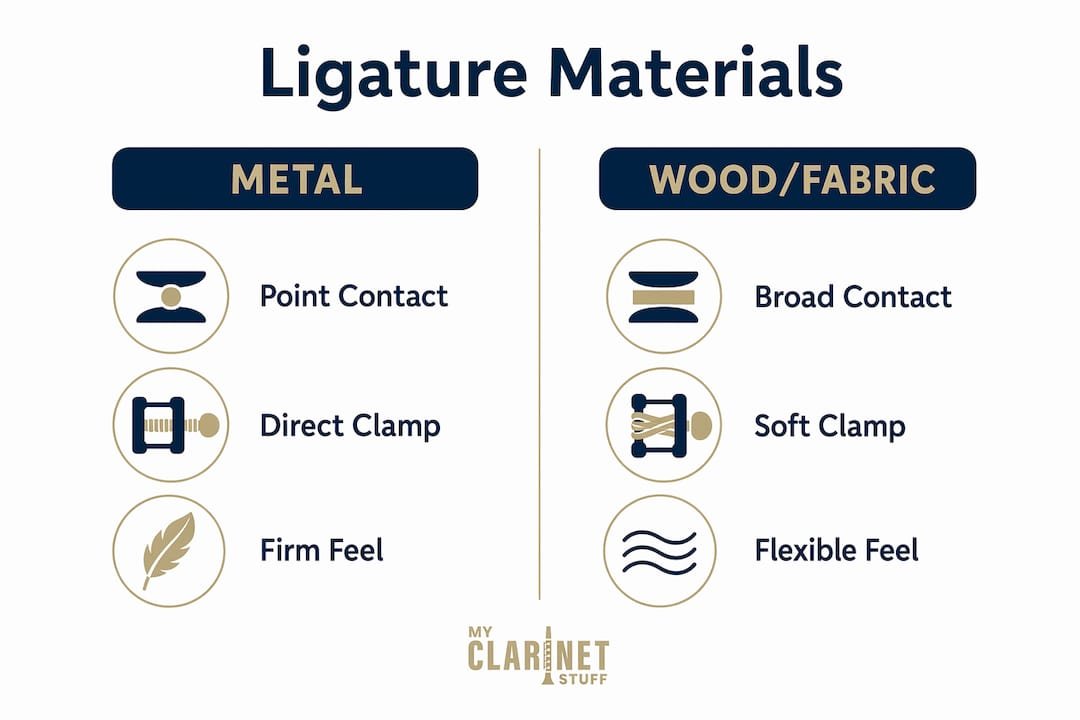
Metal ligatures like those from Vandoren provide a tight, consistent clamp. Players often describe the response as direct and immediate. Fabric ligatures, such as those from Rovner, distribute pressure across a wider area of the reed. That lighter clamp produces a softer attack and a warmer feel, which many classical players prefer.
The Kodama II’s wooden reed plate is a useful case study. Players report a distinctly different tactile sensation compared to metal or fabric designs, even though audio measurements show no tonal change. That proprioceptive feedback can influence embouchure adjustments and playing confidence, even when the sound itself is unchanged.
Pro Tip: Choose your ligature material based on how you want the reed to respond under your embouchure, not on tonal marketing claims. If you play fast, articulate passages, a metal ligature’s firm grip gives you more reed stability. If you play long lyrical phrases, a fabric or leather design may feel more forgiving.
How to correctly set up your clarinet ligature
Correct setup takes less than two minutes and prevents most of the common problems players blame on equipment. Follow these steps every time you assemble your mouthpiece.
- Wet your reed and let it soak for 30–60 seconds before assembly.
- Place the reed flat side down on the mouthpiece table, aligning the reed tip exactly with the mouthpiece tip.
- Slide the ligature over the mouthpiece and reed from the bell end, not the tip end.
- Position the ligature body so it sits roughly halfway down the reed, leaving the tip area completely free.
- Tighten the ligature screw or screws gradually, alternating sides if there are two screws.
- Stop tightening when the reed is firmly held but not compressed flat against the mouthpiece table.
- Check alignment one final time. The reed should sit centered on the mouthpiece with no gap on either side.
The most common mistake is overtightening. Overtightening chokes reed vibration, obscures tone, and reduces player control. A reed that is clamped too hard produces a flat, unresponsive sound that no amount of embouchure adjustment will fix.
The second most common mistake is placing the ligature too high, near the reed tip. That position restricts the most active vibrating section of the reed and kills your response immediately. For detailed guidance on reed care alongside ligature setup, the reed adjustment guide at Myclarinetstuff covers both topics together.
How does ligature choice affect intonation, articulation, and playing feel?
Ligature choice shapes performance in ways that go beyond tone color, and these effects are where the real differences between designs show up. Contact geometry between the ligature and reed directly affects how stable the reed stays during mouthpiece rotation and articulation. A ligature that allows micro-movement will produce inconsistent intonation across registers.
Here is what ligature stability actually controls in practice:
- Articulation consistency: A reed that shifts even slightly between notes breaks up the attack. Stable clamping keeps every note response identical.
- Intonation reliability: Reed movement during mouthpiece rotation changes the vibrating length of the reed, which shifts pitch. A stable ligature holds pitch center more reliably.
- Embouchure feedback: The tactile sensation from the ligature travels through the mouthpiece to your embouchure. Different designs give you different feedback, which can influence how you adjust your jaw and lip pressure.
- Performance reliability: During fast passages, a ligature with poor clamping consistency lets the reed creep. That creep compounds over a long performance and degrades response.
Ligature tension consistency matters more than the degree of tightening alone. A ligature that holds its clamping force through temperature changes, humidity shifts, and physical movement is more valuable than one that feels perfect at setup but loosens during a concert. This is where upgrading from a student-grade ligature to a quality metal or leather design pays off in reliability, not tone.
Players who notice their articulation becoming uneven or their intonation drifting mid-performance should check ligature stability before adjusting embouchure. The clarinet setup essentials resource at Myclarinetstuff addresses this connection directly.
Key Takeaways
The ligature’s most important job is holding the reed with consistent, firm tension at the correct position, because that stability controls articulation, intonation, and playing feel far more than any material or design claim.
| Point | Details |
|---|---|
| Ligature function | The ligature holds the reed against the mouthpiece; it does not shape tone directly. |
| Placement matters most | Position the ligature halfway down the reed to keep the tip free for full vibration. |
| Tone comes from mouthpiece and reed | Ligature contributes roughly 3–5% of sound character; the mouthpiece and reed pairing dominates. |
| Material affects feel, not audience tone | Metal grips firmly for direct articulation; fabric and leather distribute pressure for a softer feel. |
| Stability beats tonal marketing | Choose a ligature for reed stability and playing comfort, not brightness or projection claims. |
What I have learned after years of watching players chase the wrong fix
Players spend real money chasing tonal changes through ligature upgrades, and I understand why. The marketing is convincing. Words like “projection,” “warmth,” and “clarity” appear on every ligature box. But the 2026 controlled trials confirmed what experienced players have suspected for years: the ligature does not move the needle on tone in any way a listener can detect.
What I have seen actually matter is setup discipline. Players who assemble their mouthpiece the same way every time, with consistent tension and correct placement, play more reliably than players with expensive ligatures installed carelessly. A Rovner fabric ligature set up correctly outperforms a premium metal ligature overtightened by someone who does not know the difference.
The feel argument is legitimate, though. I have watched players switch from a metal to a fabric ligature and immediately play with less tension in their embouchure. The softer feedback changed how they held the mouthpiece. That change was real, even if the audience could not hear it. So test ligatures for feel and reed stability, not for tonal color. And before you buy anything new, get your mouthpiece and reed match right first. That is where your tone actually lives.
— Milos
Your mouthpiece and ligature work as a system
Ligature setup is only one part of a well-assembled clarinet. The mouthpiece you pair with your reed and ligature determines the majority of your sound, response, and intonation. Myclarinetstuff carries Gleichweit mouthpieces, precision CNC-crafted in Austria, designed to give you consistent performance across every playing condition.

If you are not sure which mouthpiece fits your playing style, the mouthpiece matchmaker at Myclarinetstuff walks you through the selection process based on your genre, experience level, and tonal goals. You can also browse the full clarinet accessory guide to see how ligatures, barrels, and reeds work together as a complete setup. Gleichweit mouthpieces ship fast across the U.S. with personalized support for students, educators, and professionals.
FAQ
What is a clarinet ligature?
A clarinet ligature is the metal, fabric, or leather clamp that holds the reed against the mouthpiece table. It sets the vibration boundary conditions that allow the reed to produce sound.
Does the ligature change clarinet tone?
Controlled trials testing 11 ligatures found no measurable tonal differences when reed clamping was consistent. The mouthpiece and reed pairing dominates tone quality; the ligature contributes a small fraction of overall sound character.
Where should the ligature sit on the reed?
The ligature should sit roughly halfway down the reed, leaving the tip area completely free. Placing it too close to the tip restricts vibration and kills response.
What happens if I overtighten the ligature?
Overtightening chokes reed vibration and produces a muffled, flat tone. The correct tension is firm enough to prevent reed movement but not so tight that the reed is compressed flat against the mouthpiece.
Metal or fabric ligature: which is better?
Neither is universally better. Metal ligatures provide a firm grip and direct articulation feel. Fabric ligatures distribute pressure more evenly and feel softer under the embouchure. Choose based on your playing style and how you want the reed to respond, not on tonal claims.
One Response