
TL;DR:
- Improving clarinet tone requires understanding the relationship between body, technique, and equipment to build consistent habits.
- Daily focused practice, including long tones and mouthpiece buzzing, significantly enhances sound quality within weeks.
You already know what a great clarinet tone sounds like. Warm, centered, resonant, with a core that carries across a room. The frustrating part is when what comes out of your bell doesn’t match what you hear in your head. Learning how to improve clarinet tone isn’t about chasing a single fix. It’s about understanding the layered relationship between your body, your technique, and your equipment, then building habits that make great tone the default, not the exception.
Table of Contents
- Key takeaways
- How to improve clarinet tone through physical setup
- Practice routines for better clarinet tone
- Shaping tone color with tongue and air
- Troubleshooting common tone problems
- My honest take on chasing better tone
- Find the right gear to match your technique
- FAQ
Key takeaways
| Point | Details |
|---|---|
| Physical setup comes first | Posture, breath support, and embouchure form the foundation that every tone improvement is built on. |
| Daily tone blocks produce results | A structured 15-25 minute session of long tones and mouthpiece buzzing shows measurable improvement within weeks. |
| Tongue position shapes tone color | Shifting between “ee” and “ah” vowel shapes inside your mouth can brighten or darken your sound without changing embouchure pressure. |
| Embouchure pressure is not air support | Squeezing harder compensates for weak air but kills resonance. Diaphragm-led airflow allows a relaxed, richer tone. |
| Equipment maintenance matters too | Leaky pads and dirty mouthpieces degrade tone quality even when your technique is solid. |
How to improve clarinet tone through physical setup
Before you touch a single exercise or swap any gear, your body has to be set up correctly. Poor posture and shallow breathing undercut every other technique adjustment you make.
Posture and airflow
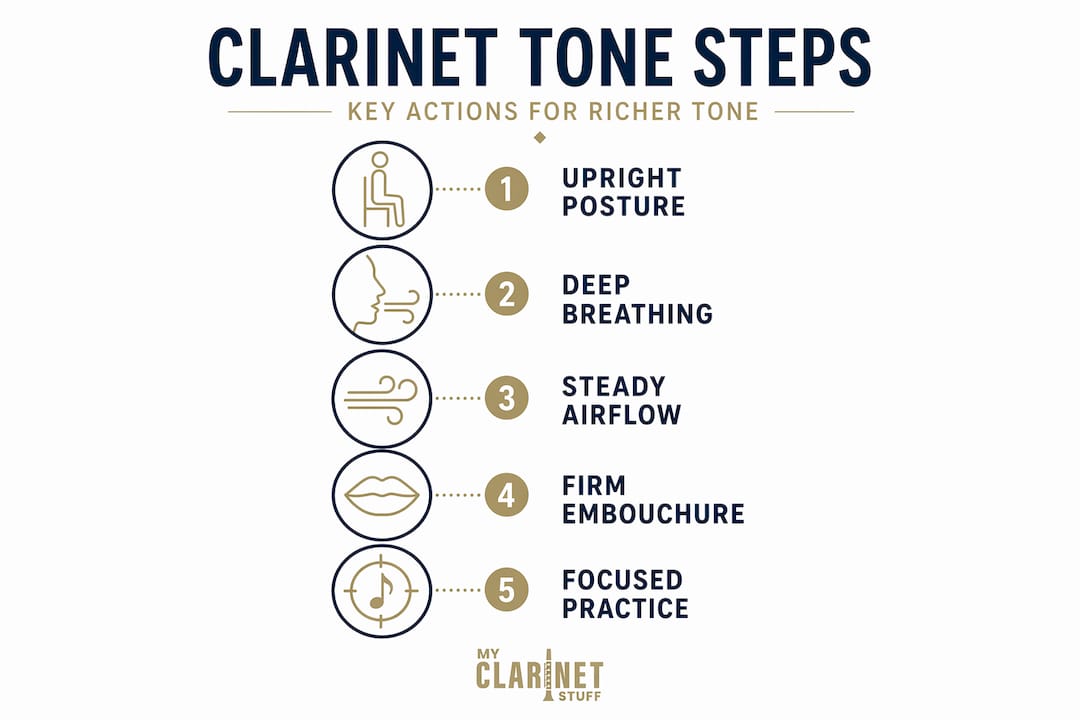
Stand or sit with your spine tall and your shoulders back and relaxed. Your instrument should angle slightly forward and away from your body, not pressed flat against your chest. This position keeps your airway open and allows the diaphragm to move freely. Collapsed posture restricts airflow the same way a kinked hose restricts water. You get less volume, less pressure, and a noticeably thinner sound.
Breathing for clarinet is diaphragmatic. When you inhale, your belly should expand outward, not just your chest. Practice this away from the instrument: put one hand on your stomach, breathe in slowly, and feel your hand move forward. That expansion is what generates the steady air column a centered tone requires.
Embouchure fundamentals
A proper embouchure involves firm corners, a flat and downward chin, and a cushioned lower lip folded gently over the bottom teeth. The upper teeth rest on the mouthpiece. The key word in all of this is firm, not clenched. Many players, especially beginners, bite down on the reed with vertical pressure. This chokes vibration and produces a thin, strangled tone.
A useful mental cue is to form the shape of the word “oo” with your mouth before placing the mouthpiece. This naturally positions the lip and reduces the urge to bite.
- Keep chin flat and pointed downward, never bunched
- Firm the corners of the mouth inward and slightly upward
- Cushion the lower lip without collapsing it into the teeth
- Avoid tilting or rolling the mouthpiece in any direction
- Check your setup regularly in a mirror until it becomes automatic
Pro Tip: Record yourself playing a single sustained note, then watch the video with the sound off. You can often catch embouchure problems visually that you never notice while playing.
Practice routines for better clarinet tone
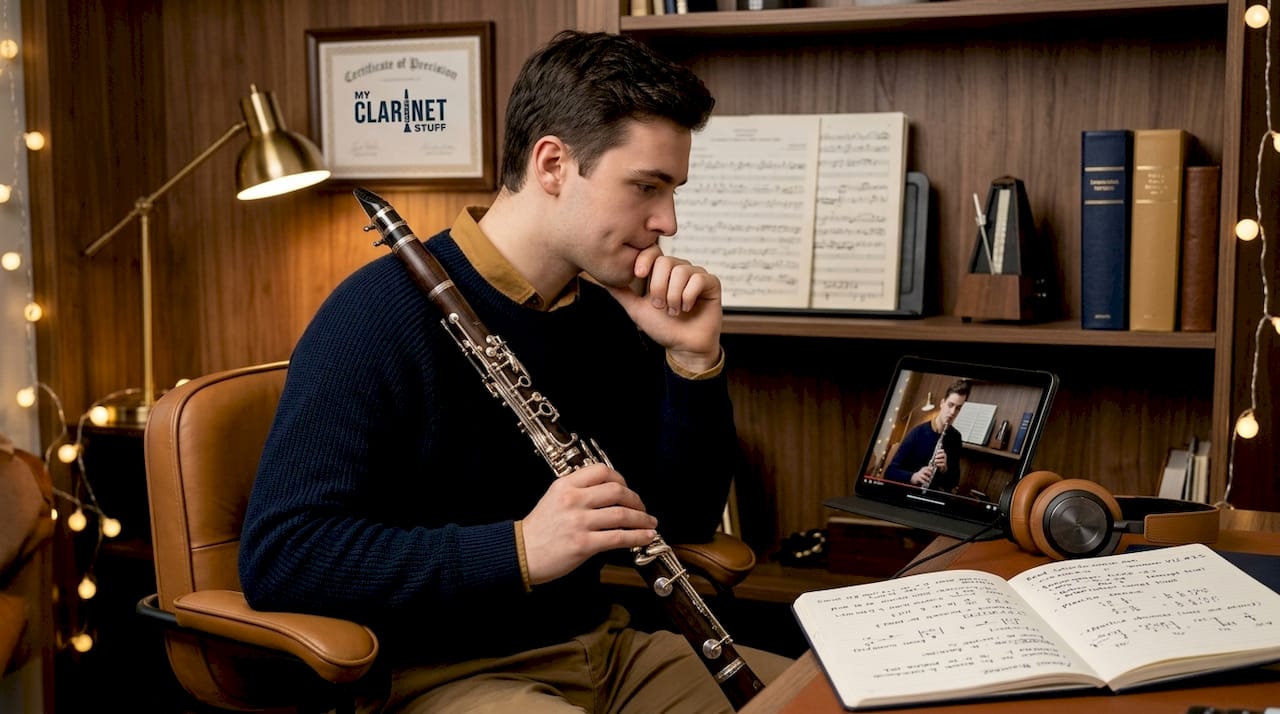
Consistent tone improvement comes from structured, intentional practice. Random playing time does not produce the same results as focused tone blocks.
The daily tone block
A structured daily tone block of 15-25 minutes targeting long tones, dynamic swells, and mouthpiece buzzing is one of the most reliable methods for improving sound quality within weeks. The format matters as much as the time. Here is a practical sequence:
- Mouthpiece and barrel buzzing (3-5 minutes). Buzz on the mouthpiece alone, targeting a concert F# to G. This isolates embouchure and air issues from instrument response and acts as a diagnostic tool before you even play a full note. A centered buzz predicts a centered tone.
- Long tones with dynamics (10-12 minutes). Pick a single pitch in the middle of the staff. Sustain it for 8-16 counts at a steady mezzo-forte. Then add a slow crescendo over 8 counts followed by a decrescendo back to piano. Do this on 4-6 pitches spanning the full range.
- Register connection drills (5-8 minutes). Play a pitch in the lower register, then slur up to its equivalent in the upper register and back down. Focus on matching tone color and air pressure across the break.
- Overtone exercises (5-10 minutes). Finger the lowest C but gradually adjust your air and embouchure to produce the G above, then the E above that. Overtone exercises practiced daily strengthen air support and embouchure control, which directly reduces squeaks and register break inconsistencies.
Pro Tip: Use a tuner during long tones not just to check pitch but to watch how steady the needle holds. Wavering pitch is often a sign of inconsistent air support, not an embouchure problem.
The table below shows a practical weekly tone block structure:
| Day | Focus area | Time |
|---|---|---|
| Monday | Long tones and buzzing | 20 minutes |
| Tuesday | Register connection and overtones | 20 minutes |
| Wednesday | Dynamic swells and phrasing | 15 minutes |
| Thursday | Full tone block with articulation | 25 minutes |
| Friday | Scales with tone focus | 20 minutes |
| Saturday | Free exploration and repertoire tone | 15 minutes |
| Sunday | Rest or light listening |
The International Clarinet Association emphasizes that tone is not static. It fluctuates with embouchure pressure and airflow, which is exactly why regular long tone and scale practice builds consistency across registers and dynamics.
Shaping tone color with tongue and air
Once you have a stable baseline tone, you can start shaping how that tone sounds. This is where clarinet playing becomes genuinely expressive.
Tongue position as an acoustic filter
The position of your tongue inside your mouth acts like an acoustic filter for your sound. A higher tongue position, created by thinking the vowel “ee,” brightens the tone, giving it more edge and projection. A lower tongue position using “ah” darkens and broadens the sound. This happens because tongue height changes the shape of the oral cavity, which filters the acoustic resonance of the instrument.
Try this: hold a long tone in the middle register at a comfortable dynamic. Slowly shift your internal vowel from “ah” to “ee” and back again. You will hear the tone color change noticeably without altering your embouchure pressure at all.
- Use “ah” for warm, darker tones in lyrical passages and lower registers
- Use “ee” for brighter, more projected sounds in louder dynamics and higher registers
- Practice smooth transitions between these positions on single sustained notes
- Apply them consciously in scales before applying them in repertoire
Air speed and direction
Faster air brightens and focuses tone. Slower air broadens and darkens it. Angle also matters. Directing air slightly downward into the mouthpiece supports the lower register. A slightly more upward angle helps the upper register speak with more clarity. Most players never experiment with this consciously. Those who do gain a level of tonal flexibility that technique alone cannot provide.
Resonance fingerings are another advanced tool worth adding to your toolkit. Certain notes, particularly in the upper register, tend to sound thin or slightly flat. Adding an alternate or resonance fingering can stabilize pitch and add body to the tone without any embouchure adjustment.
Troubleshooting common tone problems
Even with strong technique, tone problems appear. Knowing how to diagnose them quickly saves hours of frustration and prevents bad habits from taking root.
Thin, airy, or unfocused sound
The most common cause is insufficient air support. When your air runs out before the phrase does, the tone thins out and loses center. Weak air support compensated by increased embouchure pressure is a double problem: it kills resonance and fatigues the embouchure faster.
- Check your posture and breathing setup first before adjusting embouchure
- Practice sustaining long tones at piano dynamic, which requires more precise air control than forte
- If the tone feels airy, check reed placement on the mouthpiece. Even a millimeter of misalignment changes the seal and the sound
- Clarinet sound troubleshooting covers many of these issues with quick fixes that apply at any skill level
Squeaking and register break problems
Squeaks are almost always either embouchure tension, rushed air changes across the break, or reed/mouthpiece issues. Before blaming technique, check the reed. A warped or uneven reed will squeak regardless of how good your embouchure is. Check that the reed is centered on the mouthpiece and that the tip of the reed aligns exactly with the tip of the mouthpiece.
“Poor instrument maintenance, like leaks or sticky pads, significantly degrades tone quality even when technique is solid.” The same principle applies at the reed level. A clean mouthpiece and a properly seated reed are non-negotiable starting points.
Pro Tip: Run your tongue lightly across the flat side of the reed before playing. If you feel any warping or high spots, that reed needs adjustment or replacement. A poorly seated reed is one of the fastest ways to undo good technique.
Instrument leaks from worn pads or loose tone holes cause airy, unstable tone that no amount of technique can fully compensate for. If you have ruled out embouchure and air issues and the problem persists, take the instrument to a repair technician for a leak test.
My honest take on chasing better tone
I’ve watched a lot of players, myself included at various points, spend money on new mouthpieces, new reeds, and new barrels hoping equipment would solve a tone problem that was actually a technique problem. It rarely does.
The uncomfortable truth is that sound concept drives tone more than any piece of gear. The clarinet is trying to imitate the human voice. The clearer and more specific your internal image of the sound you want, the more accurately your body will produce it. I’ve heard students with entry-level instruments produce genuinely beautiful tone because they listened carefully and practiced with intention. I’ve also heard professionals with exceptional equipment produce generic, uninspiring sound because they had never developed a clear idea of what they wanted to sound like.
The balance I’ve found that actually works: spend 80% of your tone work on air and embouchure refinement, and be patient with the equipment side. When technique is genuinely solid and a limitation clearly comes from gear, then upgrading a mouthpiece or reed makes a dramatic difference. In that order. Not the other way around.
Daily tone work changed my playing more than any single equipment upgrade ever did. Start with 15 minutes of focused long tones every day for two weeks. The improvement is real, and it’s permanent.
— Milos
Find the right gear to match your technique
Once your technique is producing consistent results, the right equipment will amplify everything you have worked for.

At Myclarinetstuff.com, we have built a resource specifically for clarinetists who are ready to match their gear to their sound goals. The Clarinet Mouthpiece Matchmaker walks you through your playing style, tonal preferences, and experience level to recommend mouthpieces that actually fit how you play. Gleichweit mouthpieces from Austria are CNC-crafted for consistency across every unit, which means the tone you dial in during testing is the tone you get every time. Pair that with the reed adjustment guide and the mouthpiece testing methodology on the site, and you have a complete picture of how technique and gear work together.
FAQ
What is the fastest way to improve clarinet tone?
A structured daily tone block of 15-25 minutes focusing on long tones, dynamic control, and mouthpiece buzzing produces noticeable improvement within weeks. Consistency matters far more than session length.
Why does my clarinet tone sound thin or airy?
Thin or airy tone is most often caused by insufficient air support or a misaligned reed. Check reed placement and posture first, then work on sustaining long tones at soft dynamics to build precise air control.
How does tongue position affect clarinet tone?
Tongue height changes the shape of your oral cavity, which acts as an acoustic filter. A higher “ee” position brightens the tone, while a lower “ah” position darkens and broadens it without any change in embouchure pressure.
How often should I practice tone exercises?
Daily practice is ideal. Even 15 minutes of focused long tones every day beats an hour-long session twice a week, because tonal consistency is built through repetition and muscle memory over time.
Does the mouthpiece affect clarinet tone quality?
Yes, significantly, but only once your technique is consistent. A quality mouthpiece with predictable response amplifies what your embouchure and air support are already producing. Test mouthpieces systematically rather than switching based on general recommendations.
One Response