
What causes clarinet squeaks and how do you fix them?
Clarinet squeaks stem from two categories: player-related factors like embouchure tension, reed placement, and articulation errors, and equipment issues like chipped reeds, mechanical leaks, and key misalignment. Knowing which category applies to your squeak cuts troubleshooting time dramatically. Work through technique first, then reed condition, then instrument mechanics.
Immediate steps to try right now:
- Relax your jaw and release biting pressure on the mouthpiece
- Check that your reed tip aligns precisely with the mouthpiece tip rail
- Confirm every tone hole is fully sealed by your fingers
- Swap to a fresh, moistened reed from your rotation
- Play a slow two-octave scale and note exactly which notes squeak
Reducing clarinet squeaks steps follows a logical sequence: technique, reed, then instrument. Skipping ahead to instrument repair when the real problem is embouchure tension wastes time and money. Regular maintenance and periodic professional checkups keep mechanical issues from compounding player-related ones.
Table of Contents
- How do player technique issues cause clarinet squeaks?
- How does finger positioning affect clarinet squeaks?
- How does reed condition affect squeak reduction?
- What clarinet maintenance prevents squeaks?
- What does science tell us about why clarinets squeak?
- Key Takeaways
- Find the Right Mouthpiece for a Squeak-Free Setup
How do player technique issues cause clarinet squeaks?
Excessive jaw pressure, commonly called “biting,” is the leading cause of squeaks among beginners. When the jaw clamps down, it forces the reed closed and prevents free vibration, producing a sharp, high-pitched squeak especially in the upper register. Too little lip pressure creates the opposite problem: the reed vibrates too freely and produces airy, unstable squeaks in the lower range.
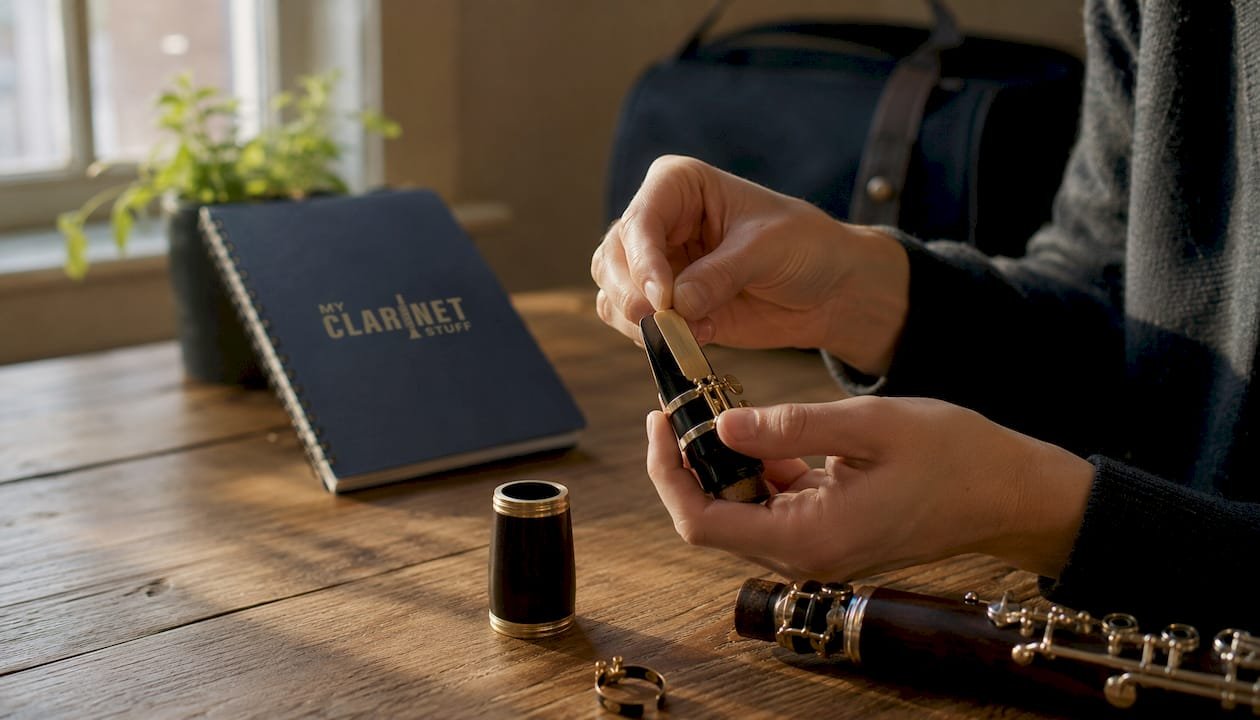
The correct embouchure keeps the bottom lip firm but not tight against the reed, with the top teeth resting lightly on the mouthpiece. Keep your chin flat and pulled slightly downward, corners firm and pushed slightly forward. Think of tightening a drawstring from the sides of your mouth rather than clamping from below.
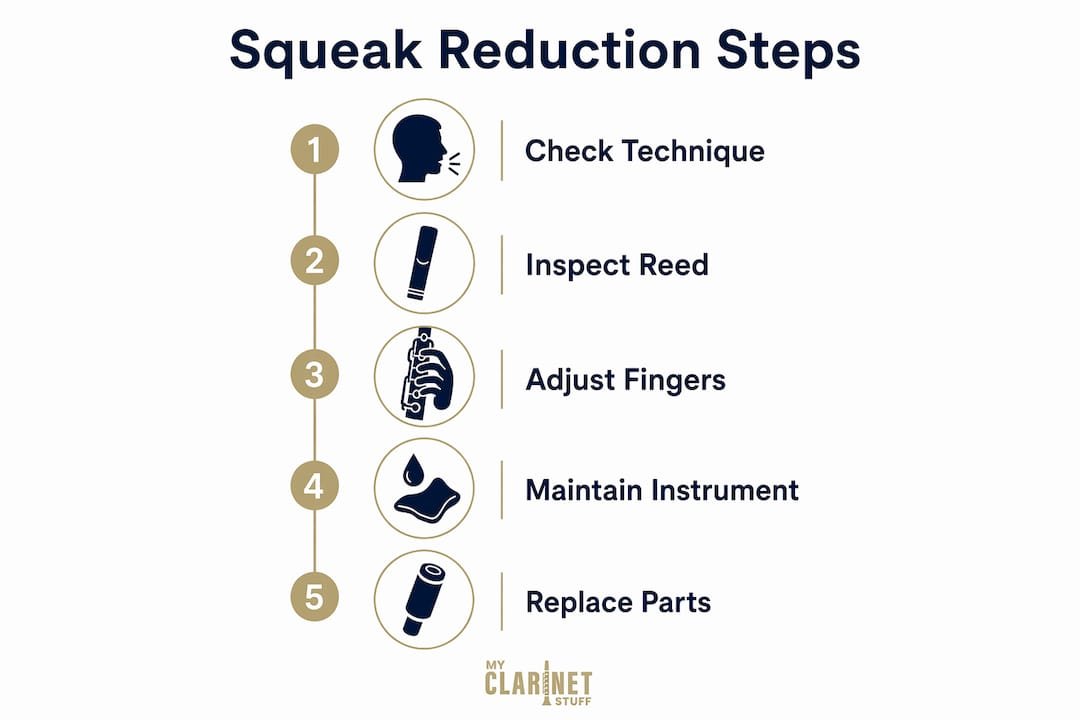
Articulation errors also trigger squeaks. Tonguing too heavily or placing the tongue too far down the reed slams it shut and causes a squeak on the attack. Aim for a light “tee” or “dee” motion near the tip of the reed. Practice slow, soft tonguing on long tones before adding faster passages.
Pro Tip: Proper embouchure pairs fast air with firm corners. If you reduce air speed or volume, reed vibration weakens and squeaks follow. Think “fast and steady” rather than “loud,” and support your air from the diaphragm through every note.
Embouchure fatigue is a real but often overlooked trigger. As a practice session extends, lip pressure shifts and squeaks increase. Taking a short break and resetting your embouchure often restores clean tone immediately.
How does finger positioning affect clarinet squeaks?
Finger leaks from accidental key presses or incomplete tone hole coverage are among the most common squeak causes, particularly for players still building hand muscle memory. The clarinet has between 17 and 23 keys, and even a palm edge resting against a side key can send the instrument into an unintended register.
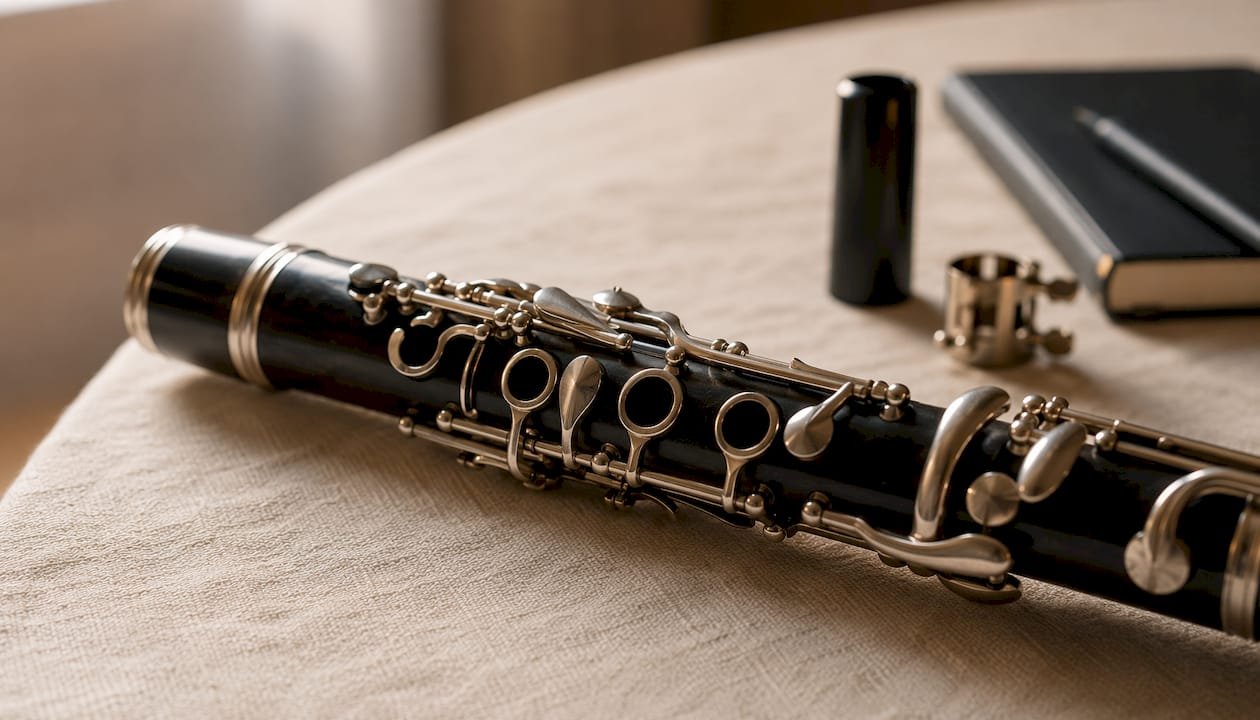
Keep your hands rounded and relaxed, covering holes firmly with the fleshy pad of each fingertip rather than the very tip or edge. Practicing in front of a mirror lets you spot accidental key contact that you cannot feel in the moment. If squeaks cluster on specific notes, isolate each finger one at a time by gently adjusting its position while sustaining the note.
Checklist for finger coverage and instrument seal:
- Confirm fingers are curved, not flat, over tone holes
- Check that no palm or finger edge is resting on a side key
- Test each hand separately by playing notes that isolate left-hand and right-hand coverage
- Use the “one-finger wiggle” test: on a squeaky note, gently shift one finger at a time until the sound stabilizes
- After assembly, gently twist each joint to confirm it is fully seated with no rocking
Bridge key misalignment after assembly is a frequent mechanical source of squeaks that players often mistake for technique problems. If squeaks appear or change immediately after putting the clarinet together, reseat the joints carefully and retest.
How does reed condition affect squeak reduction?
The reed is responsible for more clarinet squeaks than any other single component. A reed that is too stiff demands more air pressure and embouchure control than most players can consistently provide, leading to upper-register squeaks. A reed that is too soft vibrates too freely and produces unstable, airy squeaks across the full range.
Signs your reed is causing squeaks:
- A visible chip or crack at the tip rail
- Uneven “V” shape when held up to light, indicating imbalance
- Squeaks that persist regardless of embouchure or finger adjustments
- Increasing squeaks over several sessions on the same reed
Reed care practices that prevent squeaks:
- Moisten the reed thoroughly before every playing session
- Align the reed tip precisely with the mouthpiece tip, leaving only a hairline of black visible
- Position the ligature over the thicker stock of the reed, snug but not crushing
- Rotate at least three to five reeds and allow each to dry fully between sessions
Rotating reeds and letting them dry prevents waterlogging, which causes weak reed response and increases squeaks. A reed played every day without rest loses firmness and vibrates inconsistently. For a deeper look at managing your reed rotation, Myclarinetstuff’s reed care workflow covers the full process. Reed strength matters too: beginners who squeak consistently are often using reeds that are too stiff for their current embouchure development.
What clarinet maintenance prevents squeaks?
Mechanical issues cause squeaks that no amount of technique adjustment will fix. A chipped or defective mouthpiece produces unavoidable squeaks regardless of reed or embouchure changes, because damage to the tip rail disrupts the reed’s seal at the most critical point of vibration. Inspect the mouthpiece tip under bright light and replace it if you see any chips or unevenness on the table or tip rail.
Basic maintenance checklist:
- Swab the mouthpiece after every session to clear moisture and debris
- Clean tone holes every few weeks with a soft pipe cleaner, especially the throat tone holes around G and A
- Apply cork grease to tenon corks so joints seat smoothly without bending keys
- Check key alignment visually after every assembly, particularly the bridge key mechanism
- Press each key firmly while sustaining a note to test whether sealing that key changes the sound
“The most common issues I see on the clarinet from a teacher’s perspective are lower joint alignment issues on the E/B pinky keys, bridge key alignment issues that cause squeaks, and pointer finger A key screw alignment issues.” — Copeland Clarinets
When squeaks persist on one specific note but not nearby notes, a leaking pad is the likely cause. A repair technician can diagnose this quickly with a leak light. Schedule a professional inspection at least once a year, or any time squeaks appear suddenly on notes that were previously clean. Mechanical problems rarely resolve on their own.
What does science tell us about why clarinets squeak?
Acoustic research confirms that clarinet squeaks occur when the resonance of the reed and embouchure passes through the resonance of the instrument bore, causing the clarinet to shift into a higher register. Small embouchure fluctuations drive this shift. Notes played on an artificially blown clarinet in the second register remain stable over several minutes, which confirms that changes in the embouchure, not the instrument itself, trigger most squeaks.
Voicing is the practical application of this science. The shape of your oral cavity directly affects which register the clarinet speaks in. For low notes, shape your oral cavity toward an “ooo” vowel. For higher notes, transition through “aaa” and “eee.” This shifts the resonance inside your mouth to match the register you want, reducing the chance of an unintended register jump.
“Squeaking is a rite of passage for clarinetists. Pros distinguish themselves by swiftly isolating mechanical or physical causes rather than internalizing it.” — Jenny Maclay, clarinetist and educator
Practicing intentional squeaks, deliberately making the reed jump to a higher partial, builds awareness of exactly how much embouchure pressure and air speed trigger the shift. That awareness transfers directly into better register control during performance.
Key Takeaways
Reducing clarinet squeaks requires a systematic approach: address technique first, then reed condition, then instrument mechanics, in that order.
| Point | Details |
|---|---|
| Technique before equipment | Check embouchure tension and finger coverage before replacing reeds or seeking repairs. |
| Reed rotation prevents squeaks | Rotating three to five reeds and letting each dry fully between sessions maintains responsiveness. |
| Voicing controls register | Shaping the oral cavity toward “ooo” for low notes and “eee” for high notes prevents unintended register jumps. |
| Mechanical leaks need a technician | A squeak on one specific note that persists across reeds and embouchure adjustments points to a leaking pad. |
| Embouchure fatigue increases squeaks | Taking a break mid-session and resetting lip pressure often restores clean tone immediately. |
Find the Right Mouthpiece for a Squeak-Free Setup

Even with perfect technique and a well-maintained instrument, a worn or poorly matched mouthpiece can introduce squeaks that nothing else resolves. At Myclarinetstuff, we carry precision CNC-crafted Gleichweit synthetic mouthpieces designed and manufactured in Austria, built to deliver consistent tip rail geometry and tonal stability session after session. Unlike traditional hard rubber, synthetic construction eliminates the variability that contributes to unpredictable reed response.
Not sure which model fits your playing style and reed setup? Use the Mouthpiece Matchmaker at Myclarinetstuff to find your ideal match, or explore our clarinet setup essentials guide for a complete equipment foundation. We offer an at-home test box program so you can evaluate mouthpieces in your own practice space before committing.
2 Responses