


The most effective way for a clarinet student to reduce performance anxiety is to combine targeted preparation, predictable equipment, and short mental and physical routines. Each pillar attacks a different piece of the problem: preparation builds stress-resistant memory, consistent gear removes physical surprises, and quick psychological tools calm the nervous system in the moment. This reduces situational anxiety substantially, but severe cases with panic symptoms or avoidance still call for professional support.
TL;DR:
- Consistently rotate reeds and confirm the mouthpiece, ligature, and cork are properly seated at least a week before to prevent physical surprises during performance.
- Use retrieval-based practice to accurately test memory under stress and build more resilient skills over a structured four-week plan.
- Check and repair instrument components like the ligature and pad leaks well in advance, and avoid last-minute equipment changes that can introduce unpredictability.
- Incorporate mental routines such as specific cognitive cues, breathing exercises, and visualization to calm physiological and emotional anxiety in the moments before playing.
- Gradually expose yourself to mock performances with increasing stakes, such as recording solo practice, playing for teachers or peers, and simulating adjudicated performances, to build long-term confidence.
Table of Contents
- Clarinet Student Performance Anxiety: A Day-of Checklist That Actually Works
- How Practicing the Right Way Builds Resistance to Stress
- Clarinet Gear Checks That Remove Preventable Surprises
- Mental Skills That Calm Both Mind and Body
- Building Tolerance Through Graduated Mock Performances
- A Time-Boxed Warm-Up for the Final 90 Minutes
- When Self-Help Routines Aren’t Enough
- Nutrition, Hydration, and Physical Health Shape How Nerves Show Up
- Confidence Builds in Layers, Not All at Once
- How Anxiety Changes Your Sound Before It Changes Your Score
- Leaning on Teachers and Peers to Carry Some of the Weight
- Myths About Performance Anxiety That Music Students Should Stop Believing
- A Teacher’s-Eye View on What Actually Calms Nervous Clarinet Students
- A Predictable Mouthpiece Is One Less Thing to Worry About Onstage
- Sources
Clarinet Student Performance Anxiety: A Day-of Checklist That Actually Works
The hour before a recital or audition is not the time to improvise. Run through this sequence and you remove most of the variables that spike adrenaline right when you need steady hands and steady air.
- Reeds: rotate to a reed you’ve played on for at least a week, with two backups broken in and ready in your reed case.
- Mouthpiece and ligature: confirm the mouthpiece is seated fully on the barrel and the ligature screws are snug, not overtightened.
- Cork check: a dry cork causes a stuck barrel or joint mid-performance, so apply cork grease the night before, not backstage.
- Micro warm-up: four minutes of low, relaxed long tones followed by slow articulation patterns on open G.
- One short run: play the hardest eight bars of your piece once, slowly, then stop. Do not drill it to death.
- Two cognitive cues: short phrases like “I know this piece” and “breathe before you play,” repeated silently.
- 60-second visualization: picture walking onstage, the first note landing clean, and the audience’s neutral, ordinary faces.
- Skip caffeine and heavy last-minute drilling: both raise heart rate and shake confidence right when you need calm.
- Arrive early enough to sit still for five minutes before you’re called, rather than rushing in warm and rattled.
Pro Tip: Keep a small index card in your case listing your two cognitive cues and your reed rotation schedule. Reading it backstage takes less mental effort than trying to remember it under stress.
How Practicing the Right Way Builds Resistance to Stress
Preparation is not just about hours logged. It’s about the type of practice, and the research on this is specific. Retrieval practice, where you test yourself on a passage from memory instead of simply replaying it with the music in front of you, produces memories that hold up better under stress than memories built through repetition alone, according to research on performance anxiety published in a psychological science review. Restudying feels productive because it’s comfortable. Retrieval feels harder because it exposes what you don’t actually know yet, which is exactly why it works better on stage.
A practical four-week plan puts this to use:
- Week 1: Learn notes and rhythms accurately at half tempo. Test yourself daily on the opening four bars from memory before looking at the page.
- Week 2: Build tempo in small increments and start closed-book run-throughs of individual phrases, especially the transitions between sections.
- Week 3: Full run-throughs at performance tempo, recorded on your phone. Identify the two or three spots where your air or fingers hesitate.
- Week 4: Mock performances (covered in detail below), plus targeted “error-hardening” drills on exactly those weak transitions, breath points, and awkward fingerings you flagged in week 3.
Isolate the failure points rather than replaying the whole piece. If the break between the low register and the clarion register keeps cracking, loop just that four-note bridge fifteen times slowly, then at tempo, then in context. Fixing a weak link directly is faster than hoping the surrounding music will carry it.
There’s a measurable payoff to this approach beyond just sounding better. Surveys of music students consistently show that those who prepare more deliberately report lower performance anxiety, mediated by higher self-efficacy, meaning the confidence comes from knowing you’ve stress-tested the material, not from hoping it goes well. For structured rehearsal timelines built around this kind of preparation, Myclarinetstuff’s audition prep guide and its companion guide to practice routines walk through the same principle in more depth.
Clarinet Gear Checks That Remove Preventable Surprises
A cracked reed or a squeak from a loose ligature screw doesn’t just cost you a few seconds onstage. It confirms, in that moment, that something outside your control can derail you, and that fear is often what’s really driving the anxiety in the first place. Research on performance anxiety and technical concerns suggests that addressing instrument unpredictability directly can reduce anxiety as effectively as psychological intervention, because a chunk of what students label as “nerves” is really an accurate read on a setup they can’t fully trust.
Run this check at least a week before any performance, not the morning of:
- Reed rotation: three reeds broken in, with the “hearting” (the darker vertical lines near the tip) even on both sides.
- Mouthpiece seating: the mouthpiece should sit on the barrel with light resistance, not so loose it wobbles or so tight it strains the cork.
- Ligature tension: even pressure across both screws, no gaps under the plate.
- Staple and reed fit: the reed’s back edge should align exactly with the mouthpiece table with no overhang.
- Barrel fit and pad leaks: press each key gently and listen for hissing, a sign of a leaking pad that needs a technician’s attention before, not after, a recital.
- Cork lubrication: every joint, checked the night before.
Swap a reed no closer than three days before a major performance, so you have time to notice if it’s a dud. The same logic applies to bigger changes: an equipment shift like trying a new mouthpiece should happen at least three weeks before, giving your embouchure time to adapt without last-minute surprises. This is also where consistency matters more than most students realize. A hard rubber mouthpiece can vary piece to piece even within the same model line, while CNC-crafted synthetic options hold their facing and tip opening within tight tolerances, which removes one more unknown from the equation. For a full walkthrough of what to check and adjust, see Myclarinetstuff’s accessory selection guide and the reed adjustment guide.
Pro Tip: If a reed cracks minutes before you go on, don’t panic and grab a brand-new one cold. Reach for the second reed in your rotation, the one you’ve already broken in, even if it’s not your top choice. Familiar and slightly imperfect beats unfamiliar and untested every time.
Mental Skills That Calm Both Mind and Body
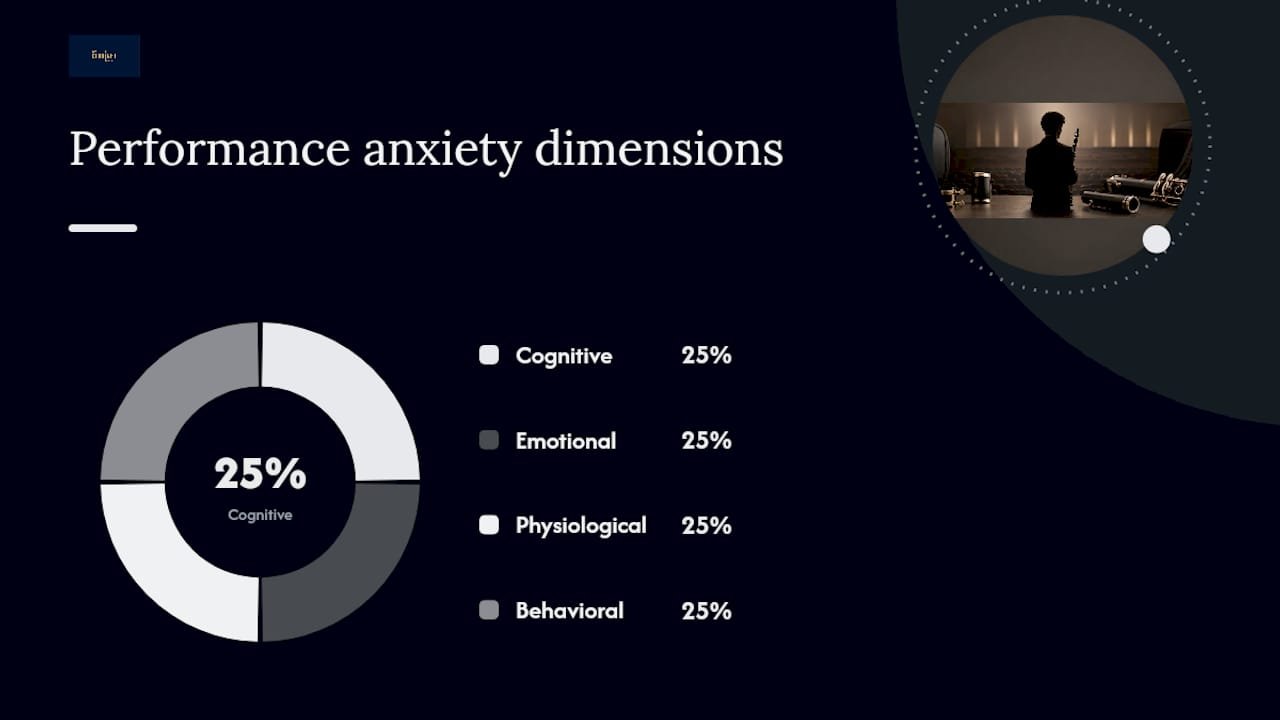
Performance anxiety doesn’t show up as one single feeling. Researchers break it into four dimensions: cognitive (racing, negative thoughts), emotional (dread, panic), physiological (racing heart, shallow breath, dry mouth), and behavioral (avoidance, rushing tempo). A student who only practices breathing but ignores the negative self-talk is treating a quarter of the problem, which is why the strongest approaches combine tools across all four dimensions.
Cognitive reframing takes about ten seconds and works backstage. When you catch an automatic thought like “I’m going to mess up the altissimo entrance,” don’t argue with it at length. Use a two-line script instead: name the thought, then replace it with a specific, true counter. “I’m scared I’ll crack that note” becomes “I’ve hit that entrance clean eleven times this week. My air is ready.” Vague reassurance doesn’t work as well as a specific fact rebuttal.
Breathing regulates the physiological side directly. Box breathing, four seconds in, four seconds hold, four seconds out, four seconds hold, done for two minutes, lowers heart rate before you play a note. Diaphragmatic breathing, low and slow through the warm-up, does double duty since it’s also the foundation of your clarinet air support. Pair the two: box breathing to calm down, then diaphragmatic breathing as you pick up the horn.
Visualization works best when it includes mild pressure, not a fantasy of a perfect run. Picture the actual room, a slightly stiff reed, a judge glancing at their notes, and picture yourself playing through it anyway. Rehearsing under imagined pressure transfers better to the stage than rehearsing a flawless daydream.
Reviews of intervention research describe mixed but genuinely encouraging results for these approaches: mindfulness, progressive muscle relaxation, and music-assisted relaxation techniques show real reductions in state anxiety across multiple small trials, even though study designs and effect sizes vary. None of these tools require a therapist to learn, and all of them fit into a warm-up that already takes ten minutes.
- Notice the automatic negative thought without judging yourself for having it.
- Counter it with one specific, factual statement about your preparation.
- Run a two-minute box-breathing cycle.
- Visualize the actual room and one small imperfection, then yourself recovering smoothly.
Pro Tip: Write your two-line reframing script on the same index card as your reed rotation notes. Under stress, you want to read a script, not compose one from scratch.
Building Tolerance Through Graduated Mock Performances
Confidence onstage comes from having already survived versions of that exact moment. Graduated exposure, moving from low-stakes to high-stakes performance conditions in stages, is one of the more consistently supported tools in the research, and it’s also the easiest to build into a normal practice week.
- Record yourself alone. Play the full piece once, on video, no stopping. Watch it back and note two things you did well before you note what to fix.
- Play for your teacher. A single listener changes your physiology more than you’d expect, and it’s a controlled environment to notice that shift.
- Play for a small, informal audience. Family, a practice partner, even a sibling scrolling their phone. The goal is bodies in the room, not expert critique.
- Run a mock adjudicated performance. Ask your teacher to score you like a judge would, comments and all.
- Perform the real event.
Space these across your final two to three weeks, not crammed into the last three days. One trial per stage, with a few days between each to adjust, gives you real data on what’s improving. A 12-week pedagogical study combining awareness, skill training, simulation, and reflection found that this kind of staged exposure produced anxiety reductions that held up at three-month follow-up, not just a temporary calm before one event.
A Time-Boxed Warm-Up for the Final 90 Minutes
Structure removes decisions, and removing decisions is exactly what a nervous brain needs.
- 90 minutes out: Full physical warm-up away from the instrument. Light stretching, diaphragmatic breathing for three minutes, then assemble your clarinet and check the swab, cork, and reed seating one last time.
- 60 minutes out: Long tones for four minutes, low and relaxed, followed by slow articulation patterns. Tune against a drone, not by ear alone, since anxiety skews pitch perception.
- 30 minutes out: One slow run of your hardest passage, then one at performance tempo. Stop there. Do not run the whole piece again.
- 10 minutes out: Box breathing, your two cognitive cues from the index card, and the 60 second visualization.
- At the door: Roll your shoulders back, take one slow diaphragmatic breath, and walk in at a normal pace.
For more warm-up phrasing and stage-specific tips, Myclarinetstuff’s performance tips guide covers additional variations worth trying in lessons before you rely on them at a recital.
When Self-Help Routines Aren’t Enough
Most performance anxiety responds well to the practice and preparation strategies above. But some red flags mean it’s time to bring in a teacher, counselor, or clinician: avoiding performances altogether, panic symptoms severe enough to interfere with breathing or playing, reliance on substances to get through a performance, or anxiety that’s spreading into non-musical parts of life.
Evidence-based options exist beyond what a student can self-administer. Individual cognitive behavioral therapy addresses the thought patterns underneath the anxiety directly. Group CBT programs built into school music curricula have shown significant, lasting reductions in self-reported performance anxiety among high school students, with benefits still measurable at follow-up. Mindfulness-based programs offer a gentler entry point for students uncomfortable with formal therapy.
Starting the conversation is simpler than it feels. Tell a teacher or counselor specifically what happens, not just that you’re “nervous.” A referral, if one happens, is a normal next step, not a sign that something is fundamentally wrong. Prevalence research suggests performance anxiety is genuinely common among music students, so asking for help puts you in good company, not an unusual one.
Nutrition, Hydration, and Physical Health Shape How Nerves Show Up
What you eat and drink in the 24 hours before a performance changes how your body responds to stress. Caffeine amplifies a racing heart and shaky hands, exactly the physiological symptoms you’re trying to manage, so cutting back on the day of a recital is one of the simplest, most controllable moves available. Dehydration dries out the exact tissue you need to be flexible and responsive: your lips, tongue, and embouchure muscles.
Steady blood sugar matters more than most students think. A heavy, greasy meal right before playing pulls blood flow toward digestion and away from focus, while skipping food entirely leaves you light headed exactly when you need steady breath support. A modest meal with protein and complex carbohydrates two to three hours before performing, plus water throughout the day, keeps energy level without the crash.
Sleep deprivation compounds every other symptom on this list. A tired nervous system is already primed for a stronger startle response and worse impulse control, both of which make cognitive reframing harder to execute under pressure. If you’re cramming the night before a recital, the marginal technical gain rarely outweighs what you lose in composure the next day.
None of this replaces the preparation and mental skills covered above. But a dehydrated, over-caffeinated, sleep-deprived student is fighting performance anxiety with one hand tied behind their back before they even pick up the clarinet.
Confidence Builds in Layers, Not All at Once
Long-term confidence rarely arrives from one great performance. It accumulates from a string of smaller ones, each slightly harder than the last, that a student survives and learns from. This is the same graduated exposure logic covered above, but applied across months and years rather than the final weeks before one event.
Start with genuinely low-stakes opportunities: playing for a single trusted friend, performing in a studio class with peers at a similar level, joining a community ensemble where the pressure is diffused across a section rather than resting on one soloist. Each successful low-pressure performance becomes evidence the brain can draw on later, which is exactly what self-efficacy research points to when it links preparation and repeated successful experience to lower anxiety over time.
Keep a simple log of performances, even small ones: date, what went well, and one thing to adjust. Reading back through six months of entries does more for confidence than any single pep talk, because it’s a written record that contradicts the anxious brain’s tendency to remember only the mistakes.
Avoid the trap of only counting the big, formal events. A clean run through a passage for your stand partner counts. Playing a solo for your family after dinner counts. Confidence is built from volume of exposure, not just from the size of the audience.
How Anxiety Changes Your Sound Before It Changes Your Score
Performance anxiety on clarinet shows up in the sound before a single wrong note gets played. A tightened embouchure under stress narrows the tone, often producing a thinner, more strained quality than a player’s relaxed sound. Shallow, anxious breathing reduces air support, which shows up as flat pitch in the lower register and sharp pitch in the clarion and altissimo registers, since clarinet intonation depends heavily on steady air pressure.
Articulation suffers in a specific, recognizable way. Nervous tongue muscles tend to overcorrect, producing either clipped, hard-edged attacks or, in the opposite direction, mushy articulation that loses definition entirely. Vibrato, if a player uses it stylistically, often becomes erratic under stress, wavering in a way that reads as nerves even when the pitch is technically fine.
Musical expression takes the biggest hit, and it’s often invisible to the player in the moment. Phrasing flattens out. Dynamic contrast shrinks toward a safe middle volume because pushing to a real forte or pulling back to a true pianissimo feels riskier under pressure. The breathing exercises and diaphragmatic warm-ups covered earlier address this directly, since steady air support is the physical foundation both intonation and expressive phrasing depend on. A clarinet student who fixes their breathing before a performance is protecting their musicality, not just their nerves.
Leaning on Teachers and Peers to Carry Some of the Weight
Anxiety feels heavier when a student carries it alone. Teachers and peers are an underused resource for lightening that load, and building the habit early changes how a student relates to every performance afterward.
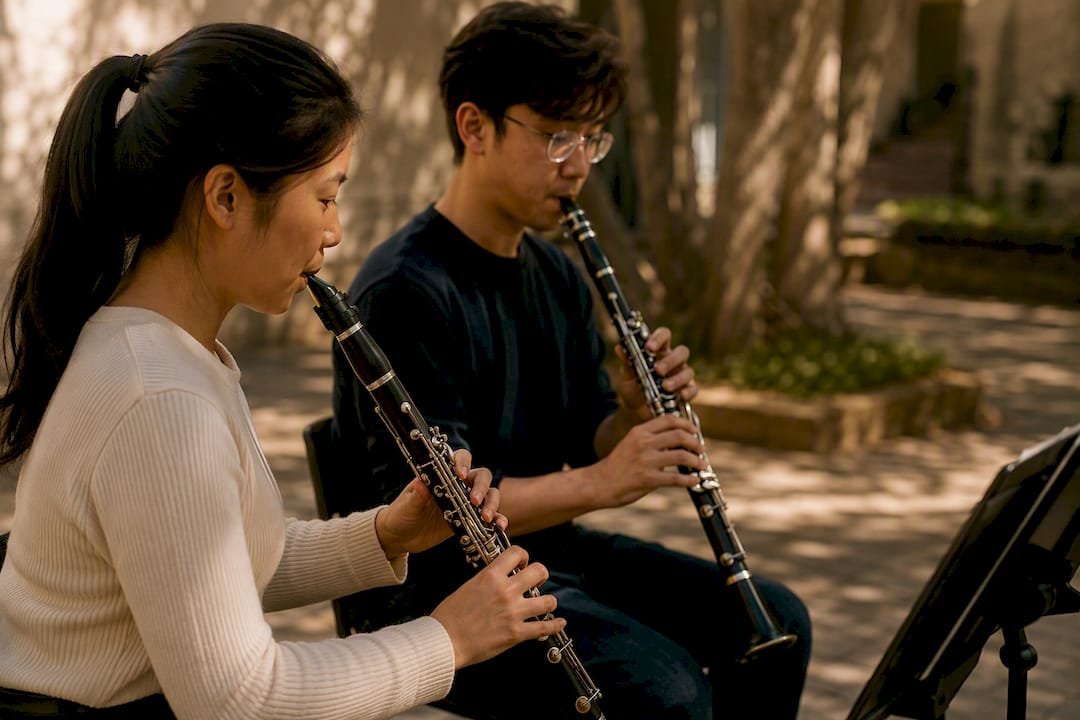
Teachers can create genuinely low-stakes simulated performances inside normal lesson time. A short, unannounced mock audition during a lesson serves two purposes at once: it gives the teacher real assessment information, and it functions as exposure practice without requiring extra scheduling or a formal recital setting. This kind of embedded practice run is easy to request directly. A student can simply ask, “Can we do a run-through like it’s the real thing today?”
Peers offer something teachers can’t: a shared, relatable experience of the exact same stress. Studio classes, sectional rehearsals, and informal group practice sessions where students perform for each other build a support network that normalizes nervousness rather than treating it as a private failure. Talking openly with a peer about pre-performance jitters often reduces their intensity simply because the anxious thought loses its “this is only happening to me” quality.
Parents and school counselors play a role too, particularly around exam and audition periods when academic and musical stress compound each other. Resources aimed at supporting students through high pressure exam periods apply directly to audition season, since the underlying stress response and coping strategies overlap heavily between academic and musical high stakes moments.
Myths About Performance Anxiety That Music Students Should Stop Believing
Myth: Only unprepared or untalented students get nervous. Prevalence research shows the opposite. Reported rates of music performance anxiety range from 16 percent up to 96 percent depending on the study population, and highly accomplished professional musicians report significant performance anxiety at high rates too. Skill and nervousness are not mutually exclusive.
Myth: Real musicians don’t feel nervous, they just look calm. Every visibly composed performer has a nervous system reacting to stakes. What’s different is not the absence of anxiety but the presence of tools to manage its physical and cognitive symptoms, which is the entire premise behind the checklist and mental skills covered above.
Myth: More practice always equals less anxiety. Volume of practice matters less than the type. A student who restudies the same passage fifty times without ever testing themselves from memory builds a less stress-resistant skill than one who uses retrieval-based practice far fewer times but under harder, self-testing conditions.
Myth: Anxiety is purely psychological, so equipment doesn’t matter. A student fighting a wobbly ligature or an inconsistent reed is dealing with a real, physical source of unpredictability, not just an imagined fear. Addressing the gear often removes a genuine variable, not just a perceived one.
Myth: If breathing exercises don’t work in five minutes, they don’t work. Relaxation and mind body techniques build effectiveness with repeated practice over weeks, similar to any physical skill. Trying box breathing once backstage and dismissing it afterward misses how these tools are meant to be trained.
A Teacher’s-Eye View on What Actually Calms Nervous Clarinet Students
The students I’ve seen calm down the fastest are rarely the ones who got a pep talk. They’re the ones who fixed something concrete, a wobbly ligature, an inconsistent reed, and felt one less thing that could go wrong. That’s not a coincidence. Two habits worth adding to any lesson: a two-minute unannounced mock run-through every few weeks, and a standing question at the end of each lesson asking what felt physically shaky, not just musically wrong. Gear consistency won’t replace practice or psychological work, but pair it with both and you’ve covered the three pillars that actually move the needle.
— Milos
A Predictable Mouthpiece Is One Less Thing to Worry About Onstage
Every unpredictable element in your setup is one more thing your brain has to monitor under pressure, and that’s exactly where Myclarinetstuff fits into a preparation plan. Our CNC crafted synthetic mouthpieces hold their facing and tip opening with a precision hard rubber can’t consistently match, so the instrument in your hands the week of a recital plays the same as the one you practiced on a month earlier.
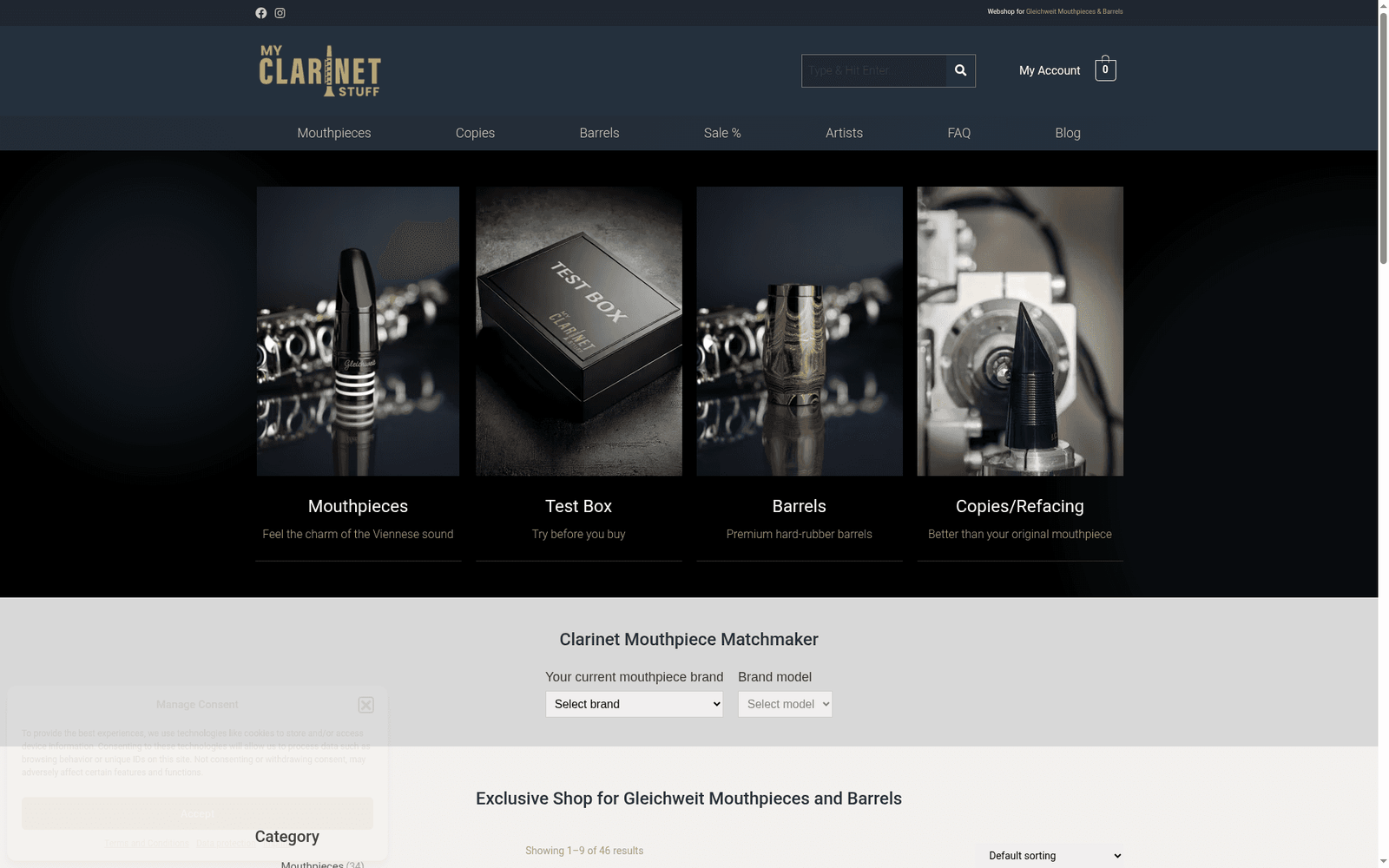
If you’re not sure which facing or tip opening suits your embouchure, the Clarinet Mouthpiece Matchmaker walks you through the fit in a few questions, and our Mouthpiece FAQ covers the technical details behind facing length and tip opening for players who want to understand the why before they buy. For students who want to test before committing, our at home Test Box lets you trial up to five mouthpieces in your own practice room, on your own reeds, before a purchase decision. Schedule that trial at least three weeks before a major event, not the week of, so your embouchure has time to settle in. Gear consistency is one pillar of a solid preparation plan, not a replacement for the practice and mental skills covered above, but it’s the pillar most students overlook. Visit the Matchmaker to start narrowing down your options today.
This article is general information, not a substitute for advice from a qualified doctor. Consult a qualified healthcare professional about your own circumstances before acting on anything here.