
TL;DR:
- Effective clarinet audition preparation relies on structured practice, mental readiness, and equipment reliability. Practicing with a deliberate routine, managing anxiety with proven techniques, and ensuring gear is in optimal condition significantly increase chances of success. Running full mock auditions, maintaining proper equipment, and controlling nerves through visualization help performers present their best selves under pressure.
Effective clarinet audition preparation is defined by three pillars: structured practice, mental readiness, and equipment optimization. Knowing how to prep for clarinet auditions means more than running your pieces the night before. It means building a deliberate routine week in advance, managing performance anxiety with proven techniques, and walking into the room with gear you trust completely. The International Clarinet Association recognizes performance psychology as a core part of audition readiness, not an afterthought. Get all three pillars right, and your chances of impressing a panel improve dramatically.
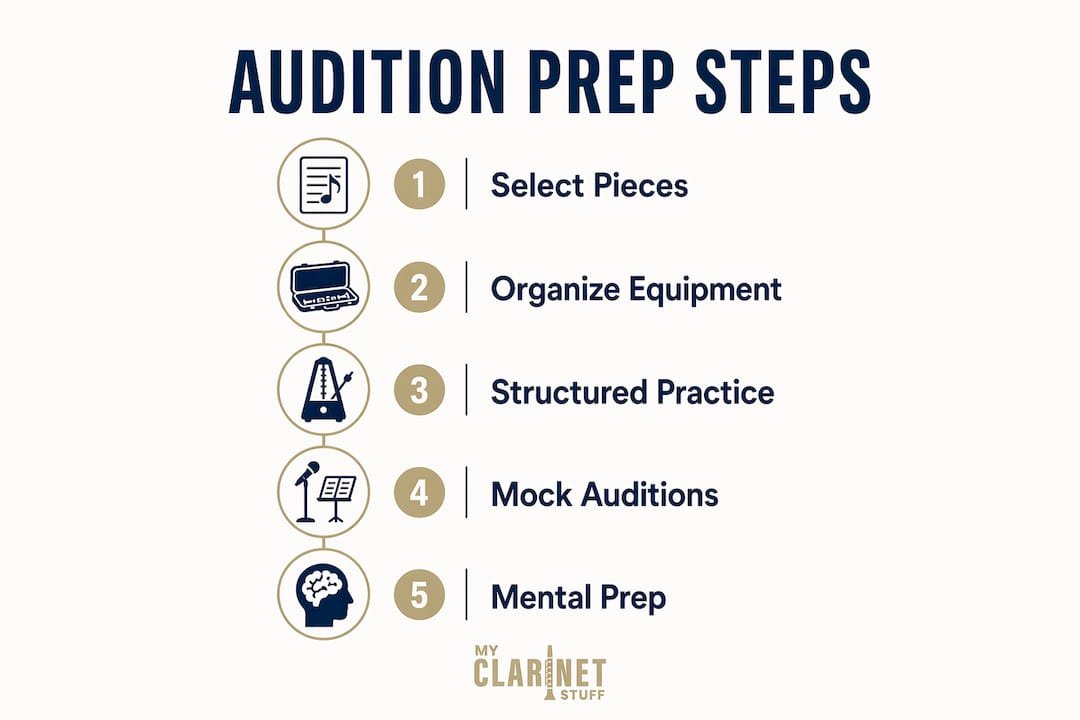
What are the essential materials needed for clarinet auditions?
Collegiate auditions typically require two contrasting solo pieces, all major scales, a three-octave chromatic scale (both slurred and tongued), and prepared orchestral excerpts. Some programs also request a 12–20 minute pre-screening video before you ever enter the room. Knowing the exact requirements early gives you time to select repertoire that shows your range.
Beyond the music itself, your equipment list matters just as much. A well-maintained clarinet, a reliable mouthpiece, and a selection of broken-in reeds are non-negotiable. Carry a maintenance kit with swabs, cork grease, and a screwdriver. Bring a tuner and a metronome, even if you do not plan to use them in the room.
Auditions also test sight-reading, aural skills, and sometimes a short interview about your repertoire interests. That means your preparation cannot stop at the pieces you memorized. General musicianship, listening habits, and the ability to talk about music all count.
| Requirement | Details |
|---|---|
| Solo repertoire | Two contrasting pieces showing technical and lyrical range |
| Scales | All major scales plus three-octave chromatic, slurred and tongued |
| Orchestral excerpts | Selected and prepared in advance per program requirements |
| Equipment | Clarinet, mouthpiece, spare reeds, maintenance kit, tuner, metronome |
| Sight-reading and aurals | Tested at many collegiate and conservatoire auditions |
Pro Tip: Pre-moisten two or three spare reeds the night before and store them in a reed case. A reed that fails mid-audition is recoverable if you have a warm backup ready to go.
How should you structure your practice sessions?
Quality practice beats quantity every time. A well-structured session follows a clear time allocation: 15–20 minutes of warm-up, 30–40 minutes of technical work, 60–90 minutes of repertoire study, and 20–30 minutes of performance simulation. That last block is the one most clarinetists skip. It is also the one that makes the biggest difference on audition day.
Follow this sequence in each practice session:
- Warm up slowly. Long tones and gentle scales wake up your embouchure without straining it. Start at a comfortable dynamic, not full volume.
- Work technique in isolation. Scales, arpeggios, and articulation exercises build the muscle memory your fingers need under pressure.
- Study repertoire in sections. Break each piece into phrases. Fix problem spots before running the full piece.
- Practice slowly to expose flaws. Slow practice reveals intonation gaps, coordination errors, and phrasing issues that disappear at performance speed. Correct them at a slow tempo, then gradually increase.
- Simulate the audition. Stand up, breathe, and play your full program from start to finish without stopping. Treat it like the real thing.
Varying your rhythms during technical passages builds accuracy faster than straight repetition. Try dotted rhythms, reversed dotting, and staccato bursts on any passage that feels uneven. Your fingers will lock in the pattern from multiple angles.
The clarinet performance tips you apply in the practice room directly shape what comes out in the audition room. Build the habit of focused, intentional repetition rather than mindless run-throughs.
Pro Tip: Once a week, put on your audition clothes, set up a music stand in a different room, and play your full program as if the panel is watching. The change in environment alone reveals nerves you did not know you had.
What mental and physical preparation reduces audition stress?
Performance anxiety is a physiological event, not a character flaw. The fight-or-flight response floods your body with adrenaline, tightens your muscles, and sharpens your focus in ways that can either help or hurt you. Twenty minutes of light exercise the day before an audition signals to your brain that the perceived threat has passed, which lowers cortisol and improves sleep quality that night. A short walk or easy bike ride is enough.
Physical readiness on audition day comes down to a few basics:
- Sleep. Aim for your normal amount. Sleeping extra rarely helps and often backfires.
- Hydration. Dry lips and a dry throat affect tone and reed response. Drink water consistently throughout the day.
- Nutrition. Eat a normal meal. Performing on an empty stomach increases anxiety; performing on a heavy meal slows you down.
- Caffeine. Moderate your intake. Excess coffee amplifies the jitters that adrenaline already creates.
Visualization is a legitimate preparation tool used by professional performers across every discipline. Spend five minutes the night before mentally walking through your audition: entering the room, setting your tempo, playing the opening phrase cleanly. Your nervous system rehearses the sequence even when your hands are not on the instrument.
“Performance anxiety is not just for students. Even seasoned professionals experience it. The difference is that experienced performers have learned to channel the adrenaline rather than fight it.” — International Clarinet Association
Pro Tip: Build a short pre-performance ritual: three slow breaths, a mental image of your opening phrase, and a quiet moment before you raise the instrument. Repeat this ritual in every practice run-through so it becomes automatic under pressure.
How do mock auditions help you refine your performance?
A mock audition is the single most underused tool in audition preparation. Running your full program once in a simulated setting reveals more than weeks of isolated practice. A tapering schedule in the final week works like this: Day 7 is a full mock audition in performance attire; Days 5–6 focus on targeted repairs of specific problem spots; Days 1–2 shift to light maintenance and mental run-throughs only.
Stagecraft is part of the evaluation from the moment you walk in. Audition panels assess how you enter the room, how you handle page turns, and whether you acknowledge the panel calmly. Rehearse all of it. Walk to the stand, nod, set your tempo internally, and begin. Do not skip this in your mock runs.
| Mock audition type | Primary benefit |
|---|---|
| Solo run-through at home | Builds stamina and exposes memory gaps |
| Recorded video playback | Reveals posture, tone, and phrasing issues you cannot hear in real time |
| Peer or teacher audience | Simulates panel pressure and generates specific feedback |
| Full dress rehearsal | Combines attire, environment, and stagecraft into one realistic trial |
Audition panels value musical instinct and teachability as much as technical accuracy. If a panelist asks you to replay a passage differently, your ability to adapt quickly matters more than whether you played it perfectly the first time. Practice responding to mid-session instructions by asking a teacher or peer to redirect you during mock runs.
Pro Tip: When reviewing a recorded run-through, watch it twice: once with the sound off to check posture and physical ease, and once with your eyes closed to focus purely on tone and phrasing. You will catch different problems each time.
What common mistakes undermine clarinet audition preparation?
The most damaging mistake is learning new material in the final week. Last-minute additions introduce uncertainty at exactly the moment you need confidence. The final week belongs to polishing what you already know, not expanding your repertoire.
Other mistakes that cost clarinetists in auditions:
- Skipping sight-reading practice. Sight-reading appears in most auditions and cannot be faked. Build it into your weekly routine from the start, not the final days.
- Neglecting equipment maintenance. A sticky key or a cracked reed can derail an otherwise strong audition. Use a clarinet maintenance checklist to inspect your instrument at least a week before the date.
- Chasing perfection instead of recovery. Mistakes happen in auditions. Panels watch how you recover. Practice continuing through errors in your mock runs so stopping mid-phrase never becomes a reflex.
- Ignoring general musicianship. Panels ask about repertoire interests and musical influences. Read program notes, listen to recordings, and know your pieces in context.
- Under-preparing your reed selection. Bring more reeds than you think you need. A reed that played well yesterday may not respond the same way in a different room’s humidity and temperature.
Pro Tip: Three days before your audition, play your program for someone who has never heard it before, such as a family member or a non-musician friend. Their honest reaction to the energy and engagement of your playing tells you more than a teacher’s technical notes.
Key Takeaways
Effective clarinet audition preparation requires structured daily practice, a deliberate tapering schedule in the final week, and equal attention to mental readiness and equipment reliability.
| Point | Details |
|---|---|
| Structure every session | Divide practice into warm-up, technique, repertoire, and performance simulation blocks. |
| Taper in the final week | Shift from learning to polishing by Day 7; use Days 1–2 for mental run-throughs only. |
| Manage performance anxiety | Light exercise the day before and a consistent pre-performance ritual reduce audition stress. |
| Run full mock auditions | Simulate attire, stagecraft, and panel interaction at least one week before the audition. |
| Protect your equipment | Inspect your instrument, select reeds in advance, and carry pre-moistened spares on audition day. |
What I have learned from years of watching clarinetists prepare
The clarinetists who walk into auditions with real confidence are not the ones who practiced the most hours. They are the ones who practiced the right things at the right time. I have seen technically gifted players fall apart because they never simulated the actual conditions of an audition. And I have seen players with modest technique impress panels because they were calm, adaptable, and clearly musical.
The detail most clarinetists overlook is stagecraft. The audition begins at the door, not at the first note. How you carry yourself into the room, how you set up without rushing, how you acknowledge the panel without being theatrical. These things register before you play a single pitch. Rehearse them as seriously as you rehearse your scales.
My honest advice: start your preparation earlier than feels necessary, and resist the urge to add new material when anxiety spikes in the final week. That urge is the fight-or-flight response trying to convince you that more is better. It is not. Confidence comes from depth, not breadth. Know your pieces so well that nerves cannot shake them loose.
View every audition as information, not a verdict. The feedback you collect, whether you advance or not, is the fastest way to improve for the next one.
— Milos
Your audition setup deserves the same attention as your practice
Your tone, response, and confidence in the room all start with the equipment in your hands. A mouthpiece that does not match your playing style creates resistance you fight against every time you perform. Myclarinetstuff carries Austrian-made Gleichweit synthetic mouthpieces, precision CNC-crafted for consistent response across every register. Use the Clarinet Mouthpiece Matchmaker to find the right fit for your style and audition goals. For a broader look at what your setup needs, the accessory selection guide walks you through every component from barrels to reeds. Good gear does not replace preparation, but it removes one more variable from an already high-pressure day.
FAQ
What pieces work best for clarinet auditions?
Most auditions ask for two contrasting solo pieces that show both technical control and lyrical phrasing. Choose works that sit comfortably in your strongest register and that you can perform confidently under pressure.
How far in advance should I start audition preparation?
Start at least six to eight weeks before the audition date. That timeline allows for deep repertoire work, consistent technical development, and a proper tapering schedule in the final week.
How do I manage nerves on audition day?
Light exercise the day before lowers cortisol and improves sleep. On the day itself, moderate caffeine, stay hydrated, and use a short breathing ritual before you play to settle your nervous system.
Do audition panels care about more than technical accuracy?
Panels assess musical instinct, phrase shaping, and teachability alongside technical skill. Demonstrating the ability to adapt quickly to mid-audition feedback often matters as much as a clean run-through.
How many reeds should I bring to an audition?
Bring at least four to six reeds, with two or three pre-moistened and ready to play. Room temperature and humidity affect reed response, and having warm backups prevents equipment failure from derailing your performance.
Recommended
- Clarinet Performance Tips Guide for Achieving Your Best Sound – My Clarinet Stuff
- 7 Clarinet Practice Essentials for Better Sound and Skills – My Clarinet Stuff
- 7-Step Clarinet Sound Improvement Checklist for Experts – My Clarinet Stuff
- 7 Expert Clarinet Warm-Up Tips to Enhance Your Sound Quality – My Clarinet Stuff
2 Responses