
Choosing the right clarinet mouthpiece is one of the most consequential decisions you’ll make as a serious player. The difference between a student model and a professional mouthpiece isn’t just price. It shows up in every phrase you play, every dynamic shift, every articulation under pressure. With hundreds of options on the market, knowing exactly what to look for saves you time, money, and frustration. This guide breaks down the features that professional clarinetists prioritize so you can make a confident, informed choice.
Table of Contents
- What sets professional mouthpieces apart?
- Material matters: Hard rubber, crystal, and more
- Tip opening and facing: Shaping your sound
- Chamber design and baffle: The secret to tonal character
- Precision manufacturing and custom options
- Which features matter most for each genre?
- Find your perfect professional mouthpiece
- Frequently asked questions
Key Takeaways
| Point | Details |
|---|---|
| Material shapes sound | Hard rubber and crystal offer superior tonal quality and projection for advanced players. |
| Tip opening affects flexibility | Selecting the right balance of tip opening and facing gives you both power and control. |
| Design fits the genre | Matching chamber and baffle design to your musical style enhances your expressive range. |
| Professional consistency | Precision manufacturing and custom finishing deliver predictable results on stage and in the studio. |
What sets professional mouthpieces apart?
Not all mouthpieces are built with the same intent. Student models are designed for durability and ease of play. Professional mouthpieces are engineered for something more demanding: precision, control, and consistency across every register.
Tonal consistency and control are the defining hallmarks of a professional mouthpiece. That means tighter manufacturing tolerances, better materials, and a design that responds predictably to your technique rather than fighting it.
Here’s what separates pro-level mouthpieces from the rest:
- Precision crafting that produces consistent results from one mouthpiece to the next
- Advanced tonal control across the full dynamic range, from pianissimo to fortissimo
- Nuanced articulation response that rewards refined breath support and tongue placement
- Long-term durability so the mouthpiece holds its geometry and performance over years of use
- Compatibility with a wide range of clarinet mouthpiece types and playing styles
“The gap between a good mouthpiece and a great one is felt most clearly in ensemble playing, where blend, intonation, and dynamic control are non-negotiable.”
For professional clarinetists, these aren’t luxury features. They’re baseline requirements.
Material matters: Hard rubber, crystal, and more
Material is one of the first things professionals consider, and for good reason. The physical properties of the mouthpiece body directly shape how sound is produced, projected, and colored.
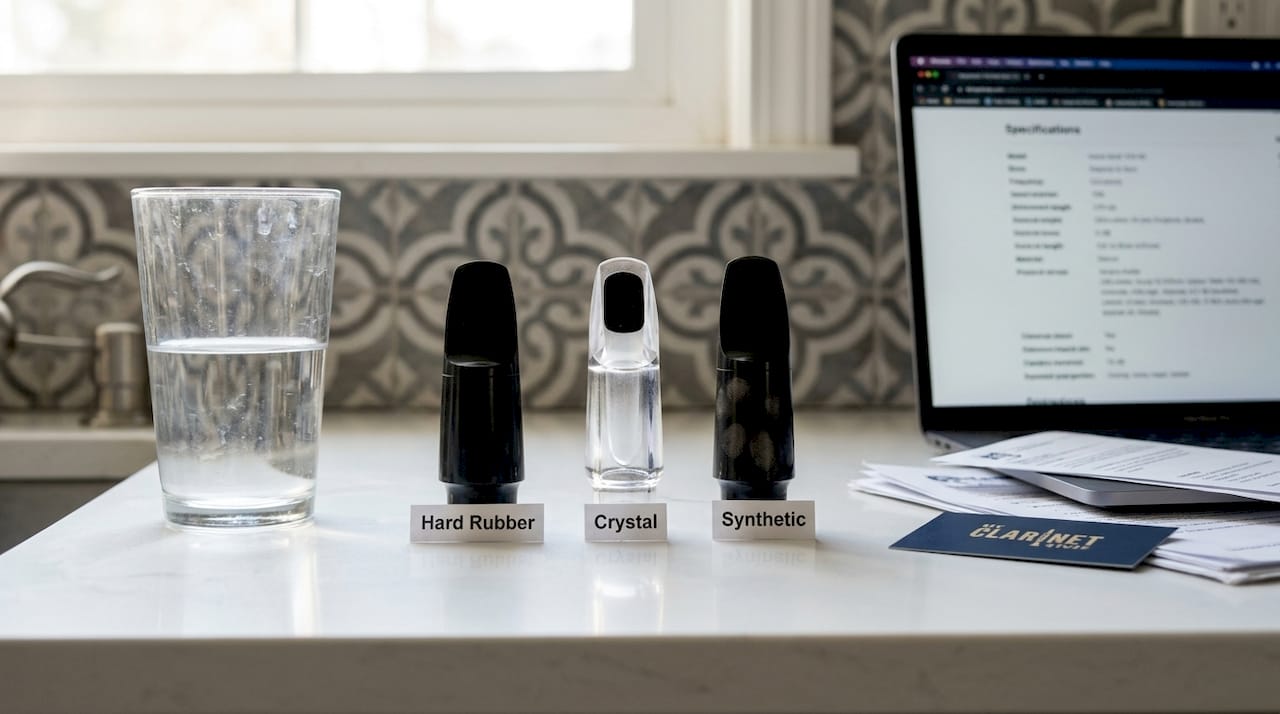
Hard rubber and crystal are the top choices among professionals for their resonance and reliability. Each material has a distinct acoustic personality.
Here’s a breakdown of the most common options:
- Hard rubber (ebonite): Rich, focused core tone with excellent projection. The go-to for classical players and many jazz professionals.
- Crystal (glass): Bright, clear tone with a smooth, fast response. Popular in jazz and contemporary styles.
- Synthetic resin: Highly consistent, resistant to temperature and humidity changes. Increasingly favored for recording and touring.
- Plastic: Durable and affordable, but lacks the tonal nuance needed at the professional level.
- Metal: Rare, used for specific jazz effects and niche applications.
| Material | Tone character | Best for |
|---|---|---|
| Hard rubber | Warm, focused | Classical, orchestral |
| Crystal | Bright, clear | Jazz, contemporary |
| Synthetic resin | Balanced, consistent | Touring, recording |
| Plastic | Neutral | Student practice |
| Metal | Edgy, projecting | Niche jazz |
Exploring premium clarinet mouthpiece materials in depth will help you understand why synthetic options are gaining ground even among traditionalists.
Pro Tip: If you travel frequently or perform in varying climates, synthetic resin mouthpieces offer a significant advantage. They don’t swell, warp, or change response the way hard rubber can in extreme humidity.
Tip opening and facing: Shaping your sound
Once you’ve settled on a material, the next variables that define your sound are tip opening and facing length. These two measurements work together to determine how the reed vibrates and how the mouthpiece responds to your air.
Tip opening and facing length significantly affect mouthpiece response and reed pairing. Getting this combination right is critical for both playability and tone.
Here’s how each variable works:
- Tip opening (narrow): Produces a more focused, controlled sound. Easier to play softly. Works well with harder reeds.
- Tip opening (wide): Allows greater flexibility and dynamic range. Requires more air support. Pairs best with softer reeds.
- Facing (short): Fast, immediate response. Ideal for articulation-heavy passages and quick technical work.
- Facing (long): Greater tonal flexibility and color variation. Preferred for expressive, lyrical playing.
| Feature | Narrow/Short | Wide/Long |
|---|---|---|
| Tip opening | Focused, controlled | Flexible, dynamic |
| Facing length | Fast response | Expressive range |
| Reed pairing | Harder reeds | Softer reeds |
| Best genre fit | Classical, chamber | Jazz, solo |
Use the clarinet tip opening guide to match your current reed strength to the right mouthpiece geometry. And if you’re still narrowing down your options, these tip selection tips offer a practical framework for the decision.
Chamber design and baffle: The secret to tonal character
The outside of a mouthpiece tells you very little about how it will actually sound. The real story is inside. Chamber shape and baffle design are the internal features that define a mouthpiece’s tonal personality.
Chamber and baffle shapes are crucial for achieving the desired tone color and projection. These aren’t subtle differences. They can completely transform the character of your sound.
Here’s how each element works:
- Large chamber: Produces darker, rounder, more centered tones. Preferred in classical and orchestral settings where blend matters more than cut.
- Medium chamber: Balanced tone with moderate brightness. Versatile across genres.
- Small chamber: Yields a brighter, punchier sound with more edge. Common in jazz and folk styles.
- Flat baffle: Smooth, even airflow. Contributes to a darker, more traditional tone.
- Rollover baffle: Adds brightness and focus without harshness. A popular middle ground.
- High baffle: Maximum brightness and projection. Used for cutting through loud ensembles or amplified settings.
You can compare these design variables side by side using the mouthpiece comparison chart to see how different models stack up.
Pro Tip: Don’t assume a darker mouthpiece means a quieter one. A large chamber with a rollover baffle can produce a full, projecting sound that still blends beautifully in an orchestra. Tone color and volume are separate variables.
Precision manufacturing and custom options
Even the best design is only as good as its execution. At the professional level, manufacturing precision is what separates a mouthpiece that performs consistently from one that surprises you at the worst possible moment.
Hand-finishing by artisans ensures consistency and allows for custom tuning that mass-produced models simply can’t match. This matters most in ensemble and recording contexts where every variable counts.
Here’s what precision manufacturing delivers:
- Tight tolerances across tip opening, rail symmetry, and table flatness so every mouthpiece plays as designed.
- Predictable response that lets you focus on music rather than compensating for equipment inconsistencies.
- Custom finishing options that allow advanced players to dial in specific tonal characteristics or response profiles.
- Long-term stability so the mouthpiece doesn’t drift in performance as it ages.
“When you’re recording or performing in a professional ensemble, you need to know your equipment will behave the same way every single time. That reliability only comes from precision manufacturing.”
If you want to evaluate mouthpieces before committing, these mouthpiece testing tips walk you through a structured approach to comparison.
Which features matter most for each genre?
All of the features above interact differently depending on your musical context. A mouthpiece that’s perfect for a symphony orchestra audition may feel completely wrong in a jazz club. Here’s how to align your feature priorities with your genre.
Different genres require unique mouthpiece attributes, with darker tones favored in classical settings and greater projection needed for jazz.
| Genre | Material | Chamber | Tip opening | Facing |
|---|---|---|---|---|
| Classical | Hard rubber | Large | Medium | Medium to long |
| Jazz | Crystal or synthetic | Small to medium | Wide | Short to medium |
| Folk/multistyle | Synthetic or hard rubber | Medium | Medium | Medium |
Here’s a quick summary by style:
- Classical: Prioritize warmth, blend, and intonation stability. Hard rubber with a large chamber and medium tip opening is the standard starting point.
- Jazz: Projection and flexibility come first. Crystal or synthetic with a smaller chamber and wider tip opening gives you the edge and responsiveness jazz demands.
- Folk and multistyle: You need versatility above all. A balanced chamber, responsive facing, and consistent synthetic material handle genre shifts without fighting you.
For a deeper look at matching your setup to your playing goals, the mouthpiece choice tips resource covers the full decision process.
Find your perfect professional mouthpiece
You now have a clear picture of what makes a professional mouthpiece worth the investment. The next step is finding the one that fits your instrument, your genre, and your playing style.

At MyClarinetStuff.com, we carry a curated selection of Gleichweit professional mouthpieces designed and manufactured in Austria with precision CNC crafting. Whether you play classical, jazz, or folk, our lineup covers the full range of chamber designs, tip openings, and materials. Use the mouthpiece matchmaker to get a personalized recommendation based on your genre and playing level. You can also explore our accessory selection guide to build a complete, optimized setup around your new mouthpiece. Not sure where to start? Our at-home test box program lets you try before you commit.
Frequently asked questions
What is the most important feature in a professional clarinet mouthpiece?
Tip opening and material quality are the two most influential factors for sound, response, and overall playability. Getting both right for your style makes every other variable easier to manage.
Can I use a professional mouthpiece for all clarinet genres?
Yes, but certain mouthpiece designs are optimized for specific genres, so a mouthpiece built for orchestral playing may not give you the projection and flexibility jazz requires.
How do I choose the right reed for my professional mouthpiece?
Match reed strength to your tip opening and facing length. Wider openings pair with softer reeds, while narrower openings work better with harder reeds.
Are custom mouthpieces worth the investment?
Custom finishing gives professional players a meaningful edge in tonal control and response consistency, especially for recording or high-stakes ensemble work.