


A custom barrel earns its place when your embouchure and reeds are already consistent and you need better tuning control, a more focused tone, or smoother response across registers. Students still developing basic consistency should hold off. Teachers evaluating gear for a student and professionals chasing ensemble precision are the players who benefit most, and the fastest way to know is a direct A/B swap with your own mouthpiece and reed.
TL;DR:
- Custom barrels are most beneficial for players with stable embouchure and reeds, especially professionals switching between different pitch standards.
- Bore shape, internal taper, and material significantly influence pitch center, tone color, and response, with taper affecting register and sound resistance.
- Testing a new barrel requires isolating it from other variables, using a tuner and subjective notes to confirm audible and measurable improvements.
- Custom barrels are a practical solution for correcting pitch and response issues that arise from bore wear or specific ensemble tuning needs.
- Cost varies widely, but testing programs and trial periods reduce financial risk by allowing players to evaluate fit and sound before committing.
Table of Contents
- What Changes When You Try Custom Barrels
- How Barrels Actually Work: Bore, Taper, and Material
- Who Should Try a Custom Barrel (and Who Should Wait)
- How to Test a Custom Barrel Before You Commit
- The History Behind Custom Barrel Design
- Common Myths About Custom Barrels
- What Custom Barrels Typically Cost
- Caring for a Custom Barrel Long Term
- Custom Barrels vs Standard Barrels: Real Scenarios
- Projection and Intonation: The Real Payoff
- Why Trust This Guide on Custom Barrels
- Try Before You Commit: Barrels and Test Boxes at Myclarinetstuff
- Sources
What Changes When You Try Custom Barrels
The clearest reason to try custom barrels is that they change three things you can actually hear and measure: pitch center, tone color, and response.
Length is the most direct lever. A longer barrel lowers pitch; a shorter one raises it. Standard Bb clarinet barrels run 65mm or 66mm, and players tuning to A=440 often move to a shorter barrel, with some going as short as 64mm when matching an A=442 ensemble. That two-millimeter difference is not cosmetic. It shifts your entire pitch center before you touch an embouchure adjustment.
Tone color shifts too, though it’s harder to quantify than pitch. A well-built barrel tends to add focus without thinning the sound, or warmth without turning muddy. What you should listen for:
- Whether soft, low passages speak more easily instead of requiring extra air pressure
- Whether loud, high passages stay controlled instead of turning edgy or spread
- Whether the break between registers (around the throat tones) smooths out or stays rough
- Whether the core of your sound stays consistent from piano to forte
A quality aftermarket barrel often smooths the tuning curve across registers, according to repair-shop experience compiled by Rice Clarinet Works, making both soft and loud playing feel less like a fight against the instrument.
There’s also a practical, unglamorous reason to try a new barrel: stock barrels wear out. Years of moisture and temperature cycling can slowly warp the bore, and a barrel that’s lost its geometry will never tune the way it did when new. Explore how custom barrel construction addresses that wear directly rather than masking it.
How Barrels Actually Work: Bore, Taper, and Material
Length gets the attention, but bore shape and internal taper do the real acoustic work. A barrel is a precision sound chamber, and how that chamber narrows or widens along its length determines how resistance builds and how registers balance against each other, a point Martin Freres makes when describing airflow control as central to agility and articulation.
Three factors interact every time you play a note:
- Bore diameter sets overall resistance. A slightly wider bore can open the sound and ease high-register response; a narrower one tends to concentrate the tone and add core.
- Internal taper governs how the bore transitions from the barrel into the upper joint, which directly shapes throat-tone behavior and cross-register evenness.
- Length sets the pitch center but only tells part of the story. Changing length by simple displacement (essentially just adding air space without adjusting the taper) can create air-pocket effects that hurt throat tones, according to acoustic analysis published in the European Journal of Physics. A custom-bore barrel corrects pitch through taper design instead, avoiding that trade-off entirely.
Materials matter for stability as much as sound. Grenadilla wood remains the traditional choice and many players prefer its resonance character, but wood is vulnerable to humidity and temperature swings over years of playing. Hard rubber and modern CNC-machined synthetics resist warping far better, which keeps the bore geometry (and therefore the tuning) consistent season after season. See how barrel materials compare in more technical detail.
One more distinction worth knowing: adjustable barrels use a sliding ring to change length by a few millimeters on the fly, while custom-bore barrels are built to one fixed geometry designed around your instrument. Adjustable models solve short-term tuning needs; custom bores solve tone and response at the same time.
Who Should Try a Custom Barrel (and Who Should Wait)
Not every player is ready for this upgrade, and knowing where you sit saves you money and frustration.
Students benefit once their embouchure and air support are stable and they’re playing on a consistent reed strength and brand. A student still fighting basic tone production or switching reeds every week won’t be able to isolate what the barrel is doing, and any improvement they hear may just be a good reed day. Teachers testing barrels for a student should first rule out the reed and mouthpiece as the source of a tuning or response complaint, since those two variables cause more problems than the barrel ever will.
Professionals have the clearest use case. Many working clarinetists carry multiple barrels specifically to switch between pitch standards, moving from an A=440 setup for one ensemble to A=442 for another without touching their embouchure. Orchestral players who travel between countries or ensembles with different tuning conventions rely on this constantly.
- Stable technique and consistent reeds: good candidate
- Chasing a specific tuning or projection problem: good candidate
- Trying to fix inconsistent reeds or embouchure issues: wrong tool for the job
- Switching between ensemble pitch standards: strong professional use case
Pro Tip: Order a barrel the same length as your current one unless you’re solving a specific, identified tuning problem. Changing length and bore profile at the same time makes it impossible to know which change caused which result.
How to Test a Custom Barrel Before You Commit
A barrel test only tells you something useful if you control every other variable. Here’s the protocol that actually produces reliable data.
- Set your baseline first. Play your current setup (same mouthpiece, same reed, same room) and record tuner readings on long tones across low, middle, and high registers. Note any registers that already run sharp or flat.
- Swap only the barrel. Keep the mouthpiece and reed identical. This isolates the barrel as the single variable, which is the entire point of the test.
- Play the same material both ways. Long tones for pitch stability, a full chromatic scale for register smoothing, and two or three orchestral excerpts you know well for real-world response.
- Measure, don’t guess. Use a tuner that reads in cents, not just note names. A shift of 10 to 15 cents in the throat tones is audible and meaningful; anything under 5 cents is likely noise.
- Log what you hear and what you measure separately. Tuner readings go in one column, subjective notes (color, resistance, ease of soft playing) in another.
| What to Log | Baseline Barrel | Test Barrel |
|---|---|---|
| Low register pitch (cents) | Record reading | Record reading |
| Throat tone stability | Record reading | Record reading |
| High register pitch (cents) | Record reading | Record reading |
| Response on soft entrances | Note subjective impression | Note subjective impression |
| Overall tone color | Note subjective impression | Note subjective impression |
Before you order anything, ask a seller directly about fit tolerances, sealing quality between joints, and whether they offer a trial or return period. A seller unwilling to stand behind a fit guarantee is a red flag worth taking seriously. Review a full equipment selection process if you want a broader framework for testing gear changes systematically, and confirm your mouthpiece and reed pairing through a setup selection guide before you start.
The History Behind Custom Barrel Design
Barrels weren’t always treated as a separate, tunable component. Early clarinet designs integrated the barrel section more rigidly into the instrument’s overall bore, with makers focused primarily on keywork and tone hole placement rather than isolating the barrel as an adjustable tuning tool.
As orchestral pitch standards drifted upward over the nineteenth and twentieth centuries (moving from lower baroque-era pitch toward the modern A=440 to A=442 range), the barrel emerged as the practical solution for adapting existing instruments without rebuilding them entirely. A shorter or longer barrel let a player match a new ensemble pitch standard without touching the rest of the horn.
The rise of boutique and independent barrel makers over the past few decades reflects a broader shift in wind instrument culture: players increasingly treat individual components as separately optimizable rather than accepting a factory barrel as fixed. That shift paralleled advances in mouthpiece design and CNC manufacturing, which made precise, repeatable bore geometry achievable outside a handful of legacy instrument factories. Today’s custom-bore barrels are a direct descendant of that mindset. Instead of accepting whatever ships with the instrument, players and makers treat the barrel as its own acoustic problem worth solving.
Common Myths About Custom Barrels
The biggest misconception is that a custom barrel will fix a fundamentally inconsistent sound. It won’t. A barrel refines what’s already there; it doesn’t replace stable air support or a well-matched reed. If your tone varies wildly from day to day, the barrel is not your first purchase.
A second myth: “longer always means darker, shorter always means brighter.” Length primarily shifts pitch center, and while tone color often shifts alongside it, the relationship isn’t purely linear. Bore taper affects color as much as raw length does, which is why two barrels of identical length from different makers can sound noticeably different.
A third myth treats adjustable barrels as strictly inferior to fixed custom-bore designs. That’s not quite right either. Adjustable barrels solve a real, narrow problem (quick pitch changes for players moving between ensembles) without claiming to solve tone or response the way a purpose-built bore does. They’re a different tool, not a lesser one.
Finally, many players assume any “custom” label guarantees improvement. It doesn’t. A custom barrel matched poorly to your mouthpiece and reed setup can perform worse than a good stock barrel. That’s precisely why testing before buying matters more than the word “custom” on the listing.
What Custom Barrels Typically Cost
Prices for custom and boutique barrels vary by material, maker reputation, and whether the piece is a standard-length offering or built to your instrument’s specific bore measurements. Synthetic and hard rubber options generally sit at a lower price point than hand-finished grenadilla barrels from specialty makers, largely because wood requires more labor to select, season, and finish consistently.
Budget for the barrel itself as one line item, but factor in the real cost of testing, too. A single barrel purchased on a guess, without a return window or trial period, risks becoming an expensive shelf item if it doesn’t suit your setup. That’s the entire argument for trial programs: paying a modest fee to test multiple barrels against your own mouthpiece and reed before committing is almost always cheaper than buying and reselling a barrel that turns out wrong for you.
Professionals who need multiple barrels for different pitch standards should think of the second and third barrel as tools, not luxuries. A working orchestral player who travels between A=440 and A=442 ensembles recoups that cost quickly just by avoiding awkward on-the-spot tuning compromises.
Caring for a Custom Barrel Long Term
A custom barrel needs the same daily discipline as the rest of your instrument, plus a little extra attention to the material it’s made from. Swab it after every playing session to remove moisture before it sits in the bore. Standing water inside a wood barrel over time is one of the most common causes of warping and cracking.
Wood barrels benefit from occasional bore oiling, following whatever schedule the maker recommends, since dry wood is more prone to cracking under humidity swings. Synthetic and hard rubber barrels skip that maintenance step entirely, which is part of why players performing in variable climates or frequent travel schedules often prefer them for long-term stability.
Store the barrel in a case with proper humidity control if you live somewhere with big seasonal swings. A barrel left in a hot car or a bone-dry heated room in winter is being slowly stressed even when nobody’s playing it. Check joint corks or tenon fit periodically too. A barrel that no longer seals tightly against the mouthpiece or upper joint will leak air and undermine everything else the barrel is designed to do, regardless of how well the bore itself was built.
Custom Barrels vs Standard Barrels: Real Scenarios
The clearest way to see the difference is through actual playing situations rather than abstract specs.
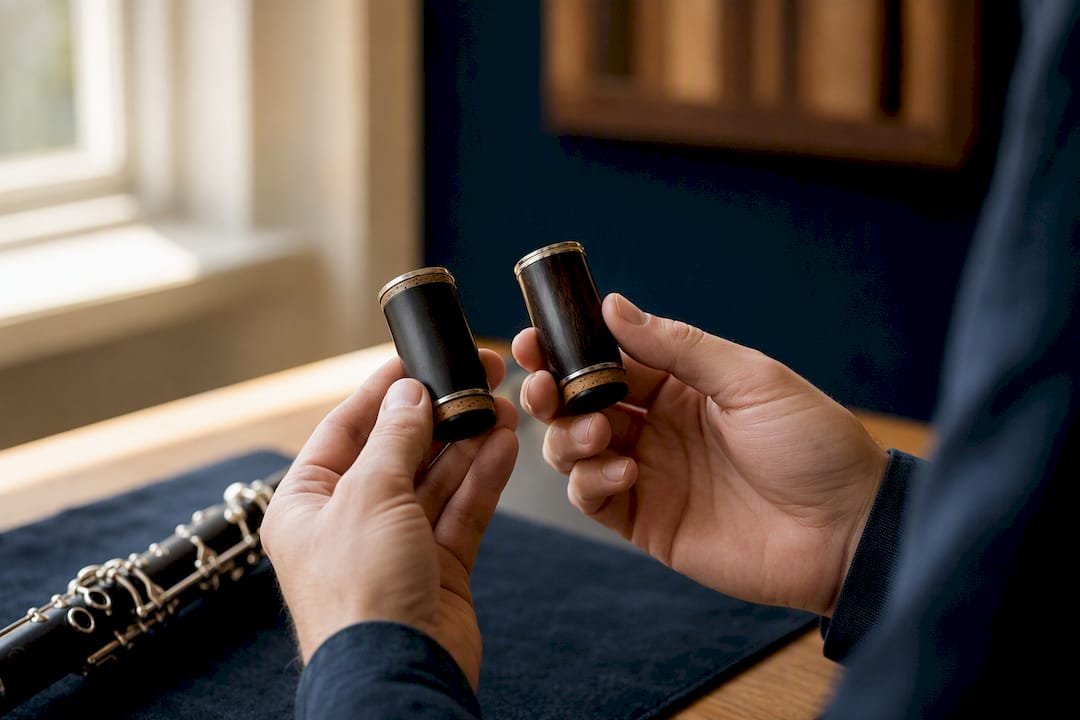
A high school student preparing for a solo and ensemble festival plays consistently on a stock barrel that came with the instrument. If tone and intonation are stable, a new barrel likely won’t move the needle much, and that budget is better spent on reeds or lessons.
A community band clarinetist notices persistent sharpness in the upper register that a reed change hasn’t fixed. Swapping to a barrel with a different bore taper, tested against their existing mouthpiece, can correct that tendency without retraining their embouchure.
A freelance orchestral player books work with two ensembles, one tuning to A=440 and the other to A=442. Carrying a 66mm barrel for one and a 64mm barrel for the other lets them arrive prepared instead of fighting pitch all night on a single fixed setup, exactly the professional pattern described across clarinet equipment guides.
A college student with a worn, decade-old stock barrel that’s started to feel unpredictable finds that even a modestly priced replacement restores consistency, simply because the old bore geometry had degraded. In each case, the standard barrel isn’t wrong. It’s just not built to solve the specific problem the player actually has.
Projection and Intonation: The Real Payoff
Projection and intonation are the two outcomes most players actually care about, and a well-matched barrel affects both, though not always in the way marketing copy suggests.
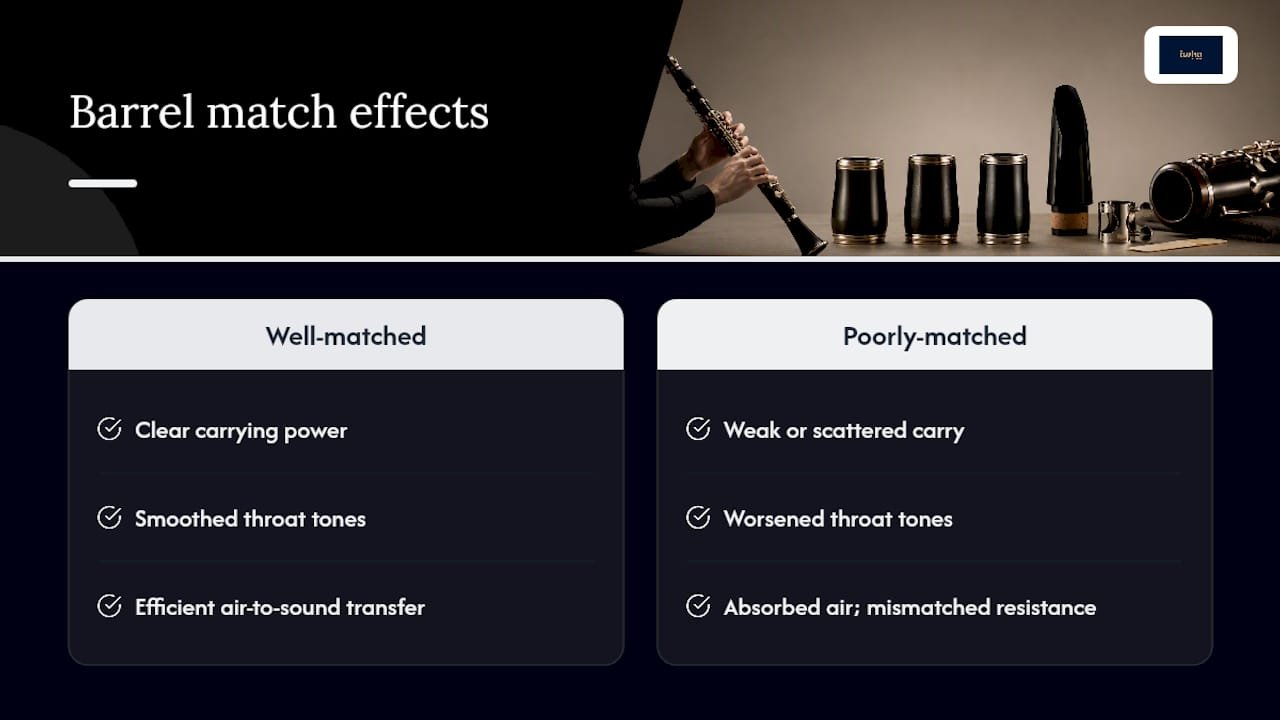
Projection isn’t about playing louder. It’s about the sound carrying clearly through a hall or over an ensemble without extra effort. A barrel with the right bore and taper lets your natural air support translate more efficiently into sound that reaches the back row, rather than getting absorbed or scattered by a mismatched resistance profile. Teachers who evaluate barrels this way, checking for consistency and carrying power rather than chasing a vague “warmer” or “brighter” label, tend to get more reliable results, a distinction Martin Freres highlights when framing the barrel as a precision chamber rather than a tone-color knob.
Intonation improvements show up most clearly in the throat tones, the notoriously unstable notes around the break between the lower and upper registers. A barrel with a taper matched to your bore can smooth that transition noticeably, while a poorly matched one (or a length change done by crude displacement) can make throat tones worse instead of better. That’s the acoustic tradeoff worth understanding before you buy on length alone.
Why Trust This Guide on Custom Barrels
This guide draws on acoustic research into bore and taper behavior, documented professional practices around pitch-standard switching, and technical analysis of how barrel geometry affects throat tones and resonance. Milos, writing on behalf of Gleichweit USA LLC, brings that research together with a straightforward goal: help players make evidence-based decisions instead of chasing marketing language.
Gleichweit’s CNC-crafted synthetic mouthpieces are built on the same principle driving this article: precision, repeatable geometry beats guesswork. That same philosophy extends to barrels, which is why Myclarinetstuff’s at-home test box program exists, letting players verify real improvements on their own instrument rather than trusting a listing description. For more on how barrel construction shapes sound, see the deeper technical breakdown on how custom barrels enhance clarinet sound.
— Milos
Try Before You Commit: Barrels and Test Boxes at Myclarinetstuff
Myclarinetstuff removes the biggest risk in trying a custom barrel: buying blind. Rather than guessing from a spec sheet, the at-home Test Box program lets you bring up to five mouthpieces and barrel options into your own practice room and test them against your instrument, your reeds, and your ears.
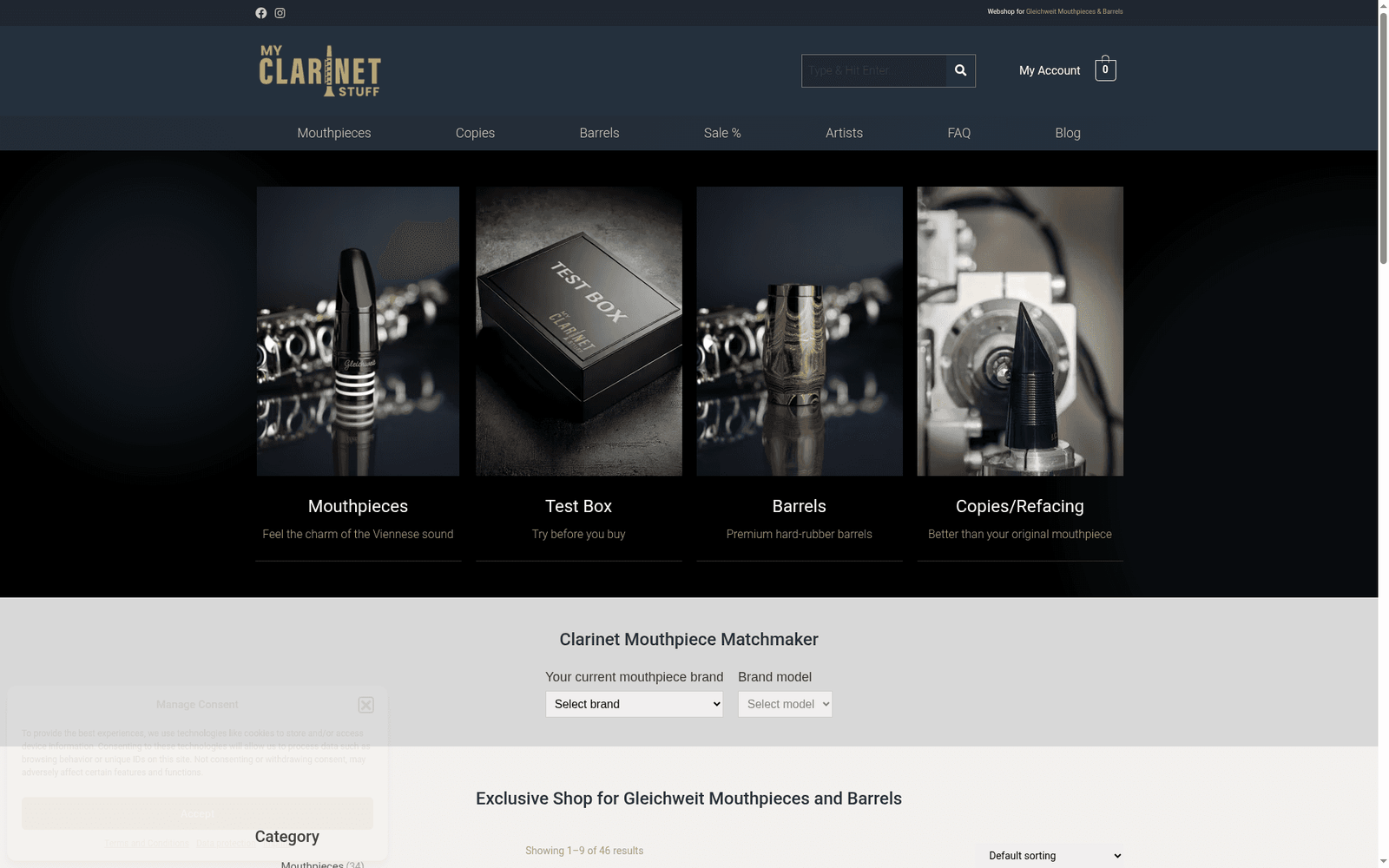
The Test Box arrives with clear fit information and straightforward return terms, so you’re not stuck with a purchase that doesn’t seal properly or match your bore. If you already know length is your issue, start with the Gleichweit B3 barrel or compare it against the B2 model to see how bore and taper differences play out on your own setup. Browse the full barrel and mouthpiece shop to see current listings, or request a Test Box today and run the A/B protocol yourself before you spend a cent on a barrel you haven’t actually heard on your own clarinet.
Sources
- The Complete Guide to Clarinet Barrels – Jenny Maclay
- IOP: analysis of barrel displacement consequences
- Best Clarinet Barrel: Backun, Buffet and More Compared – Clarinet Expert
- Mastery of the clarinet barrel — Martin Freres