
TL;DR: The main types of clarinets are the B♭ and A soprano clarinets, the small E♭ clarinet, the alto clarinet, the bass clarinet, and the contrabass clarinet. Rarer members include the C, D, and A♭ clarinets, the basset clarinet, the basset horn, and the contra-alto. Nearly all of them read the same fingerings, so a B♭ player can move to most of the family without starting over. B♭ is where almost everyone begins. B♭ and A clarinets can share one mouthpiece, but the other sizes each need their own.
Ask most people to picture a clarinet and they will describe a B♭ soprano: the black, roughly two-foot instrument found in nearly every school band. That is only one member of a very large family. Clarinets have been built in more than a dozen sizes, from tiny piccolo instruments to huge contrabass models.
Knowing the different types of clarinets helps in practical ways. Students need to know what a band director means by “alto” or “contra.” Teachers need to steer players toward the right doubling instrument. Advancing players want to know when an A clarinet or an E♭ becomes worth buying, and what they will need to put on the end of it.
This guide covers every type of clarinet you are likely to meet, what each one sounds like, where it is played, and how the mouthpiece changes from one size to the next.
Table of Contents
- What separates the types of clarinets
- Types of clarinets at a glance
- Soprano clarinets: B♭, A, and C
- High clarinets: E♭, D, and A♭
- Basset clarinet and basset horn
- Alto clarinet
- Bass clarinet
- Contra-alto and contrabass clarinets
- Which type of clarinet should you play?
- Do all types of clarinets use the same mouthpiece?
- Key Takeaways
- FAQ
- Find the right mouthpiece for your clarinet
What separates the types of clarinets
The main difference between types of clarinets is length. A longer tube sounds lower, so each member of the family is essentially the same design scaled up or down. Each is named for the concert pitch it produces when the player fingers a written C: a clarinet in E♭ sounds a concert E♭, and a clarinet in A sounds a concert A. If that idea is new to you, our guide to why the clarinet is in B♭ explains transposition step by step.
Because the music is written transposed, the fingerings stay the same across the family. A written G is fingered the same way on an E♭ clarinet as on a bass clarinet. This is the great gift of the clarinet family: the notes come easily when you change sizes, even though the embouchure, air, and reed all need to adapt.
One distinction to keep separate is the fingering system. Boehm, Oehler, and Albert are systems, not sizes, and a B♭ clarinet can be built in any of them. Our article on German vs French clarinets covers that split. Everything below assumes the Boehm system used by nearly all players in the United States.
Types of clarinets at a glance
This table lists the types of clarinets in order from highest to lowest, with the interval each one sounds from the written note.
| Clarinet | Sounds compared to written | Availability | Where you hear it |
|---|---|---|---|
| A♭ piccolo | Minor sixth higher | Very rare | Historic European wind bands |
| E♭ sopranino | Minor third higher | Common among advanced players | Orchestra, concert band, clarinet choir |
| D sopranino | Major second higher | Rare in the U.S. | Strauss, Mahler, and Stravinsky scores |
| C soprano | As written | Uncommon | Period performance, klezmer |
| B♭ soprano | Major second lower | The standard clarinet | Everywhere |
| A soprano | Minor third lower | Standard for orchestral players | Orchestra and chamber music |
| Basset horn in F | Perfect fifth lower | Specialist | Mozart, Mendelssohn, Richard Strauss |
| E♭ alto | Major sixth lower | Found mainly in bands | Concert band, clarinet choir |
| B♭ bass | Major ninth lower | Common | Orchestra, band, jazz |
| E♭ contra-alto | Octave and major sixth lower | Uncommon | Large bands, clarinet choir |
| B♭ contrabass | Two octaves and a major second lower | Uncommon | Large bands, clarinet choir, contemporary music |
Soprano clarinets: B♭, A, and C
B♭ clarinet. This is the most common clarinet by a wide margin and the usual starting point for beginners. It leads the band’s woodwind section, sits in the orchestra, and carries most of the instrument’s jazz history. Student models are often plastic, while intermediate and professional instruments are usually grenadilla. If you are deciding between them, see our comparison of wood vs plastic clarinets.
A clarinet. About an inch longer than the B♭, the A clarinet looks and feels nearly identical and sounds a semitone lower. Pieces with many sharps fall more comfortably on it, which is one reason so much orchestral and chamber music calls for it. Mozart’s Clarinet Concerto and the Brahms Clarinet Quintet are both played on A clarinet. Most classical professionals own a matched pair, and many switch back and forth within a single program. Band and jazz players rarely need one.
Players still debate whether the two sound different. The British clarinetist Jack Brymer argued they do not, while the conductor Sir Henry Wood said he always missed the A clarinet’s particular quality when it was replaced. One measurable difference is range: the A clarinet’s low E gives a concert D♭ that an ordinary B♭ cannot reach.
C clarinet. The C clarinet reads at concert pitch, so there is nothing to transpose. It was largely gone from orchestras by the early 20th century, but historically informed performance and folk styles such as klezmer have brought it back. In clarinet choirs it sometimes covers oboe parts. It remains a specialty purchase rather than a standard one.
Pro Tip: If you double on B♭ and A in the same concert, keep one mouthpiece warm and move it between instruments. A warmed-up mouthpiece and a played-in reed lower the risk of a squeak on your first note after the change.
High clarinets: E♭, D, and A♭
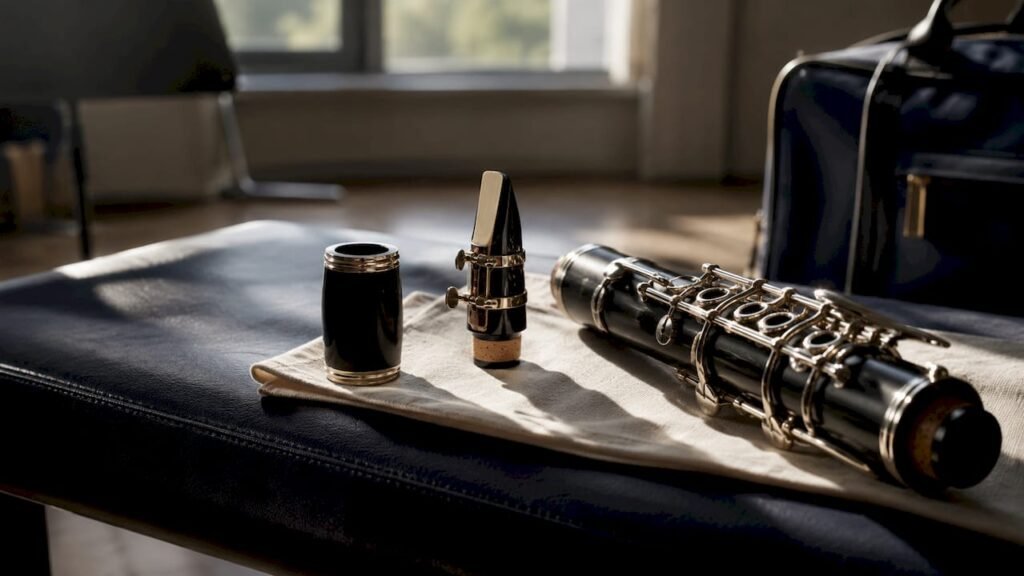
E♭ clarinet. At roughly 49 cm, the E♭ is the small clarinet you are most likely to see. It sounds a minor third above written pitch and has a bright, cutting tone that orchestral composers love for moments of wit or menace. The witches’ sabbath in Berlioz’s Symphonie fantastique and Ravel’s Boléro both feature it, and Mahler calls for two in his first three symphonies. In bands it is a true solo voice, as our list of E♭ clarinet band music examples shows. Its demands on intonation and control make it a poor first clarinet, so it is usually given to mature players.
D clarinet. Slightly larger than the E♭ at about 52 cm, the D clarinet is rare in the United States and western Europe. Its best-known parts include Richard Strauss’s Till Eulenspiegel and Stravinsky’s The Rite of Spring, which uses both D and E♭.
A♭ piccolo clarinet. This is the highest clarinet still manufactured. It was used in 19th-century European wind and military bands and in Italian opera stage bands. The slightly larger G piccolo has a Viennese connection: it was played in the small Schrammel ensembles of 1880s Vienna.
Basset clarinet and basset horn
The word “basset” tells you an instrument has extra keys that extend its range down to written low C.
Basset clarinet. This is usually an A clarinet lengthened by about 18 cm toward the bell. Mozart’s concerto was written for this kind of extended instrument, and many soloists now perform it that way to restore the original low notes.
Basset horn. Pitched in F, the basset horn has a darker, more veiled voice than the alto clarinet it resembles. It has a place in Mozart’s Requiem, which calls for two, and in Richard Strauss operas such as Elektra and Der Rosenkavalier. Mendelssohn wrote two concert pieces for clarinet and basset horn. Our full guide explains what a basset horn is and how it is built.
Alto clarinet
The alto clarinet is pitched in E♭, a whole step below the basset horn, with a wider bore and without the basset horn’s full low extension. It sounds a major sixth below written pitch, and its bent metal neck and upturned bell make it look like a small bass clarinet.
Iwan Müller was playing an early alto clarinet in F by 1809, and Adolphe Sax later improved the design. Today it lives mainly in concert bands and clarinet choirs, where it fills the middle of the section. Its place in bands has shrunk since the 1980s, and orchestras rarely use it, but it remains a warm, rewarding voice in a clarinet choir.
Bass clarinet
The bass clarinet is the most widely played of the low types of clarinets. It sounds an octave below the B♭ soprano, rests on a floor peg or neck strap, and has a curved metal neck. Most modern models go down to written low E♭, while professional instruments reach written low C.
Its orchestral history took off with a famous solo in Act 4 of Meyerbeer’s Les Huguenots (1836). Wagner then made it a fixture of the opera orchestra, and Mahler gave it long solos, especially in his Sixth Symphony. See our guide to the bass clarinet in the orchestra for more on that repertoire. In jazz, Harry Carney brought it into the Duke Ellington orchestra, and Eric Dolphy turned it into a major solo voice.
The fingerings transfer from the soprano, but the instrument wants more air and a lower voicing.
Contra-alto and contrabass clarinets
These are the lowest common types of clarinets. The E♭ contra-alto sits an octave below the alto clarinet, and the B♭ contrabass sits an octave below the bass clarinet. Both add a deep foundation to large bands and clarinet choirs, and the contrabass in particular appears in contemporary music for its extreme low register.
Below those are the octocontra-alto and octocontrabass, built as prototypes by Leblanc in the 1930s. They are curiosities rather than working instruments, although Foag Klarinetten began making B♭ versions in 2025.
Pro Tip: On any low clarinet, check for leaks before blaming your embouchure. Long instruments have many pads and joints, and a small leak can make low notes refuse to speak.
Which type of clarinet should you play?
For almost everyone, the answer starts with B♭. It has the most music, the most teachers, the widest choice of instruments, and it prepares you for every other size. Our clarinet buying guide covers how to choose one. After that, the right next instrument depends on where you play.
| If you are… | Consider | Why |
|---|---|---|
| A beginner of any age | B♭ soprano | Standard instrument, most music, easiest to find teachers and repairs |
| A band student who needs a new challenge | Bass or alto clarinet | Bands need low voices, and the fingerings transfer |
| A college or pre-professional player | A clarinet | Orchestral and chamber repertoire requires it |
| A strong section leader | E♭ clarinet | Bright solo role in band and orchestra |
| A doubler or jazz player | Bass clarinet | The most useful second clarinet outside the orchestra |
| A clarinet choir enthusiast | Alto, contra-alto, or contrabass | They provide the low end of the choir |
Do all types of clarinets use the same mouthpiece?
No, with one important exception. B♭ and A clarinets share the same bore size, so a single mouthpiece and reed work on both. Every other size needs a mouthpiece built for it. E♭ mouthpieces are smaller, while alto, bass, and contrabass mouthpieces are progressively larger and fit into a neck rather than a barrel.
| Clarinet | Mouthpiece | Gleichweit example |
|---|---|---|
| B♭ and A | Shared soprano mouthpiece | Closed, medium, and open models from 1.01 to 1.40 mm |
| E♭ | Smaller, dedicated mouthpiece | JG6 (1.19 mm tip, 23 mm facing), JG7 (1.23 mm tip, 23 mm facing) |
| Alto | Larger, dedicated mouthpiece | A14 |
| Bass | Wider and longer, fits the neck | 19, 22-3, and Stephan (2.32 mm tip, 26 mm facing) |
| Contrabass | Largest, with a long facing | B24 (2.05 mm tip, 32 mm facing) |
Barrels follow the same logic. A pair of B♭ and A clarinets each have their own barrel, so you can select the length for each instrument. Our guide to clarinet barrel length explains how to choose. For the principles behind tip opening, facing, and resistance, start with how to choose a clarinet mouthpiece.
Key Takeaways
| Point | Details |
|---|---|
| Length sets the type | Types of clarinets differ mainly in size, and each is named for the concert pitch of its written C. |
| Fingerings carry over | Written notes use the same basic fingerings across the family, though embouchure, air, and reeds must adapt. |
| B♭ comes first | The B♭ soprano is the standard clarinet and the best starting point for almost every player. |
| A is for orchestra and chamber music | Classical players usually own both B♭ and A, and much of the core repertoire needs the A clarinet. |
| Bass is the most useful second clarinet | It works in orchestra, band, and jazz. |
| Mouthpieces are size-specific | B♭ and A share a mouthpiece, but E♭, alto, bass, and contrabass each need their own. |
FAQ
How many types of clarinets are there?
It depends on how you count. Historic and experimental sizes bring the total to more than a dozen, but most players only meet a handful: B♭, A, E♭, alto, bass, and contrabass.
What is the most common type of clarinet?
The B♭ soprano clarinet. It is the instrument used by beginners, in concert bands, and in most jazz, and it is also the main instrument of orchestral clarinetists.
What is the difference between an A clarinet and a B♭ clarinet?
The A clarinet is about an inch longer and sounds a semitone lower. The keywork and playing approach are nearly identical, and the same mouthpiece fits both. Composers often chose A for music in sharp keys.
Is the bass clarinet harder to play than the B♭ clarinet?
It is different more than harder. The fingerings are familiar, but it takes more air and a different feel in the embouchure, and the instrument itself is heavier and larger.
Can I use my B♭ mouthpiece on an E♭ or bass clarinet?
No. An E♭ clarinet needs a smaller mouthpiece, and a bass clarinet needs a much larger one that fits its neck. A B♭ mouthpiece is only interchangeable with the A clarinet.
Find the right mouthpiece for your clarinet
Whatever type of clarinet you play, the mouthpiece shapes how it responds. If you play B♭ or A, a Variety Mouthpiece Test Box (1.16–1.40 mm) lets you compare five Gleichweit mouthpieces at home for 7 days for a $40 test fee. If you already know your range, choose the Closed-Tip Test Box (1.01–1.20 mm), the Medium-Tip Test Box (1.17–1.24 mm), or the Open-Tip Test Box (1.27–1.40 mm). One choice will serve both of your soprano clarinets.
For the rest of the family, Gleichweit makes the JG6 and JG7 E♭ clarinet mouthpieces, the A14 alto clarinet mouthpiece, hard rubber bass clarinet models including the Stephan and 22-3, and the B24 contrabass clarinet mouthpiece. For soprano barrels, look at the B2 and B3.
The clarinet family is large, and most of it is within reach once you can play one of its members. Start with the right setup on the instrument in front of you, and the rest of the family will be easier to explore.